Pressure systems are unpredictable. When a mechanical safety valve freezes or a process reaction runs away, a rupture disc is your absolute last line of defense against a catastrophic blowout.
But not all bursting discs are engineered the same way. Installing the wrong disc in a high-pulsation line or a highly corrosive chemical loop can lead to premature fatigue, nuisance bursting, or worse—total failure to relieve pressure.
Understanding the different types of rupture discs is critical for plant managers, reliability engineers, and safety inspectors. In this guide, we break down the core designs, how they operate, and exactly where they belong in your facility.
Quick Comparison: Major Rupture Disc Designs
Disc Type | Operating Ratio | Fragmentation | Best Application |
Forward-Acting | Up to 80% | Often fragments | General pressure relief, low cost |
Reverse-Acting | Up to 95% | Non-fragmenting | High-pulsation, isolating safety valves |
Graphite | Up to 80% | Fragments | Highly corrosive chemical environments |
Core Rupture Disc Designs
1. Forward-Acting Rupture Discs (Tension Loaded)
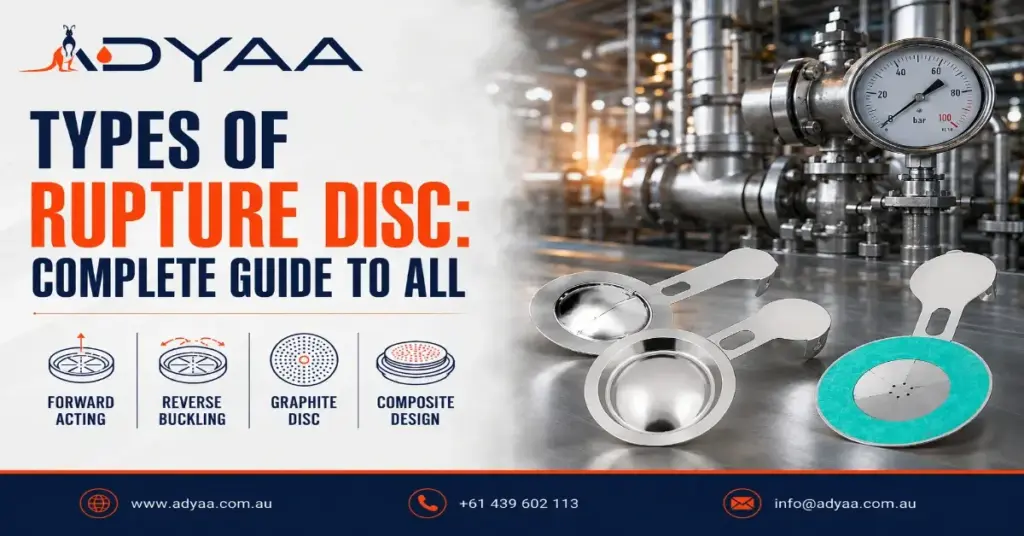
The forward-acting disc is the traditional workhorse of overpressure protection. In this design, the dome of the disc faces the process media. As pressure builds, the metal is subjected to tension. Once it hits the exact calibrated burst pressure, the metal stretches past its tensile strength and bursts outward.
- Operating Ratio: Typically limited to 70% to 80% of the marked burst pressure. Operating too close to the burst limit causes metal fatigue.
- Fragmentation: Older, solid-metal designs fragment upon bursting. However, modern scored (cross-scored) forward-acting discs open along pre-weakened lines to prevent shrapnel.
- Best For: General manufacturing applications and low-pulsation environments where downstream debris is not a critical concern.
2. Reverse-Acting Rupture Discs (Compression Loaded)
Reverse-acting discs flip the engineering upside down. The dome faces against the process pressure. Instead of stretching the metal (tension), the process pressure pushes against the dome (compression). When the burst pressure is reached, the dome buckles and reverses, striking a knife blade or tearing along a scored line to open fully.
- High Operating Ratio: Because metal handles compression better than tension, these discs can operate continuously at up to 90% or 95% of their rated burst pressure without suffering fatigue.
- Non-Fragmenting: The buckling action allows the disc to tear open cleanly without sending metal fragments downstream.
- Best For: High-pulsation environments, isolating safety relief valves (no shrapnel to damage internal valve mechanics), and high-efficiency gas/liquid lines.
3. Graphite Rupture Discs
When process media is heavily corrosive, standard stainless steel or Inconel discs degrade quickly, drastically altering their burst pressure. Graphite rupture discs are machined from high-purity, resin-impregnated graphite, making them immune to most acids, alkalis, and organic solvents.
- Corrosion Resistance: Offers superior survival in aggressive chemical and petrochemical environments.
- Fragmentation: Graphite is brittle and shatters upon bursting. It cannot be used directly upstream of a safety relief valve.
- Best For: Highly corrosive pipelines and low-pressure applications venting to a flare header or containment tank.
How to Choose the Right Type of Rupture Disc
Specifying the right overpressure device comes down to evaluating your specific pipeline conditions.
Essential Selection Criteria
1. Operating Ratio Considerations
If your normal operating pressure is very close to your maximum allowable working pressure (MAWP), you must use a reverse-acting disc. A forward-acting disc will fatigue and fail under those tight margins.
2. Downstream Fragmentation Sensitivity
If you are venting into a delicate manifold or protecting a safety valve, you must use a non-fragmenting reverse-acting or scored forward-acting disc. Never use a standard solid-metal or graphite disc in these positions.
3. Media and Corrosion Resistance
For standard steam, gas, or water, metallic discs are perfect. For aggressive acids like hydrochloric or sulfuric acid, graphite or exotic alloys (like Hastelloy or Tantalum) are mandatory to prevent the burst pressure from drifting due to corrosion.
FAQ – Types of Rupture Discs
Q: What is a rupture disc?
A: A rupture disc is a non-reclosing pressure relief device that bursts at a predetermined pressure to protect industrial systems from catastrophic overpressure.
Q: What is the difference between forward-acting and reverse-acting rupture discs?
A: Forward-acting discs burst under tension and typically fragment, while reverse-acting discs buckle under compression, allowing for higher operating pressures without sending shrapnel downstream.
Q: Can a rupture disc be used with a safety relief valve?
A: Yes, but only non-fragmenting discs (like reverse-acting or cross-scored discs) should be used upstream to prevent metal fragments from jamming the safety valve internals.
Q: What does the operating ratio of a rupture disc mean?
A: It is the maximum allowable ratio between the system’s normal operating pressure and the disc’s marked burst pressure, usually expressed as a percentage (e.g., 80% or 95%).
Q: Why use a graphite rupture disc?
A: Graphite rupture discs offer extreme corrosion resistance, making them the best choice for highly aggressive chemical and petrochemical environments where metal would degrade.
Q: Can you reuse a ruptured disc?
A: No. Rupture discs are strictly one-time-use safety devices. Once they burst, they must be completely replaced to restore system protection.
Secure Your Plant with ADYAA Pressure Relief Solutions
Do not leave your plant’s safety to guesswork. Choosing between the different types of rupture discs requires precision engineering and a deep understanding of process dynamics. As a leading supplier across Australia, ADYAA provides ASME and API-compliant overpressure protection designed to keep your facility safe and operational. Consult with ADYAA Overpressure Experts Today.