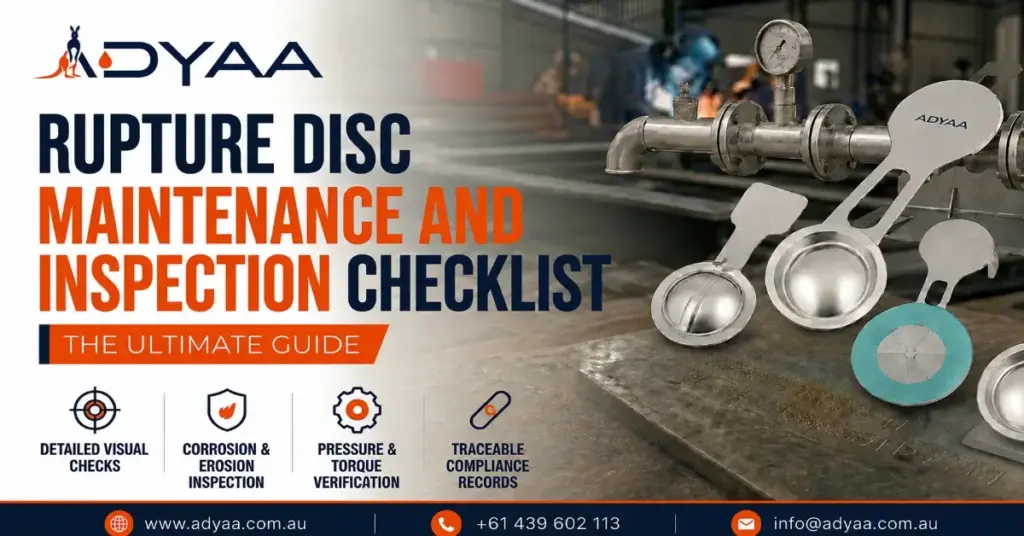
Treating a rupture disc as a “set it and forget it” device is a dangerous compliance violation. Because these are static, non-mechanical safety devices, operators often assume they require zero upkeep.
However, hidden corrosion, loose flange bolts, and microscopic metal fatigue can silently alter a disc’s burst pressure over time. To guarantee your overpressure protection activates when needed, plant managers must enforce a strict rupture disc maintenance and inspection protocol. Use this checklist to keep your facility safe and compliant.
Quick Reference: Recommended Inspection Frequencies
Maintenance Task | Recommended Frequency | Action Required |
External Holder Visual | Monthly | Check for flange corrosion, leaks, and loose bolting. |
Burst Sensor Loop Test | Quarterly | Verify electrical continuity to the DCS/SCADA system. |
Internal Disc Inspection | Annual / Turnaround | Inspect the dome for pitting, stretching, or product buildup. |
Preventative Replacement | 1 to 3 Years | Replacement intervals typically depend on pressure cycling, thermal fatigue, process conditions, and system wear. |
The Core Rupture Disc Maintenance and Inspection Checklist
Routine audits prevent catastrophic failures. Divide your maintenance strategy into external, internal, and electronic checks.
1. External Visual Inspection (Monthly)
You do not need to shut down the process to perform external checks. Operators should visually audit the assembly during routine rounds.
- Inspect the Flange Connections: Look for signs of fugitive emissions, weeping fluids, or localized corrosion around the holder.
- Check the Tell-Tale Assembly: If you use a pressure gauge between the disc and a safety valve, check it. Any pressure reading above zero indicates a pinhole leak or premature burst.
- Verify the Tagging: Ensure the stainless steel data tag is securely attached and readable. An auditor will fail your system if the tag is missing.
2. Internal Maintenance (During Shutdowns)
When the pipeline is depressurized and safe, remove the holder to inspect the actual rupture disc membrane.
- Look for Micro-Stretching: If a forward-acting disc looks overly domed or warped, it has suffered metal fatigue from high operating ratios.
- Check for Chemical Attack: Inspect the process-facing side for microscopic pitting, rust, or chemical discoloration.
- Examine for Buildup: Ensure polymerized material or crystallized chemicals have not accumulated on the disc, which artificially increases its burst pressure.
- CRITICAL RULE: Never touch, press, or clean the dome of a rupture disc. Any physical force applied during inspection can damage the calibration. If it is dirty, replace it.
3. Burst Sensor Testing (Quarterly)
A burst detector is useless if the wiring is dead.
- Test the Continuity: Use a multimeter to ensure the closed-loop circuit is intact.
- Trigger a Test Alarm: Temporarily bypass the sensor to simulate a broken wire, ensuring the control room SCADA system registers the alarm instantly.
Establishing Preventative Replacement Intervals
You should not wait for a rupture disc to burst before replacing it.
- The Reality of Fatigue: Every time a pump cycles, the disc flexes. Over months of thermal cycling and pressure spikes, the metal fatigues.
- Preventative Swaps: To prevent nuisance bursts that shut down production, most reliability engineers mandate a preventative replacement interval.
- Standard Timelines: In high-pulsation or highly corrosive lines, discs are replaced every 12 months. In stable, clean gas lines, replacement may stretch to 3 years.
FAQ – Rupture Disc Maintenance and Inspection
Q: Can you repair or clean a rupture disc?
A: No. Rupture discs are precision-calibrated, one-time-use items. Cleaning or touching the dome will alter its burst pressure. If it is dirty or damaged, replace it.
Q: How often should rupture disc maintenance and inspection be performed?
A: External visual checks should be done monthly, electronic sensor tests quarterly, and full internal inspections annually during scheduled plant turnarounds.
Q: What causes a rupture disc to burst below its rated pressure?
A: Premature bursting is almost always caused by metal fatigue from an excessive operating ratio, temperature spikes, or chemical corrosion thinning the metal.
Q: Why is there pressure between my rupture disc and safety valve?
A: Pressure in this cavity indicates the rupture disc has developed a pinhole leak, or it has burst entirely. The disc must be replaced immediately.
Q: Can I reuse a rupture disc if I remove it for inspection?
A: Generally, no. Once a disc is torqued into a holder and exposed to process pressure, removing it alters the critical “bite” of the seal. Most manufacturers strongly advise against re-torquing a used disc.
Q: Do rupture disc holders need maintenance?
A: Yes. The seating surfaces of the holder must be cleaned with a soft solvent and inspected for scratches or pitting before installing a new disc to ensure a leak-tight seal.
Maintain Your Plant Integrity with ADYAA
Do not let poor maintenance practices jeopardize your facility. Sourcing the right overpressure devices and maintaining them correctly requires expert guidance.
As Australia’s premium industrial safety supplier, ADYAA provides fully certified rupture discs, precision-machined holders, and automated burst detection systems. Consult with ADYAA Maintenance Experts Today