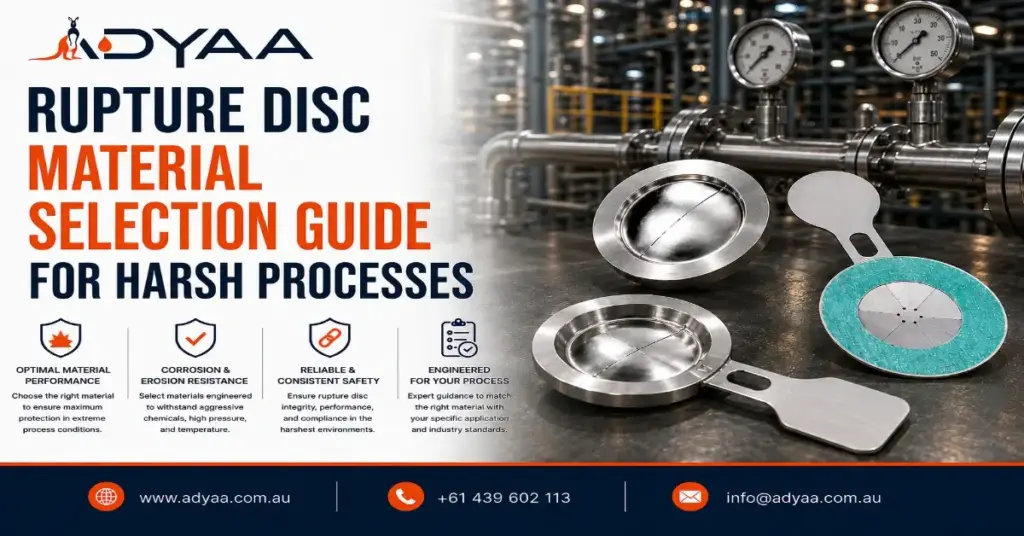
If you pump highly corrosive acids or superheated steam through a standard stainless steel rupture disc, you are setting your plant up for failure. Corrosion eats away the metal membrane, artificially lowering the burst pressure and causing unexpected, dangerous blowouts.
When dealing with aggressive chemical pipelines or extreme thermal cycling, standard metals simply will not survive. You must consult a dedicated rupture disc material selection guide to match your process media with the exact metallurgy required to prevent premature degradation.
Quick Reference: Thermal & Corrosion Limits by Material
Material | Max Operating Temperature | Corrosion Resistance Level | Best Application |
316 Stainless Steel | 480°C | Moderate | Standard water, steam, non-corrosive gas |
Nickel 200 | 400°C | Good | Alkaline processes, dry halogens |
Monel 400 | 430°C | High | Hydrofluoric acid, saltwater, marine |
Inconel 600 | 590°C+ | Excellent | Extreme high heat, severe thermal cycling |
Hastelloy C276 | 480°C | Extreme | Severe corrosives, chlorides, wet chlorine |
Graphite | 200°C (Standard) | Ultimate | Highly aggressive acids and solvents |
Why Material Selection is Critical to Safety
A rupture disc is a highly sensitive, calibrated membrane. Its ability to burst at the correct pressure depends entirely on its structural thickness and tensile strength.
- The Threat of Corrosion: Even a microscopic layer of corrosion thins the metal. A disc rated for 150 PSI could easily weaken and burst at 90 PSI if eaten by acid.
- The Threat of Heat: Extreme temperatures alter the molecular structure of standard metals, causing them to stretch and fatigue well below their rated burst pressure.
- The Threat of Contamination: In pharmaceutical or food-grade lines, the disc material must not leach metallic particles or react with the process media.
Top Materials for Industrial Rupture Discs
1. Standard Industrial Metals
For general manufacturing, standard metals are cost-effective and highly reliable—provided the media is clean.
- 316 Stainless Steel: The industry default. Highly durable but susceptible to chloride stress-corrosion cracking.
- Nickel 200: Offers excellent resistance to caustic alkalis and is highly ductile, making it great for low-pressure disc designs.
2. High-Performance Exotic Alloys
When process temperatures spike or aggressive chemicals are introduced, you must upgrade to exotic alloys to maintain burst stability.
- Inconel 600: The ultimate high-temperature alloy. It retains its tensile strength in superheated environments where stainless steel would warp.
- Monel 400: Highly resistant to sea water and hydrofluoric acid. Ideal for offshore platforms and marine engineering.
- Hastelloy C276: The ultimate metal for surviving severe chemical attacks, including wet chlorine gas and hypochlorites.
3. Non-Metallic Solutions
When the chemical environment is so harsh that no metal can survive, non-metallic options become mandatory.
- Graphite: Resin-impregnated graphite is entirely immune to most industrial acids, alkalis, and organic solvents. It shatters cleanly upon bursting.
- PTFE / Fluoropolymer Liners: Instead of buying a solid exotic alloy, engineers often use a standard stainless steel disc protected by a thin layer of PTFE (Teflon) on the process-facing side to block chemical attacks.
3 Steps to Match Material to Your Process
Follow this exact workflow to specify your disc material securely:
Step 1: Check the Chemical Compatibility
- Review the Safety Data Sheet (SDS) of your process media.
- If chlorides, strong acids, or halogens are present, immediately rule out standard Stainless Steel.
Step 2: Verify the Coincident Temperature
- Determine the exact temperature of the process when the overpressure event occurs.
- If temperatures exceed 480°C, upgrade directly to Inconel to prevent thermal weakening.
Step 3: Evaluate the Downstream Environment
- Standard metals can fragment. Graphite always fragments.
- If you are discharging into a delicate manifold or a safety valve, you must choose a ductile metal (like Nickel or Stainless Steel) in a non-fragmenting reverse-acting design.
FAQ – Rupture Disc Material Selection Guide
Q: What is the best rupture disc material for highly corrosive acids?
A: Graphite or Hastelloy C276 are the premier choices, as they offer extreme resistance to acidic degradation.
Q: Can I use 316 Stainless Steel for high-temperature steam?
A: Yes, but only up to roughly 480°C; beyond that, Inconel 600 is required to prevent thermal fatigue.
Q: What is a PTFE-lined rupture disc?
A: It is a standard metallic rupture disc that features a thin fluoropolymer (Teflon) layer to protect the metal from corrosive chemical attacks.
Q: Why would I choose Nickel 200 over Stainless Steel?
A: Nickel 200 provides vastly superior corrosion resistance against caustic alkalis and is more ductile for precise low-pressure bursting.
Q: Can a graphite rupture disc be used upstream of a safety valve?
A: No. Graphite shatters into solid chunks upon bursting, which will instantly jam the internal mechanisms of a downstream safety valve.
Q: How does temperature affect my material choice?
A: High temperatures lower the tensile strength of metals, meaning a material with high thermal stability (like Inconel) is required to prevent premature bursting.
Engineer Your Overpressure Protection with ADYAA
Do not guess which material will survive your pipeline. Sourcing the right alloy requires precision engineering and exact process mapping.
As Australia’s premium supplier of industrial safety solutions, ADYAA provides fully certified rupture discs in exotic alloys, graphite, and PTFE-lined configurations to secure your most aggressive processes. Consult with ADYAA Materials Experts Today.