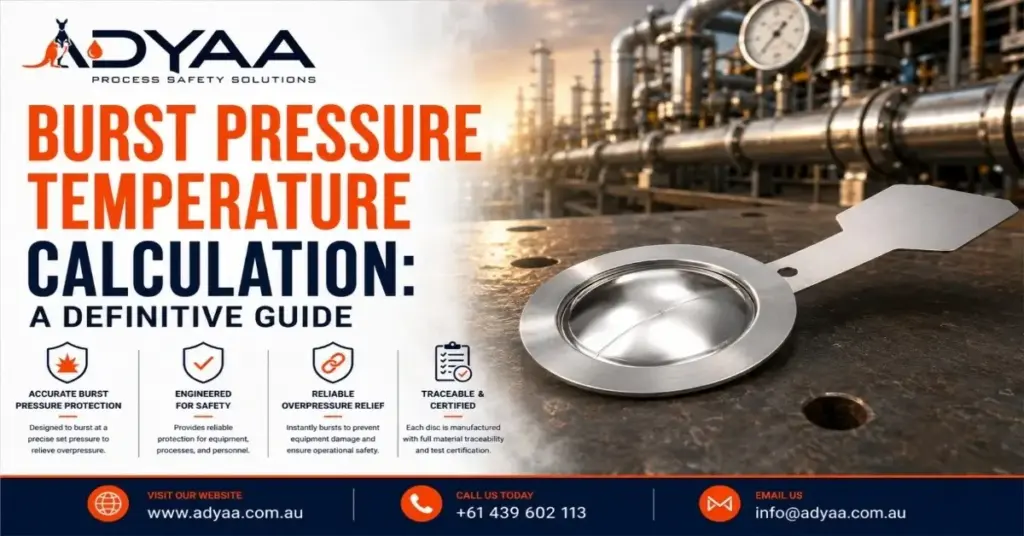
When designing an overpressure protection system, specifying a rupture disc based solely on ambient temperature is a dangerous engineering oversight. The tensile strength of metals and graphite changes drastically as temperatures rise. If a process spikes to 400°C, the disc will burst far below its stamped rating, leading to nuisance bursting, process downtime, and lost product.
To guarantee that your safety systems activate exactly at your Maximum Allowable Working Pressure (MAWP), engineers must perform a precise burst pressure temperature calculation. This guide breaks down the core physics, the derating formulas, and how to apply them to real-world industrial pipelines.
Quick Reference: Thermal Limits of Common Disc Materials
Material | Max Operating Temp (°C) | Temperature Sensitivity |
316 Stainless Steel | ~480°C | Strength reduces significantly at elevated temperature |
Nickel 200 | ~400°C | Good thermal resistance |
Monel 400 | ~430°C | Stable in moderate high-temperature service |
Inconel 600 | ~590°C+ | Excellent high-temperature stability |
Graphite | ~200°C (Standard) | Very thermally stable until oxidation/degradation |
Understanding Coincident Temperature
In overpressure engineering, you cannot separate pressure from heat. The coincident temperature is defined as the exact expected temperature of the disc material at the exact moment the burst pressure is reached.
Because industrial rupture discs are precision-calibrated membranes, heat expands their molecular structure, lowering the amount of physical force (pressure) required to tear or buckle the dome. Therefore, a rupture disc rated to burst at 100 PSI at 20°C may rupture at a lower pressure, such as around 85 PSI, when exposed to elevated operating temperatures like 250°C due to the reduction in material strength at higher temperatures.
(Note: Actual reduction depends on disc material, thickness, manufacturing method, and ASME temperature correction factors. )
The Core Formula for Temperature Derating
To find the actual burst pressure of a disc at an elevated temperature, manufacturers use a temperature correction factor (often referred to as a derating factor).
The foundational burst pressure temperature calculation is:
PT=PA×CF
Where:
- PT = corrected burst pressure at operating temperature
- PA = burst pressure at ambient/reference temperature
- CF = temperature correction factor
Example:
If:
Then:
PT =100×0.85=85 PSI
Note: While engineers use this formula for estimations, rupture disc manufacturers test batches of material in thermal chambers to establish exact, certified curves for every specific lot.
How Material Selection Impacts Burst Pressure Calculations
If the operating or coincident temperature fluctuates significantly, highly temperature-sensitive materials such as Stainless Steel or Aluminum may experience greater variation in burst pressure due to the reduction in mechanical strength at elevated temperatures.
To improve burst pressure stability across varying temperatures, higher-performance materials are often selected:
- Inconel 600:
This nickel-chromium superalloy retains its mechanical strength exceptionally well at elevated temperatures. Its temperature correction curve is relatively stable, making it suitable for high-temperature steam, refinery, and petrochemical applications. - Graphite:
Resin-impregnated graphite rupture discs exhibit excellent thermal stability and are less affected by thermal softening compared to metallic discs. Within their recommended operating range, the temperature correction effect is often minimal for many standard applications.
FAQ – Burst Pressure Temperature Calculation
Q: What is coincident temperature?
A: Coincident temperature is the exact physical temperature of the rupture disc material at the exact moment it is required to burst.
Q: Why does a rupture disc burst at a lower pressure when hot?
A: Heat alters the molecular structure of the metal, lowering its tensile and yield strength, meaning less pressure is required to tear or buckle the dome.
Q: Can I calculate the exact temperature correction factor myself?
A: No. While you can estimate it, the exact correction factor varies by the specific batch of raw material and must be certified by the manufacturer through destructive thermal testing.
Q: What material should I use for highly fluctuating temperatures?
A: Inconel 600 is highly recommended for fluctuating high-temperature environments because its tensile strength remains remarkably stable compared to standard stainless steel.
Q: How does cold temperature affect burst pressure?
A: Extreme cold (cryogenic temperatures) increases the tensile strength of the metal, which will artificially raise the burst pressure, requiring a reverse temperature calculation.
Q: Do graphite rupture discs need temperature correction?
A: Generally, no. Graphite remains physically stable and its burst pressure does not fluctuate significantly with heat, provided it stays below the thermal limit of its resin binder.
Engineer Your Overpressure Protection with ADYAA
Precision engineering leaves zero room for error. Calculating the thermal impact on your safety devices requires exact metallurgical data and certified manufacturing.
As Australia’s leading supplier of industrial safety solutions, ADYAA provides fully tested, ASME-certified rupture discs calibrated for your exact coincident temperatures. Consult with ADYAA Overpressure Experts Today