
Burst Disk Indicators: Improving Plant Safety
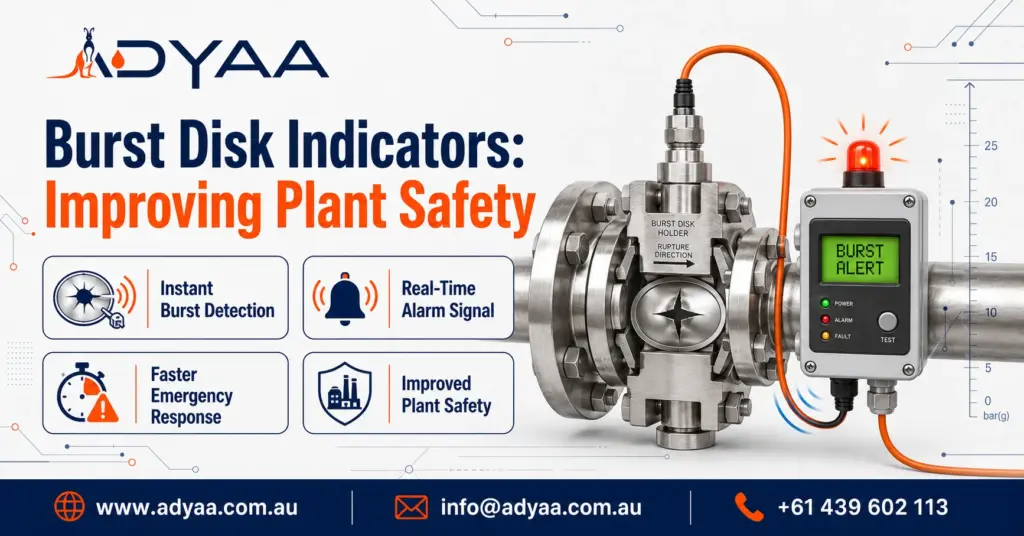
Burst Disk Indicators: Improving Plant Safety A rupture disc provides reliable protection against overpressure, but once it bursts, operators need to know immediately. A Burst Disk Indicator continuously monitors the condition of a rupture disc and instantly signals when the disc has activated. This allows maintenance teams to respond quickly, minimise downtime and restore normal operations as soon as possible. From chemical processing plants to power generation facilities, burst disk indicators improve process visibility while supporting safer and more efficient industrial operations. What Is a Burst Disk Indicator? A Burst Disk Indicator is an electronic monitoring device used with a rupture disc to detect when the disc has burst. During normal operation, the monitoring circuit remains intact. When the rupture disc activates because of an overpressure event, the electrical circuit changes state, sending an alarm or signal to the plant’s control system. This immediate notification helps operators identify pressure events without manually inspecting the rupture disc. Why Burst Disk Indicators Matter Adding a burst disk indicator improves both plant safety and operational efficiency. Immediate Burst Detection Receive instant notification when a rupture disc activates. Reduce Downtime Allow maintenance teams to respond quickly after a pressure event. Improve Plant Safety Reduce the time equipment operates after rupture disc activation. Support Remote Monitoring Transmit alarm signals directly to PLC and SCADA systems. Improve Maintenance Planning Identify activated rupture discs without manual inspections. Increase Operational Reliability Provide continuous monitoring of pressure protection devices. How a Burst Disk Indicator Works Burst disk indicators continuously monitor the rupture disc during operation. The rupture disc remains intact during normal operating conditions. The burst disk indicator monitors the electrical circuit. An overpressure event causes the rupture disc to burst. The monitoring circuit changes state. An alarm is sent to the control room, PLC or SCADA system. Maintenance personnel replace the rupture disc and restore the system. This simple monitoring method improves response times following overpressure events. Types of Burst Disk Indicators Different monitoring solutions are available depending on plant requirements. Electrical Burst Disk Indicators Monitor the rupture disc using electrical continuity. Intrinsically Safe Indicators Designed for hazardous area applications where explosion protection is required. PLC Integrated Indicators Provide direct communication with industrial automation systems. Remote Monitoring Indicators Allow operators to monitor rupture disc status from central control rooms. Visual Indicator Systems Provide local visual confirmation after rupture disc activation. Smart Monitoring Systems Support advanced diagnostics and integration with modern industrial networks. Burst Disk Indicator Comparison Type Best For Typical Application Electrical General Industry Manufacturing Intrinsically Safe Hazardous Areas Oil & Gas PLC Integrated Automation Process Plants Remote Monitoring Central Control Large Facilities Visual Indicator Local Monitoring Storage Tanks Smart System Industry 4.0 Advanced Manufacturing Where Burst Disk Indicators Are Used Burst disk indicators are widely used wherever rupture discs protect critical equipment. Oil & Gas Monitor rupture discs installed on pressure vessels and process equipment. Chemical Processing Provide immediate notification following pressure relief events. Petrochemical Support continuous monitoring of pressure protection systems. Pharmaceutical Monitor sterile process equipment while maintaining system integrity. Food & Beverage Support pressure protection in hygienic production systems. Power Generation Monitor boilers, steam systems and pressure vessels. Water & Wastewater Protect chemical dosing and pressurised treatment systems. Manufacturing Improve equipment monitoring and maintenance response times. Burst Disk Indicator Selection Checklist Before selecting a burst disk indicator, consider: ✔ Rupture disc type ✔ Electrical compatibility ✔ Control system integration ✔ Hazardous area requirements ✔ Operating temperature ✔ Environmental conditions ✔ Alarm requirements ✔ Cable routing ✔ Maintenance accessibility ✔ Industry standards Choosing the correct monitoring system improves safety and operational reliability. Common Mistakes When Selecting Burst Disk Indicators Common issues include: Selecting an incompatible indicator Ignoring hazardous area approvals Incorrect wiring Poor installation practices Failing to test alarm systems Delaying replacement after activation Not integrating with plant monitoring systems A properly designed monitoring system helps avoid these problems. Why Burst Detection Matters A rupture disc performs its job only once before it must be replaced. Without a burst disk indicator, operators may not immediately know that the disc has activated. Continuous monitoring helps reduce production delays, improve maintenance response times and ensure pressure protection systems are restored as quickly as possible. Why Choose ADYAA? ADYAA supplies pressure protection and monitoring solutions for industries across Australia. Complete Pressure Protection Portfolio Rupture Discs, Safety Valves, Tank Protection Systems and monitoring accessories. Technical Expertise Support in selecting compatible rupture disc monitoring solutions. Reliable Industrial Products Designed for demanding industrial operating environments. Automation Ready Compatible with PLC, SCADA and industrial control systems. Australia-wide Support Reliable technical assistance across Australia. Long-Term Reliability Helping industries improve pressure protection, monitoring and operational safety. Frequently Asked Questions What is a Burst Disk Indicator? A Burst Disk Indicator monitors a rupture disc and sends an alarm when the disc bursts during an overpressure event. Does a Burst Disk Indicator prevent overpressure? No. The rupture disc provides pressure protection, while the burst disk indicator detects when the rupture disc has activated. Can Burst Disk Indicators connect to PLC systems? Yes. Many models integrate directly with PLC, SCADA and other industrial automation systems. Where are Burst Disk Indicators commonly used? Oil & Gas, Chemical Processing, Pharmaceutical, Food & Beverage, Manufacturing, Power Generation and Water Treatment industries. Do Burst Disk Indicators require maintenance? Routine inspection and functional testing help ensure reliable operation. How do I choose the right Burst Disk Indicator? Selection depends on the rupture disc type, control system, operating environment, hazardous area requirements and monitoring needs. A Burst Disk Indicator improves the effectiveness of rupture disc systems by providing immediate notification when pressure relief occurs. Fast detection allows maintenance teams to restore equipment quickly, helping minimise downtime and maintain safe industrial operations. ADYAA supplies burst disk indicators, rupture discs and complete pressure protection solutions for industries across Australia, helping businesses improve safety, monitoring and operational reliability. Need help selecting the right Burst Disk Indicator? Our specialists can help you choose a compatible monitoring solution for your rupture disc and pressure protection system. Burst Disk
Forward Acting vs Reverse Acting Rupture Disc Explained
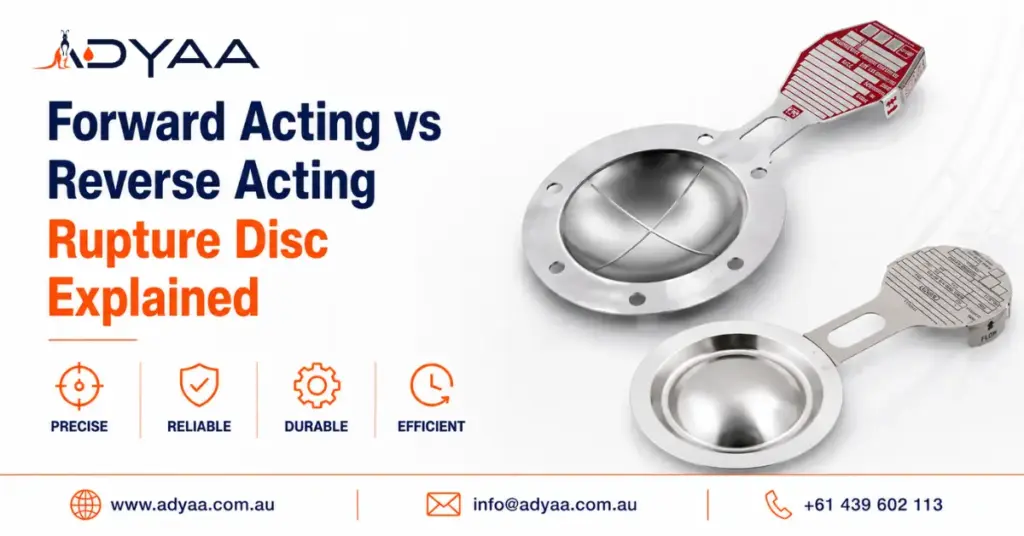
Forward Acting vs Reverse Acting Rupture Disc: Which One Should You Choose? Selecting the wrong Rupture Disc can affect equipment safety, process reliability and maintenance costs. Although both Forward Acting and Reverse Acting Rupture Discs are designed to protect pressure systems from overpressure, they operate differently and are suited to different industrial applications. The right choice depends on operating pressure, process conditions, cycling frequency and the type of media flowing through the system. Understanding these differences makes it easier to choose a solution that delivers reliable protection and longer service life. What Is a Rupture Disc? A Rupture Disc is a non-reclosing pressure relief device designed to burst at a predetermined pressure, protecting vessels, pipelines and process equipment from excessive pressure. Unlike relief valves, rupture discs respond almost instantly and provide full-bore pressure relief when activated. They are commonly installed in: Pressure vessels Chemical reactors Storage tanks Heat exchangers Pipelines Process equipment What Is a Forward Acting Rupture Disc? A Forward Acting Rupture Disc is installed so that process pressure causes the disc to stretch outward. As pressure increases to the rated burst pressure, the disc fails in tension and ruptures, relieving excess pressure. How It Works Process pressure pushes against the disc. The disc stretches under tensile stress. When the burst pressure is reached, the disc tears open. Best Suited For Moderate pressure applications Stable operating conditions General industrial processes Standard pressure protection Advantages Simple construction Cost-effective solution Reliable burst performance Widely used across industries What Is a Reverse Acting Rupture Disc? A Reverse Acting Rupture Disc is installed so that process pressure causes the disc to buckle inward. When the burst pressure is reached, the disc reverses its shape (buckles) and then opens along a scored pattern. How It Works Process pressure compresses the disc. The disc buckles at a predetermined pressure. The disc then opens along precision score lines. Best Suited For High operating pressures Pressure cycling applications Pulsating process conditions Critical industrial systems Advantages Longer service life Excellent fatigue resistance Higher operating ratios Improved durability Forward Acting vs Reverse Acting Rupture Disc Feature Forward Acting Reverse Acting Installation Concept Pressure stretches the disc Pressure compresses the disc Failure Mode Tension rupture Buckling then rupture Pressure Cycling Moderate Excellent Operating Ratio Lower Higher Service Life Standard Longer Best Applications General process protection High-cycle critical applications Neither design is universally better. The correct selection depends on your process requirements. Which Industries Use Each Type? Chemical Processing Both designs are widely used depending on operating pressure and process conditions. Oil & Gas Reverse acting rupture discs are often selected for demanding pressure cycling applications. Pharmaceutical Manufacturing Forward acting rupture discs are commonly used where clean process protection is required. Food & Beverage Pressure protection supports hygienic processing equipment. Power Generation Protect boilers, pressure vessels and heat exchangers. General Manufacturing Provide reliable overpressure protection across industrial production systems. Common Mistakes When Selecting a Rupture Disc Avoid these common issues: Selecting based only on burst pressure Ignoring operating pressure ratio Overlooking pressure cycling Choosing incompatible materials Ignoring temperature effects Installing the disc incorrectly These mistakes can shorten service life and reduce pressure protection reliability. How Do You Choose the Right Rupture Disc? Before selecting a Pressure Relief Device, consider: Operating pressure Burst pressure Process temperature Pressure cycling frequency Process media Corrosion resistance Installation orientation Industry standards and compliance requirements Considering these factors helps improve equipment protection and long-term reliability. Frequently Asked Questions Which rupture disc lasts longer? In applications with frequent pressure cycling, Reverse Acting Rupture Discs generally offer longer service life. Which rupture disc is better? Neither is universally better. The correct choice depends on the application’s pressure, temperature and operating conditions. Can rupture discs replace pressure relief valves? Some applications use rupture discs independently, while others combine them with relief valves for additional protection. What industries commonly use rupture discs? Chemical processing, oil & gas, pharmaceuticals, food processing, power generation and manufacturing. Why is correct rupture disc selection important? Proper selection improves equipment safety, reduces downtime and provides reliable overpressure protection. Final Thoughts Choosing between a Forward Acting vs Reverse Acting Rupture Disc depends on your operating conditions rather than the product alone. Understanding pressure cycling, burst pressure and process requirements helps improve safety, equipment protection and long-term reliability. If you’re selecting Rupture Discs, Pressure Relief Devices or complete Industrial Safety Solutions, ADYAA supplies reliable products designed to support demanding industrial applications across Australia. Forward Acting vs Reverse Acting Rupture Disc Explained How Industrial Automation Sensors Improve Efficiency in Manufacturing Efficiency is the primary metric of success. The difference between a profitable… Read More → How Industrial Automation Sensors Improve Efficiency in Manufacturing How Industrial Automation Sensors Improve Efficiency in Manufacturing Efficiency is the primary metric of success. The difference between a profitable… Read More → Gaskets vs O-Rings: Which Sealing Solution Is Right for You? Gaskets vs O-Rings: Which Sealing Solution Is Right for You? In any fluid handling system, the weakest point is always… Read More →
Rupture Disc Maintenance and Inspection Checklist
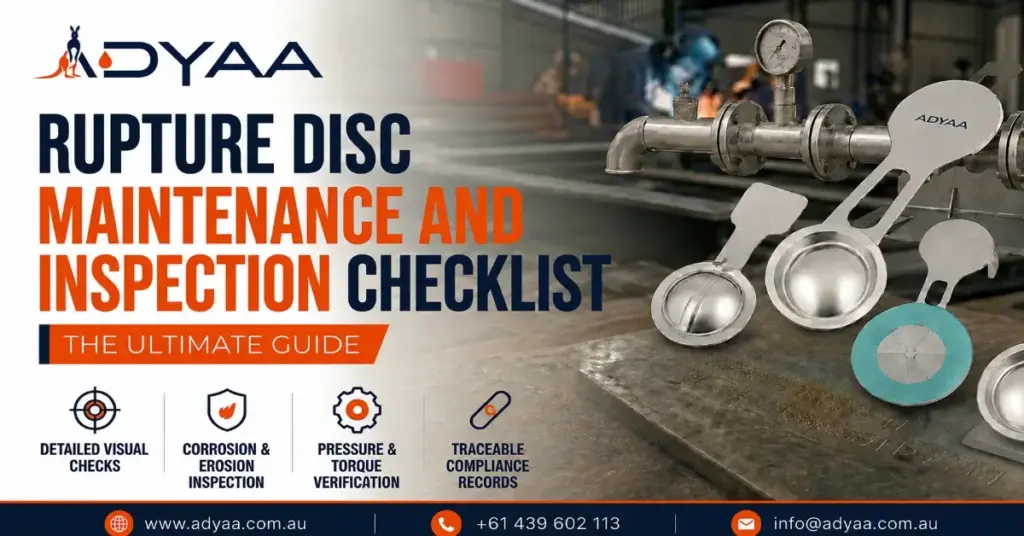
Rupture Disc Maintenance and Inspection Checklist Treating a rupture disc as a “set it and forget it” device is a dangerous compliance violation. Because these are static, non-mechanical safety devices, operators often assume they require zero upkeep. However, hidden corrosion, loose flange bolts, and microscopic metal fatigue can silently alter a disc’s burst pressure over time. To guarantee your overpressure protection activates when needed, plant managers must enforce a strict rupture disc maintenance and inspection protocol. Use this checklist to keep your facility safe and compliant. Quick Reference: Recommended Inspection Frequencies Maintenance Task Recommended Frequency Action Required External Holder Visual Monthly Check for flange corrosion, leaks, and loose bolting. Burst Sensor Loop Test Quarterly Verify electrical continuity to the DCS/SCADA system. Internal Disc Inspection Annual / Turnaround Inspect the dome for pitting, stretching, or product buildup. Preventative Replacement 1 to 3 Years Replacement intervals typically depend on pressure cycling, thermal fatigue, process conditions, and system wear. The Core Rupture Disc Maintenance and Inspection Checklist Routine audits prevent catastrophic failures. Divide your maintenance strategy into external, internal, and electronic checks. 1. External Visual Inspection (Monthly) You do not need to shut down the process to perform external checks. Operators should visually audit the assembly during routine rounds. Inspect the Flange Connections: Look for signs of fugitive emissions, weeping fluids, or localized corrosion around the holder. Check the Tell-Tale Assembly: If you use a pressure gauge between the disc and a safety valve, check it. Any pressure reading above zero indicates a pinhole leak or premature burst. Verify the Tagging: Ensure the stainless steel data tag is securely attached and readable. An auditor will fail your system if the tag is missing. 2. Internal Maintenance (During Shutdowns) When the pipeline is depressurized and safe, remove the holder to inspect the actual rupture disc membrane. Look for Micro-Stretching: If a forward-acting disc looks overly domed or warped, it has suffered metal fatigue from high operating ratios. Check for Chemical Attack: Inspect the process-facing side for microscopic pitting, rust, or chemical discoloration. Examine for Buildup: Ensure polymerized material or crystallized chemicals have not accumulated on the disc, which artificially increases its burst pressure. CRITICAL RULE: Never touch, press, or clean the dome of a rupture disc. Any physical force applied during inspection can damage the calibration. If it is dirty, replace it. 3. Burst Sensor Testing (Quarterly) A burst detector is useless if the wiring is dead. Test the Continuity: Use a multimeter to ensure the closed-loop circuit is intact. Trigger a Test Alarm: Temporarily bypass the sensor to simulate a broken wire, ensuring the control room SCADA system registers the alarm instantly. Establishing Preventative Replacement Intervals You should not wait for a rupture disc to burst before replacing it. The Reality of Fatigue: Every time a pump cycles, the disc flexes. Over months of thermal cycling and pressure spikes, the metal fatigues. Preventative Swaps: To prevent nuisance bursts that shut down production, most reliability engineers mandate a preventative replacement interval. Standard Timelines: In high-pulsation or highly corrosive lines, discs are replaced every 12 months. In stable, clean gas lines, replacement may stretch to 3 years. FAQ – Rupture Disc Maintenance and Inspection Q: Can you repair or clean a rupture disc? A: No. Rupture discs are precision-calibrated, one-time-use items. Cleaning or touching the dome will alter its burst pressure. If it is dirty or damaged, replace it. Q: How often should rupture disc maintenance and inspection be performed? A: External visual checks should be done monthly, electronic sensor tests quarterly, and full internal inspections annually during scheduled plant turnarounds. Q: What causes a rupture disc to burst below its rated pressure? A: Premature bursting is almost always caused by metal fatigue from an excessive operating ratio, temperature spikes, or chemical corrosion thinning the metal. Q: Why is there pressure between my rupture disc and safety valve? A: Pressure in this cavity indicates the rupture disc has developed a pinhole leak, or it has burst entirely. The disc must be replaced immediately. Q: Can I reuse a rupture disc if I remove it for inspection? A: Generally, no. Once a disc is torqued into a holder and exposed to process pressure, removing it alters the critical “bite” of the seal. Most manufacturers strongly advise against re-torquing a used disc. Q: Do rupture disc holders need maintenance? A: Yes. The seating surfaces of the holder must be cleaned with a soft solvent and inspected for scratches or pitting before installing a new disc to ensure a leak-tight seal. Maintain Your Plant Integrity with ADYAA Do not let poor maintenance practices jeopardize your facility. Sourcing the right overpressure devices and maintaining them correctly requires expert guidance. As Australia’s premium industrial safety supplier, ADYAA provides fully certified rupture discs, precision-machined holders, and automated burst detection systems. Consult with ADYAA Maintenance Experts Today Rupture Disc Material Selection Guide for Harsh Processes Rupture Disc Maintenance and Inspection Checklist If you pump highly corrosive acids or superheated steam through a standard stainless steel… Read More → Rupture Disc Maintenance and Inspection Checklist Rupture Disc Maintenance and Inspection Checklist Treating a rupture disc as a “set it and forget it” device is a… Read More → Types of Rupture Discs: Complete Guide to All Designs Types of Rupture Discs: Complete Guide to All Designs Pressure systems are unpredictable. When a mechanical safety valve freezes or… Read More →
Burst Pressure Selection for Rupture Disc Safety
Burst Pressure Selection for Rupture Disc Safety When a pressurized system experiences an unexpected spike, your safety devices need to act instantly. A rupture disc is your facility’s last line of defense against catastrophic equipment failure. However, a disc is only as good as its specifications. Getting the Burst Pressure Selection for Rupture Disc Safety right is the difference between a safely controlled release and a critical plant emergency. As specialists in industrial safety and pressure relief systems, we frequently see facilities struggle with premature disc failures. Usually, it comes down to a misunderstanding of how operating pressures interact with disc ratings. Here is exactly how to navigate this selection process to protect your equipment. The Baseline: Operating Pressure vs. Burst Pressure You cannot select a rupture disc simply by looking at your normal daily pressure. You must understand the gap between your normal state and your danger zone. Operating Pressure: The pressure your system runs at during standard daily operations. Specified Burst Pressure: The exact pressure at which the manufacturer designs the disc to open. If your burst pressure is set too close to your operating pressure, minor everyday fluctuations will cause the disc to fatigue. This leads to premature bursting, costly downtime, and lost materials. 3 Core Factors of Burst Pressure Selection To achieve reliable Burst Pressure Selection for Rupture Disc Safety, you must calculate three specific variables. 1. Operating Ratio This is the relationship between your normal operating pressure and the disc’s marked burst pressure. Different designs handle different ratios. Standard Forward-Acting Discs: Typically require a 70% operating ratio. (e.g., If bursting at 100 PSI, operate no higher than 70 PSI). Reverse-Acting Discs: Can handle up to a 95% operating ratio. These are ideal for systems running close to the Maximum Allowable Working Pressure (MAWP). 2. Burst Tolerance No manufacturing process is perfect down to the micro-psi. Burst tolerance is the acceptable variation from the specified burst pressure. If you order a disc rated for 100 PSI with a +/- 5% tolerance, it might burst anywhere between 95 PSI and 105 PSI. Factoring in this margin of error is a critical step in Burst Pressure Selection for Rupture Disc Safety. You must ensure the lower end of the tolerance doesn’t overlap with regular pressure spikes. 3. Manufacturing Design Range (MDR) MDR is a standard agreement regarding where the final stamped burst pressure will fall relative to your requested pressure. Understanding MDR prevents surprises when the final product arrives at your plant. Real-World Example: Sizing for an Industrial Plant Imagine a chemical processing tank in an Australian facility with a MAWP of 200 PSI. The plant operates the tank normally at 160 PSI. Choosing a forward-acting disc (70% ratio) means they must drop operating pressure to 140 PSI. This hurts production. The Solution: By selecting a reverse-acting disc (90% ratio), they can set the burst pressure at 200 PSI and maintain their 160 PSI operation. This highlights why strategic Burst Pressure Selection for Rupture Disc Safety directly impacts both plant profitability and operational flow. The Impact of Temperature Temperature is the hidden variable that ruins poorly planned overpressure protection. As the temperature increases, the metal of the rupture disc weakens. A disc rated to burst at 100 PSI at room temperature will burst at a lower pressure if the system runs at 200°C. Conversely, extreme cold can strengthen the metal, delaying the burst. Specifying the exact coincident temperature is an absolute requirement for accurate Burst Pressure Selection for Rupture Disc Safety. People Also Ask (FAQs) Q: What is a safe operating ratio for rupture discs? A: It depends on the disc type. Forward-acting discs usually require a 70% ratio, while reverse-acting discs can safely operate up to 90% or 95% of the burst pressure. Q: Can temperature affect my rupture disc’s burst pressure? A: Yes. High temperatures weaken the disc material, causing it to burst at a lower pressure. Extreme cold can strengthen the metal and delay the burst. Q: Why do rupture discs burst prematurely? A: The most common cause is metal fatigue. This happens when the specified burst pressure is set too close to the daily operating pressure, causing the disc to weaken from normal system pulsations. The Bottom Line Upgrading your pressure relief systems requires looking at the entire environment—pressure cycles, vacuum conditions, fluid types, and temperature extremes. Skipping just one of these metrics compromises your entire safety infrastructure. Proper sizing prevents premature failures, avoids unexpected downtime, and guarantees regulatory compliance. Upgrade Your Plant Safety Today Need help finding the exact rupture disc for your facility’s unique conditions? Don’t leave your overpressure protection to guesswork. Explore our premium industrial safety solutions or contact the ADYAA Engineering Team today for expert sizing and selection. When to Replace Rupture Discs in Pressure Equipment: A Maintenance Guide – Copy Burst Pressure Selection for Rupture Disc Safety When a pressurized system experiences an unexpected spike, your safety devices need to… Read More → When to Replace Rupture Discs in Pressure Equipment: A Maintenance Guide When to Replace Rupture Discs in Pressure Equipment: A Maintenance Guide In the world of pressure safety, the rupture disc… Read More → Flange Sealing Solutions for High-Pressure Pipes: Zero Leakage Strategies Flange Sealing Solutions for High-Pressure Pipes: Zero Leakage Strategies In high-pressure industrial environments, the weakest link is rarely the pipe… Read More →
Benefits of Rupture Disc Monitoring Technology
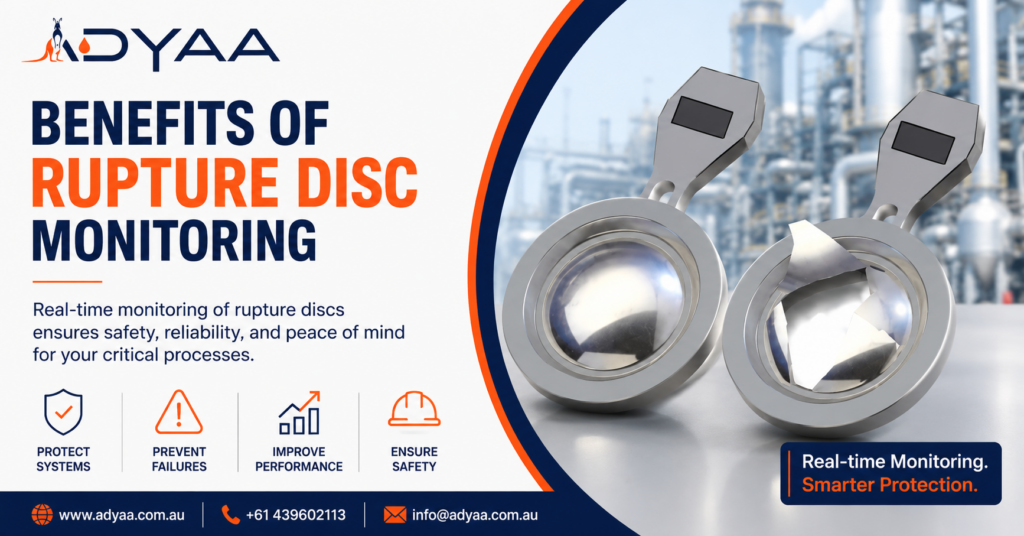
Benefits of Rupture Disc Monitoring Technology: The Eyes of Your Safety System A rupture disc is an incredibly effective safety device. It acts instantly to relieve dangerous pressure and protects your vessel from catastrophic failure. But it has one major limitation: it is silent. When a disc bursts, it usually happens inside a closed piping system. Unless you are standing right next to it (which you shouldn’t be), you might not know the device has activated. A burst disc could be venting expensive product, toxic gas, or steam for hours—or even days—before an operator notices a drop in tank level or hears a hiss. This is where monitoring technology changes the game. By adding “smart” sensors to these mechanical devices, you unlock a new layer of plant control. Here is why upgrading to monitored systems is essential, and how it maximizes the Benefits of Rupture Disc installations. The “Blind Spot” in Pressure Safety Traditionally, a rupture disc is a passive component. It sits in the pipe, waiting to do its job. While the primary Benefits of Rupture Disc designs are their speed and full-bore opening, their passive nature creates a blind spot in your control system. Without a sensor, your Distributed Control System (DCS) assumes the process is normal, even while product is venting to the flare. This “blind spot” leads to: Uncalculated Product Loss: Venting thousands of dollars of material. Environmental Fines: Releasing emissions longer than permitted. Safety Hazards: Creating a flammable cloud that grows undetected. 1. Instant Notification for Immediate Action The most immediate value of a monitoring system is speed. Modern burst indicators (such as membrane sensors or magnetic detectors) are wired directly into your plant’s PLC or SCADA system. The millisecond the disc ruptures, the sensor circuit breaks, and an alarm flashes in the control room. This allows operators to: Stop the Pump: Immediately cut the source of pressure. Close Isolation Valves: Limit the amount of fluid lost. Evacuate the Area: If the fluid is toxic, immediate alerts save lives. 2. Accurate Root Cause Analysis When a disc bursts, the first question is always: “Why?” Without monitoring, you might find a blown disc during a weekly inspection. You have no idea if it burst ten minutes ago or three days ago. This makes it impossible to correlate the failure with specific process conditions. With monitoring, you have a timestamp. You can overlay the exact moment of failure with your pressure and temperature logs. Did a specific valve close? Did a pump ramp up? The data tells the story, preventing the “mystery failures” that haunt maintenance teams. 3. Reduced Fugitive Emissions In today’s regulatory environment, “I didn’t know it was leaking” is not a valid defense. Environmental agencies often mandate strict reporting limits on releases. A monitored system provides proof of exactly when a release started and ended. This documentation is critical for compliance and avoids the heavy fines associated with prolonged, unreported venting events. 4. How the Technology Works You don’t need to rebuild your piping to get these benefits. Most monitoring solutions are non-invasive: Membrane Sensors: A thin, conductive film placed between the flanges. When the flow hits it, the circuit breaks. Magnetic Sensors: A magnet on the disc triggers a sensor on the holder. Wire-Break Sensors: A simple wire loop that snaps when the disc opens. The Bottom Line A rupture disc protects your vessel, but a burst sensor protects your process. To fully realize the Benefits of Rupture Disc protection, you cannot leave it in the dark. Integrating monitoring technology transforms a standalone mechanical part into a smart, communicative asset that empowers your team to react instantly. Is your safety system flying blind? Upgrade your critical assets with modern sensing technology. Contact ADYAA Instrumentation Team Ask us about retrofitting burst sensors to your existing discs. Industrial HVAC vs Commercial HVAC: What is the Difference? Industrial HVAC vs Commercial HVAC: Why Equipment Choice Matters If you walk onto the roof of a shopping mall and… Read More → How Industrial Automation Sensors Improve Manufacturing Efficiency How Industrial Automation Sensors Improve Efficiency in Manufacturing Efficiency is the primary metric of success. The difference between a profitable… Read More → Gems 3100/3200 Pressure Transmitters : Complete Guide Gems 3100/3200 Pressure Transmitters: Complete Guide Accurate pressure monitoring is essential across industrial environments where process visibility, operational consistency and… Read More →