
Industrial HVAC vs Commercial HVAC: What is the Difference?
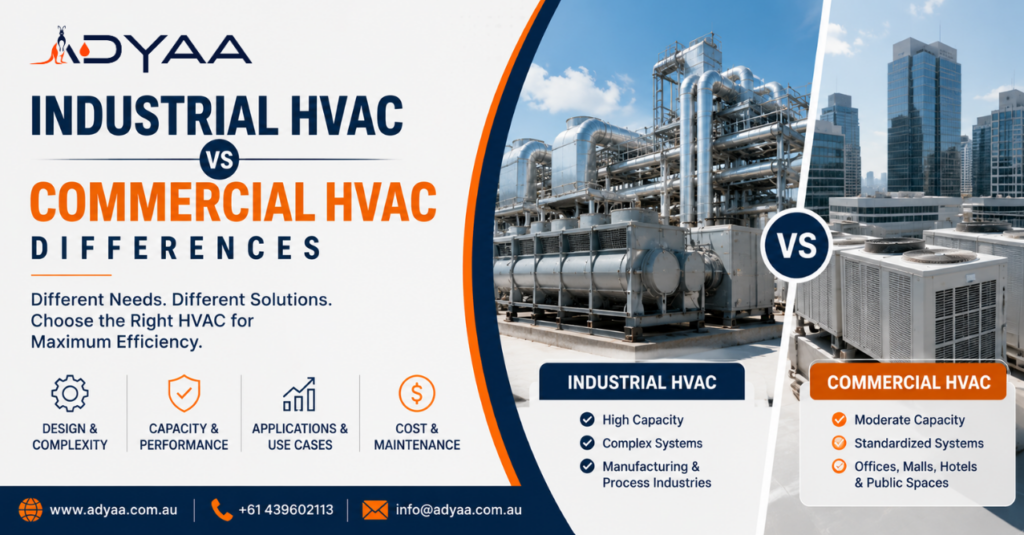
Industrial HVAC vs Commercial HVAC: Why Equipment Choice Matters If you walk onto the roof of a shopping mall and then walk into a pharmaceutical manufacturing plant, you might see large metal boxes blowing air in both places. But make no mistake: that is where the similarities end. The debate of Industrial HVAC vs Commercial HVAC isn’t just about size; it’s about purpose. One system is designed to keep people comfortable while they shop. The other is designed to keep a critical production line from shutting down or a warehouse from spoiling millions of dollars in inventory. Mistaking one for the other is a costly error. We have seen industrial facilities try to cut costs by installing commercial-grade units, only to face constant breakdowns, humidity spikes, and compliance failures. ADYAA, we provide the high-precision sensors that drive these systems. In this guide, we break down the critical differences between Industrial HVAC vs Commercial HVAC so you can make the right investment for your facility 1. Commercial HVAC: The “Human Comfort” Machine Commercial HVAC systems are found in office buildings, retail stores, schools, and hospitals. The Goal: Keep human beings comfortable. The Standard: Maintain a temperature around 21°C–23°C and reasonable humidity. These systems are generally standardized. Whether it’s a split system or a rooftop package unit (RTU), they operate intermittently. They might run hard during the day but dial back or shut off at night when the building is empty. Key Characteristic: Modular and easy to replace. Priority: Energy efficiency and quiet operation Industrial HVAC: The “Process Critical” Beast Industrial HVAC systems are found in manufacturing plants, data centers, food processing facilities, and chemical refineries. The Goal: Maintain precise environmental conditions for equipment or products. The Standard: It varies wildly. A data center might need massive cooling capacity. A paper mill might need strict humidity control to prevent paper curl. A cleanroom needs heavy filtration (HEPA) to remove particles. These systems are heavily customized. They often run 24/7, 365 days a year. If an industrial HVAC unit fails, production stops. Key Characteristic: Heavy-duty, redundant, and highly automated. Priority: Reliability and precision (Tight tolerances on Temperature/Humidity). 3. Industrial HVAC vs Commercial HVAC: The 4 Key Differences To the untrained eye, the equipment looks similar. But for an engineer, the differences are massive. A. Design Complexity & Automation Commercial: Usually a standalone unit controlled by a simple thermostat or basic BMS. Industrial: integrated into a complex ecosystem. It relies on a network of sensors—CO2, Differential Pressure, Dew Point, and Air Velocity—feeding data into a PLC or SCADA system to make micro-adjustments in real-time. B. Location & Access Commercial: almost always located on the roof (Rooftop Units) or on a concrete pad outside. Industrial: Often housed in dedicated “plant rooms” or mechanical galleries. This allows maintenance teams to work on the complex compressors and chillers without being exposed to the weather. C. Durability & Components Commercial: built with standard galvanized steel and plastic fans. Expected lifespan: 15–20 years. Industrial: Built to survive harsh environments. They use heavy-gauge steel, industrial-grade centrifugal pumps, and titanium heat exchangers if corrosive fumes are present. Expected lifespan: 20–30+ years. D. The “Cost of Failure” Commercial Failure: The office gets hot, and staff complain. Industrial Failure: A server room overheats and data is lost; or humidity rises in a pharma lab, ruining a batch of medicine. The cost is measured in production downtime, not just sweat. 4. Why Sensors Are the Heart of Industrial HVAC Because Industrial HVAC is about precision, the system is useless without accurate data. You can have a million-dollar chiller, but if the sensor feeding it data is drifting, the system fails. ADYAA supplies, we specialize in the “eyes and ears” of these systems: Dew Point Sensors: Critical for compressed air lines and drying rooms. CO2 Sensors: Essential for demand-controlled ventilation in factories. Differential Pressure Transmitters: Required to monitor filter health in cleanrooms. Air Velocity Transmitters: To ensure proper airflow in exhaust ducts. Conclusion: Match the Tool to the Job When evaluating Industrial HVAC vs Commercial HVAC, don’t just look at the price tag. If you are running a warehouse, a manufacturing line, or a critical infrastructure site, a commercial unit is a band-aid solution that will eventually peel off. You need equipment built for the load, and you need sensors that tell you the truth about your environment. Is your facility monitoring its environment correctly? 👉 Explore ADYAA HVAC Sensors 👉 View our CO2 & Dew Point Transmitters 📞 Contact our Engineering Team for a Sensor Audit. Industrial HVAC vs Commercial HVAC: What is the Difference? Industrial HVAC vs Commercial HVAC: Why Equipment Choice Matters If you walk onto the roof of a shopping mall and… Read More → How Industrial Automation Sensors Improve Manufacturing Efficiency How Industrial Automation Sensors Improve Efficiency in Manufacturing Efficiency is the primary metric of success. The difference between a profitable… Read More → Gems 3100/3200 Pressure Transmitters : Complete Guide Gems 3100/3200 Pressure Transmitters: Complete Guide Accurate pressure monitoring is essential across industrial environments where process visibility, operational consistency and… Read More →
How Industrial Automation Sensors Improve Manufacturing Efficiency
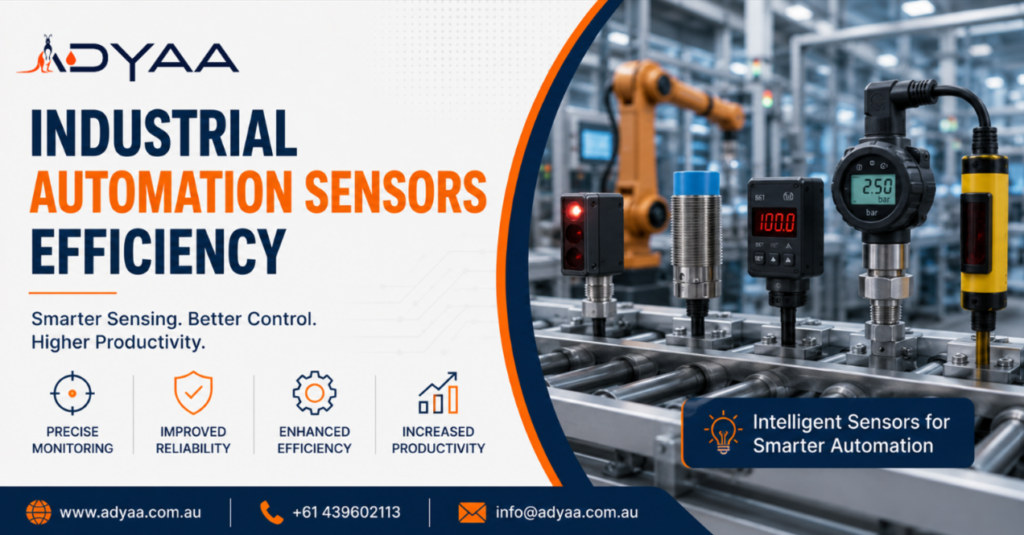
How Industrial Automation Sensors Improve Efficiency in Manufacturing Efficiency is the primary metric of success. The difference between a profitable plant and a struggling one often comes down to Overall Equipment Effectiveness (OEE)—how well your machinery is actually performing versus its theoretical potential. Achieving high OEE is impossible with manual monitoring alone. This is where Industrial Automation Sensors become the most critical assets on your factory floor. ADYAA specializes in the “nervous system” of the smart factory. We know that Industrial Automation Sensors are not merely components that switch things on and off; they are data generators that unlock higher throughput, lower waste, and zero unplanned downtime. In this deep dive, we explore exactly how these sensors transform raw machinery into intelligent, efficient systems. The Role of Industrial Automation Sensors in Industry 4.0 Before we look at efficiency, we must define what these devices do. Industrial Automation Sensors are input devices that provide a signal regarding a specific physical condition—heat, light, pressure, motion, or distance. In the past, sensors were simple, discrete devices (giving a basic “Yes/No” signal). Today, in the era of Industry 4.0 and the Industrial Internet of Things (IIoT), Industrial Automation Sensors are smart. They don’t just trigger an alarm; they communicate real-time data trends to PLCs (Programmable Logic Controllers) and SCADA systems, allowing the factory to “think” and adjust itself. 5 Ways Industrial Automation Sensors Drive Efficiency Implementing the right sensor strategy directly impacts your bottom line. Here is how: 1. Enabling Predictive Maintenance (Eliminating Downtime) The biggest killer of efficiency is unplanned downtime. When a motor burns out or a bearing seizes unexpectedly, production stops for hours. The Old Way: Run the machine until it breaks, or replace parts on a schedule whether they need it or not. The Sensor Way: Vibration and Temperature Sensors continuously monitor the health of rotating equipment. By analyzing vibration signatures, Industrial Automation Sensors can detect a misalignment or bearing wear weeks before failure occurs. This allows maintenance to be scheduled during planned shutdowns, keeping the line running during profitable hours. 2. Increasing Speed and Throughput Human operators have reaction times measured in seconds. Machines react in milliseconds. High-Speed Processing: Photoelectric and Laser Sensors can detect product presence on a conveyor belt moving at hundreds of meters per minute. They trigger actuators, fillers, and sorters with micro-second precision. Gap Control: Precise distance sensors reduce the necessary gap between products on a line, effectively squeezing more production volume into the same operating time. 3. Reducing Waste and Scrap (Quality Control) Producing defective parts is a double loss: you lose the raw material and the production time. Vision Sensors: As discussed in our previous articles, vision-based Industrial Automation Sensors inspect every single unit for defects (label alignment, cap seal, dimensions). Process Sensors: Pressure and flow sensors ensure that ingredients in chemical or food processing are mixed in exact ratios. If the pressure drops, the sensor halts the process instantly to prevent a bad batch, ensuring “First Time Right” manufacturing. 4. Enhancing Energy Efficiency Energy is a major operational cost. Sensors help manage it. Current Sensors: Monitor the power draw of large motors. If a conveyor is running empty, the system can detect the load drop and ramp down the motor speed (via VFDs), saving electricity. Compressed Air Monitoring: Flow Sensors can detect leaks in pneumatic lines—one of the most expensive forms of energy waste in factories—alerting teams to fix the leak immediately. 5. Improving Safety and Ergonomics An accident stops production immediately and triggers investigations. Safety is efficiency. Safety Light Curtains: These specialized Industrial Automation Sensors create an invisible wall. If an operator reaches into a dangerous area, the machine stops instantly. This allows for easier access to machines for loading/unloading without physical cages slowing down the workflow. Key Types of Industrial Automation Sensors You Need To optimize a facility, you need the right mix of sensor technologies. Here are the staples of efficient automation: Inductive Proximity Sensors: The workhorse of the industry. They detect metal targets without contact. Essential for positioning, counting, and confirming tooling location. Photoelectric Sensors: Use light beams to detect objects of any material. Critical for packaging lines and material handling. Laser Distance Sensors: Provide precise analog measurement of distance. Used for tank level monitoring, roll diameter measurement, and robot positioning. Pressure & Temperature Transmitters: Vital for process industries (Oil & Gas, Food & Bev) to maintain safe and efficient operating conditions. Conclusion: Data Is the New Oil The modern factory runs on data, and Industrial Automation Sensors are the pumps that keep that data flowing. By transitioning from reactive manual checks to proactive sensor-based monitoring, manufacturers can achieve a level of efficiency that was previously impossible. Whether you are looking to retrofit an old machine with smart capabilities or design a new, fully automated line, the quality of your sensors dictates the quality of your production. ADYAA supplies high-grade sensors designed to withstand the harsh conditions of Australian industry—from the dust of mining to the wash-downs of food processing. Ready to optimize your manufacturing process? View Our Range of Industrial Automation Sensors. Consult with our automation specialists today. Industrial HVAC vs Commercial HVAC: What is the Difference? Industrial HVAC vs Commercial HVAC: Why Equipment Choice Matters If you walk onto the roof of a shopping mall and… Read More → Gems 3100/3200 Pressure Transmitters : Complete Guide – Copy How Industrial Automation Sensors Improve Efficiency in Manufacturing Efficiency is the primary metric of success. The difference between a profitable… Read More → Gems 3100/3200 Pressure Transmitters : Complete Guide Gems 3100/3200 Pressure Transmitters: Complete Guide Accurate pressure monitoring is essential across industrial environments where process visibility, operational consistency and… Read More →
Gems 3100/3200 Pressure Transmitters : Complete Guide
Gems 3100/3200 Pressure Transmitters: Complete Guide Accurate pressure monitoring is essential across industrial environments where process visibility, operational consistency and system performance matter. Selecting the right Pressure Transmitters can support reliable measurement, better integration and improved operational awareness. Whether you are evaluating a new installation or comparing an industrial pressure sensing solution, understanding application requirements is the first step. This guide explains what Gems 3100/3200 Pressure Transmitters are, how they work, selection considerations and practical applications across industrial environments. What Are Gems 3100/3200 Pressure Transmitters ? Gems 3100/3200 Pressure Transmitters are industrial devices designed to convert pressure into electrical output signals that can be interpreted by monitoring and control systems. Pressure Transmitters are widely used where continuous measurement and process visibility are important. Typical environments include: Industrial process applications Water and fluid systems Manufacturing equipment Hydraulic systems Automation environments OEM machinery Their purpose is simple: Measure pressure → convert into signal → support operational decisions. Why Pressure Transmitters Selection Matters Selecting a pressure transmitter involves more than choosing a pressure range. A well-selected industrial pressure Transmitters may support: Better process visibility Reliable pressure monitoring Easier system integration Improved operational awareness More consistent measurements Selecting equipment without considering the application may create: Unstable readings Increased maintenance Reduced measurement confidence Process inefficiencies For example: A production line operating under changing conditions may require a different pressure-sensing approach than a stable water application. 5 Factors to Consider Before Selecting Gems 3100/3200 Pressure Transmitters 1. Understand Operating Pressure Conditions Review: Normal operating pressure Peak conditions Temporary fluctuations Selecting the appropriate range supports measurement consistency. 2. Evaluate Process Compatibility Industrial processes vary. Consider: Water applications Process liquids Hydraulic fluids Industrial operating environments Review process requirements before selecting instrumentation. 3. Confirm Integration Requirements Pressure Transmitters should align with existing infrastructure. Typical environments include: PLC systems SCADA platforms Control systems Industrial monitoring systems System compatibility should always be evaluated before implementation. 4. Assess Environmental Conditions Environmental conditions influence performance. Evaluate: Temperature exposure Installation environment Moisture conditions Mechanical vibration Example: Outdoor industrial environments may have different requirements compared with controlled indoor installations. 5. Plan for Long-Term Operation Selection should support long-term use. Review: Accessibility Maintenance requirements Inspection schedules Operational continuity Reliable measurement starts with selecting solutions suitable for the application lifecycle. Common Applications of Gems 3100/3200 Pressure Transmitters Water Management Supports pressure visibility across fluid systems. Industrial Equipment Helps maintain process awareness. Hydraulic Systems Supports pressure monitoring under changing operating conditions. Manufacturing Applications Improves measurement visibility across production environments. Example: Selecting Pressure Transmitters for a Manufacturing Process Imagine a production environment operating multiple pressure zones. The engineering team reviews: ✔ Pressure requirements ✔ Environmental conditions ✔ Integration requirements ✔ Maintenance expectations Instead of selecting based only on specifications, they evaluate operating requirements first. This approach often supports better long-term outcomes. Best Practices for Pressure Monitoring To improve measurement performance: Select the correct operating range Confirm process compatibility Install according to requirements Perform periodic inspection Review operating conditions regularly Reliable monitoring combines appropriate selection with good operating practices. Frequently Asked Questions What are Gems 3100/3200 Pressure Transmitters used for? They are used to measure pressure and provide electrical signals for industrial monitoring and control applications. How do I select the correct pressure transducer? Review operating pressure, application requirements, environmental conditions and system compatibility. Can pressure transducers be used in water applications? Pressure Transmitters are commonly applied in industrial water environments depending on operating conditions. What industries commonly use pressure Transmitters ? Manufacturing, industrial automation, water systems and hydraulic applications commonly use pressure Transmitters . How often should pressure Transmitters be inspected? Inspection intervals vary depending on operating conditions and maintenance practices. Final Thoughts Selecting the correct pressure sensing solution requires more than reviewing technical specifications. Gems 3100/3200 Pressure Transmitters may be considered where pressure visibility, operational consistency, and industrial integration are important. Before final selection, evaluate operating requirements, installation conditions, and system compatibility to support long-term performance. Explore product details Electromagnetic Flow Meter for Distilled Water Applications – Copy Gems 3100/3200 Pressure Transmitters: Complete Guide Accurate pressure monitoring is essential across industrial environments where process visibility, operational consistency and… Read More → Dry Type Water Meters for Accurate Water Measurement Dry Type Water Meters: Why They Remain a Preferred Choice for Accurate Water Measurement Accurate water measurement is the foundation… Read More → Electromagnetic Flow Meter for Distilled Water Applications Electromagnetic Flow Meter for Distilled Water Applications Can an Electromagnetic Flow Meter Be Used for Distilled Water? Electromagnetic (Mag) flow… Read More →
Gems 3510 Pressure Transmitter: Complete Selection Guide
Gems 3510 Pressure Transmitter: Complete Selection Guide Accurate pressure monitoring plays an important role in industrial performance, process visibility and operational consistency. Selecting the right Pressure Transmitter can help improve measurement reliability, support system integration and contribute to more efficient process control. Whether you are evaluating an industrial pressure transmitter, upgrading an existing setup or comparing a pressure measurement solution, understanding selection criteria is essential. This guide explains how to evaluate the Gems 3510 Pressure Transmitter, where it may be applied and what factors to consider before making a decision. What Is a Gems 3510 Pressure Transmitter? The Gems 3510 Pressure Transmitter is designed to convert measured pressure into an output signal that can be used by industrial monitoring and control systems. Pressure transmitters are widely used to support operational monitoring and maintain process visibility across multiple industries. Typical application environments include: Industrial process systems Water and fluid applications Manufacturing environments Hydraulic systems Automation systems OEM equipment As a process pressure transmitter, its purpose is to convert process pressure into usable measurement data. Why Pressure Transmitter Selection Matters Choosing the right transmitter involves more than selecting a specification range. A properly selected pressure monitoring system may support: Improved process visibility More consistent measurements Better operational awareness Easier maintenance planning Reliable system integration Incorrect selection may lead to: Measurement instability Frequent maintenance intervention Reduced operational confidence Increased troubleshooting time For example: A water circulation process may require different pressure measurement conditions compared with a hydraulic production environment. Understanding the application should always come before selecting equipment. 5 Factors to Consider Before Selecting a Gems 3510 Pressure Transmitter 1. Understand the Operating Pressure Range Start by identifying: Normal operating pressure Maximum pressure Temporary surge conditions Selecting an unsuitable range may influence performance. Example: Operating within the normal measurement range instead of near limits may help maintain stable readings. 2. Evaluate Process Media Compatibility Industrial environments operate under different conditions. Consider: Water applications Industrial liquids Hydraulic fluids Process environments Questions to review: What media will be measured? Are environmental conditions stable? Is material compatibility suitable? Selection based on actual operating requirements generally supports better long-term outcomes. 3. Confirm System Integration Requirements Before installation, verify compatibility with: PLC systems SCADA environments Industrial control systems Monitoring platforms An industrial instrumentation setup performs best when devices communicate effectively across the system. 4. Review Environmental Conditions Pressure transmitters often operate in demanding industrial environments. Evaluate: Temperature exposure Moisture conditions Mechanical vibration Installation location Example: Outdoor applications may have different requirements compared with indoor control systems. 5. Consider Lifecycle and Maintenance Selection should support long-term operation. Review: Installation access Service requirements Inspection schedules Operational continuity Selecting a transmitter that supports ongoing maintenance can simplify long-term management. Common Applications of Gems 3510 Pressure Transmitter The Gems 3510 Pressure Transmitter may support several industrial environments. Water Management Systems Pressure monitoring may help improve operational visibility across fluid applications. Manufacturing Equipment Supports measurement awareness across industrial processes. Hydraulic Applications Provides pressure visibility under changing operating conditions. Industrial Automation Supports broader monitoring and operational control environments. Example: Selecting a Pressure Measurement Solution Imagine an industrial facility operating a closed-loop water process. The engineering team evaluates: ✔ Pressure range ✔ Environmental conditions ✔ Process requirements ✔ Integration compatibility Instead of selecting based only on specifications, they evaluate actual operating conditions. This approach may contribute to more reliable measurement outcomes. Best Practices for Better Pressure Measurement To improve long-term measurement performance: Select the correct operating range Verify process compatibility Follow installation recommendations Schedule periodic inspection Review operating conditions regularly The right pressure transmitter applications strategy combines correct selection with suitable operating practices. Frequently Asked Questions What is a Gems 3510 Pressure Transmitter used for? The Gems 3510 Pressure Transmitter is used to measure pressure and provide output signals for monitoring and industrial control environments. How do I choose the correct pressure transmitter? Evaluate operating pressure, environmental conditions, media compatibility and system integration requirements. Can pressure transmitters be used in water applications? Pressure transmitters are commonly applied in industrial water systems depending on operating requirements. What industries commonly use pressure transmitters? Pressure transmitters are frequently used in manufacturing, automation, hydraulic systems and water-related processes. How often should pressure transmitters be inspected? Inspection intervals depend on application conditions, maintenance schedules and operational requirements. Final Thoughts Selecting the right pressure transmitter requires understanding more than technical specifications. The Gems 3510 Pressure Transmitter may be considered where reliable pressure monitoring, process visibility and integration flexibility are important. Before implementation, review application requirements, environmental conditions and compatibility to support long-term operational performance. Explore product details Electromagnetic Flow Meter for Distilled Water Applications – Copy Gems 3100/3200 Pressure Transmitters: Complete Guide Accurate pressure monitoring is essential across industrial environments where process visibility, operational consistency and… Read More → Dry Type Water Meters for Accurate Water Measurement – Copy Gems 3510 Pressure Transmitter: Complete Selection Guide Accurate pressure monitoring plays an important role in industrial performance, process visibility and… Read More → Dry Type Water Meters for Accurate Water Measurement Dry Type Water Meters: Why They Remain a Preferred Choice for Accurate Water Measurement Accurate water measurement is the foundation… Read More →
Dry Type Water Meters for Accurate Water Measurement
Dry Type Water Meters: Why They Remain a Preferred Choice for Accurate Water Measurement Accurate water measurement is the foundation of effective water management. Whether the objective is utility billing, resource conservation, leak detection, or process monitoring, reliable flow measurement helps organizations make informed decisions. While there are several types of water meters available today, dry type water meters continue to be widely used because of their simple design, dependable performance, and long operational life. In many water distribution systems, a common challenge for operators is maintaining clear and accurate meter readings over time. Exposure to moisture, sediment, and mineral deposits can affect the readability and performance of conventional meters. Dry-type water meters were developed to address these issues by isolating the register mechanism from direct contact with water. As a result, they have become a trusted solution in residential, commercial, municipal, and light industrial applications. Understanding the Dry Type Water Meter At first glance, a dry-type water meter may appear similar to other mechanical water meters. The key difference, however, lies in the design of the register. In a dry type meter, the measuring chamber and the register are separated from one another. Water flows only through the meter’s measuring section, while the counting mechanism remains enclosed in a sealed compartment. The movement generated by the flow of water is transferred magnetically to the register, allowing the meter to record consumption without exposing sensitive components to moisture. This design significantly improves readability and protects the register from corrosion, scaling, and contamination that may develop over years of service. How the Meter Measures Water Flow The operating principle of a dry type water meter is relatively straightforward. As water enters the meter body, it passes through a measuring chamber containing a moving element such as a turbine or oscillating piston. The flowing water causes this internal component to move in proportion to the flow rate. Rather than transmitting this movement mechanically through a shaft, a magnetic coupling transfers the motion to the external register. The register then converts the movement into a cumulative volume reading. Because the register remains isolated from the water, it continues to provide clear and accurate readings even after prolonged operation in demanding environments. Why Dry Type Water Meters Are Widely Used From an engineering perspective, reliability and maintainability are often more important than complexity. Dry type water meters have gained widespread acceptance because they offer a practical balance between performance, durability, and cost. One of their biggest advantages is the protection of the register assembly. Anyone who has worked with older water metering systems knows how difficult it can be to read a meter when the dial becomes cloudy or discolored. By keeping the register dry, these problems are largely eliminated. The design also contributes to lower maintenance requirements. Since the register is protected from direct exposure to water, the risk of corrosion and internal damage is significantly reduced. This often results in a longer service life compared to traditional wet-type meters. Key Features Several features make dry type water meters suitable for everyday water measurement applications: Sealed register construction that prevents moisture ingress. Magnetic coupling for non-contact transmission of movement. Clear and easy-to-read display. Durable construction for long-term operation. Resistance to dirt and sediment-related visibility issues. Availability in various sizes for residential and commercial installations. These features allow the meter to maintain reliable performance under normal operating conditions while minimizing maintenance efforts. Typical Applications Dry type water meters are commonly installed wherever accurate water measurement is required and ease of reading is important. Residential Water Supply In residential buildings, dry type meters are widely used to measure household water consumption. Their clear display makes routine meter reading straightforward for both utility personnel and property owners. Commercial Buildings Hotels, office complexes, shopping centers, hospitals, and educational institutions frequently use dry type meters to monitor water usage and manage utility expenses. Municipal Water Distribution Water utilities often select dry type meters because they provide dependable performance and maintain readability throughout their service life. Apartment Complexes In multi-unit residential developments, individual metering helps ensure fair billing and encourages responsible water usage among residents. Industrial Utility Monitoring Although larger industrial systems may use advanced flow measurement technologies, dry type meters are still commonly used for utility water monitoring, employee facilities, and auxiliary water distribution networks. Installation Considerations Even the best water meter cannot perform accurately if it is installed incorrectly. Proper installation practices play a significant role in achieving reliable measurements. The meter should always be installed in the correct flow direction and in a pipeline that remains completely full during operation. Locations immediately downstream of pumps, control valves, or sharp bends should generally be avoided, as turbulence can influence measurement accuracy. Where water quality is poor, installing a strainer upstream of the meter can help protect internal components from excessive debris and sediment. Routine inspections should also be part of the maintenance program to ensure continued performance throughout the meter’s service life. Comparing Dry Type and Wet Type Meters Both dry type and wet type meters are designed to measure water consumption, but their approaches differ. In wet type meters, the register is immersed in water, making it more susceptible to discoloration and reduced visibility over time. Dry type meters eliminate this concern by isolating the register from the measuring chamber. While dry type meters may have a slightly higher purchase cost, many users find that the improved readability, lower maintenance requirements, and extended operational life justify the investment. Limitations to Consider Like any engineering device, dry type water meters are not without limitations. They can be affected by poor water quality, excessive scaling, or the presence of large amounts of suspended solids. In addition, mechanical components may gradually wear after years of operation. Regular inspection and periodic calibration are therefore important to maintain measurement accuracy. For highly specialized industrial processes requiring extremely high precision, advanced electronic flow meters may be a more suitable option. Final Thoughts Dry type water meters have remained a popular choice
How to Select the Right Pressure Transmitter
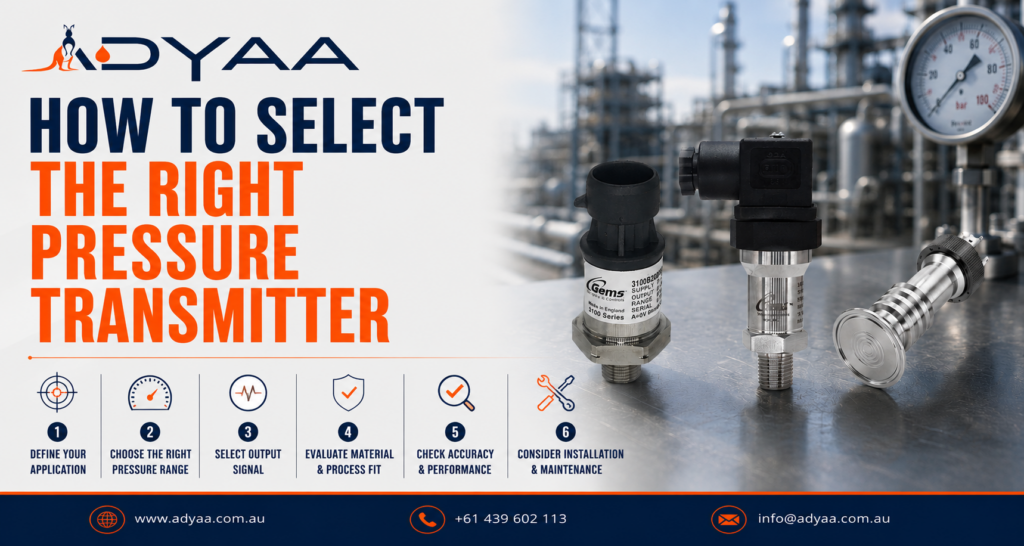
How to Select the Right Pressure Transmitter Pressure transmitters play a critical role in industrial automation, process control, water treatment, mining, manufacturing, and hydraulic systems. Selecting the correct pressure transmitter ensures accurate monitoring, improved equipment protection, and long-term operational reliability. Choosing the wrong sensor can result in inaccurate measurements, premature failures, increased maintenance costs, and process downtime. Understanding the key selection criteria helps engineers and maintenance teams achieve optimal performance from their pressure measurement systems. How to Select the Right Pressure Transmitter Understand the Required Pressure Range The first step in selecting a pressure transmitter is determining the operating pressure range of the application. A transmitter should typically operate within 30% to 80% of its full-scale range during normal conditions. Selecting an excessively large pressure range can reduce measurement accuracy, while choosing an undersized range can expose the sensor to overload conditions. Examples include: Water distribution systems: 0–10 bar Pump monitoring: 0–16 bar Hydraulic systems: 250–1000 bar Industrial compressors: 0–40 bar Always consider pressure spikes and transient conditions when selecting the final range. Choose the Correct Pressure Type Pressure transmitters are available in several measurement configurations: Gauge Pressure Measures pressure relative to atmospheric pressure and is commonly used in industrial processes. Absolute Pressure Measures pressure relative to a perfect vacuum and is often used in vacuum systems and scientific applications. Sealed Gauge Pressure References a fixed atmospheric pressure and is suitable for outdoor installations where environmental conditions vary. Selecting the correct pressure reference is essential for accurate process control. Consider Output Signal Requirements The transmitter output must be compatible with the control system or PLC. Common output signals include: 4–20 mA 0–5 V 0–10 V 1–5 V 1–10 V 0.5–4.5 V Ratiometric The 4–20 mA output remains the most widely used option due to its noise immunity and long-distance transmission capability. Evaluate Process Media Compatibility The wetted materials of the transmitter must be compatible with the process fluid. For demanding industrial environments, 316 Stainless Steel is commonly preferred due to its resistance to: Corrosion Chemical attack Moisture Process contamination Industries such as water treatment, food processing, chemical manufacturing, and mining often require robust stainless-steel construction. Check Environmental Conditions Industrial environments can expose pressure transmitters to: Vibration Hydraulic shock Temperature fluctuations Dust and moisture Chemical exposure Selecting a transmitter with suitable environmental protection improves reliability and service life. Applications involving hydraulic power units or heavy machinery may require sensors specifically designed to withstand pressure spikes and pulsation. Accuracy and Long-Term Stability Accuracy requirements vary between applications. General industrial processes typically use transmitters with accuracies between: ±0.5% Full Scale ±0.25% Full Scale Critical monitoring applications may require higher precision. Long-term stability is equally important as it reduces recalibration frequency and maintenance costs over the life of the equipment. Common Applications for Pressure Transmitters Pressure transmitters are widely used across industries including: Water Treatment Plants Mining Operations Hydraulic Systems Food and Beverage Processing Chemical Manufacturing Oil and Gas Facilities Industrial Automation Systems Pump and Compressor Monitoring Each application requires careful consideration of pressure range, output signal, material compatibility, and environmental conditions. Conclusion Selecting the right pressure transmitter involves more than simply matching a pressure range. Engineers should evaluate pressure type, output signal, process media compatibility, environmental conditions, and accuracy requirements to ensure reliable long-term performance. A properly selected pressure transmitter improves process efficiency, reduces maintenance costs, enhances equipment protection, and supports accurate industrial monitoring across a wide range of applications. Rupture Disc Operating Ratio Explained (Avoid Premature Failure) – Copy Rupture Disc Operating Ratio Explained (Avoid Premature Failure) Pressure transmitters play a critical role in industrial automation, process control, water… Read More → Rupture Disc Operating Ratio Explained (Avoid Premature Failure) Rupture Disc Operating Ratio Explained (Avoid Premature Failure) If your pressure relief devices are blowing during normal plant operations, you… Read More → Rupture Disc Selection Guide: 5 Critical Steps Rupture Disc Selection Guide: 5 Critical Steps Industrial plants cannot afford guesswork when it comes to overpressure protection. Picking a… Read More →