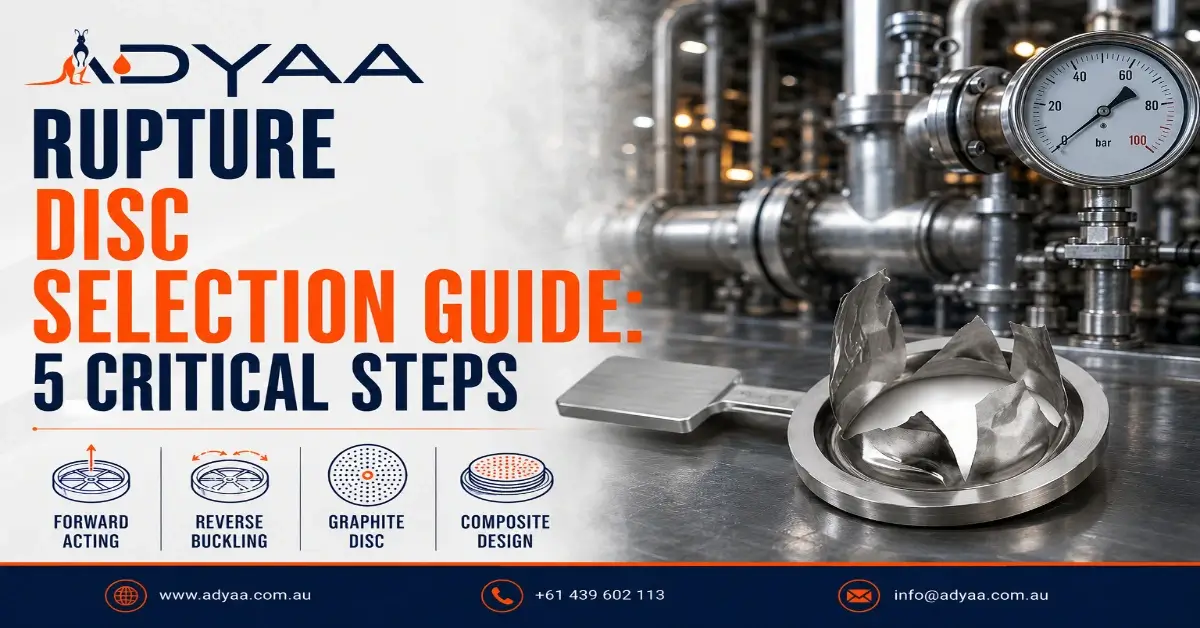
Industrial plants cannot afford guesswork when it comes to overpressure protection. Picking a bursting disc out of a catalog based purely on flange size is a recipe for nuisance bursting, premature metal fatigue, or worse—a catastrophic failure to relieve pressure.
A rupture disc is a precision-engineered life safety device. To ensure it activates exactly when your system reaches critical mass, you must match the metallurgy and mechanical design to the specific realities of your pipeline. Use this rupture disc selection guide to navigate the five essential engineering steps required to secure your facility.
The 5 Steps of Rupture Disc Selection
Step 1: Determine Burst Pressure and Coincident Temperature
The most critical baseline is establishing your required burst pressure, but pressure never exists in a vacuum. You must define the coincident temperature—the exact temperature of the pipeline at the moment the overpressure event occurs.
Because metal weakens as it gets hotter, a stainless steel disc calibrated to burst at 100 PSI at ambient temperature might burst prematurely at 80 PSI if the process runs at 200°C. You must provide your supplier with both variables so they can compensate for thermal weakening during the manufacturing process.
Step 2: Calculate Your Operating Ratio
Your operating ratio dictates whether you need a forward-acting or reverse-acting disc. This ratio is the gap between your normal operating pressure and your system’s Maximum Allowable Working Pressure (MAWP).
- Low Operating Ratio (Under 70%): If your system runs at 60 PSI and bursts at 100 PSI, a standard forward-acting disc is sufficient.
- High Operating Ratio (Up to 95%): If your system runs at 90 PSI and bursts at 100 PSI, a forward-acting disc will fatigue and fail. You must select a reverse-acting disc, which uses compression loading to handle tight pressure margins without degrading.
Step 3: Assess Media and Material Compatibility
A disc will not burst at its rated pressure if corrosive media has eaten away half its thickness. You must match the disc material to the chemical makeup of your process fluid or gas.
- Standard Media: 316 Stainless Steel or Nickel are industry standards for water, steam, and non-corrosive gases.
- Aggressive Media: For highly acidic or sour gas applications, you must upgrade to exotic alloys like Monel, Inconel, Hastelloy, or Tantalum.
- Extreme Corrosion: If metal cannot survive the environment, specify a graphite rupture disc, which is immune to most industrial solvents and acids.
Step 4: Evaluate Downstream Conditions and Fragmentation
Where is the pressure going once the disc bursts? If you are venting straight to the atmosphere, a standard fragmenting disc might be acceptable. However, if the disc is installed directly upstream of a mechanical safety relief valve, you must specify a non-fragmenting disc (like a reverse-buckling or cross-scored disc). If a standard disc shatters, the metal shrapnel will lodge in the safety valve, preventing it from closing.
A Critical Note on Backpressure
If your disc discharges into a common flare header or a closed manifold, you must account for superimposed backpressure. If there is 10 PSI of pressure pushing against the back of the disc, a 100 PSI disc will not burst until the internal system hits 110 PSI. In these scenarios, a balanced rupture disc design is required.
Step 5: Select the Right Holder and Accessories
A rupture disc is only as reliable as its installation. You cannot clamp a high-performance disc between two standard pipe flanges and expect it to work. You must select a dedicated rupture disc holder designed specifically for the disc profile (e.g., pre-torqued holders or insert-type holders). Additionally, consider integrating a burst indicator sensor that immediately alerts your SCADA system or control room the millisecond the disc activates.
FAQ – Rupture Disc Selection Guide
Q: What is the most important factor in rupture disc selection?
A: Coincident temperature and burst pressure are the most critical, as the temperature directly alters the tensile strength and burst point of the metal.
Q: When should I choose a reverse-acting rupture disc?
A: Choose a reverse-acting disc when your normal operating pressure is 80% to 95% of your burst pressure, or when you are operating in a high-pulsation environment.
Q: Do I need a non-fragmenting rupture disc?
A: Yes, you must use a non-fragmenting disc if it is installed upstream of a safety relief valve or sensitive downstream equipment that could be damaged by metal shrapnel.
Q: Can I install a rupture disc without a holder?
A: No. Rupture discs require highly specific, precision-machined holders to ensure the correct seating, sealing, and bursting mechanics.
Q: How does backpressure affect a rupture disc?
A: Superimposed backpressure pushes against the downstream side of the disc, artificially raising the internal pressure required to burst it, unless a balanced disc is used.
Q: What material is best for highly corrosive processes?
A: For extreme chemical environments where stainless steel degrades, graphite, Hastelloy, or Tantalum are the preferred materials to ensure the burst pressure remains stable.
Engineer Your Overpressure Protection with ADYAA
Relying on a generic rupture disc selection guide is just the first step. Finalizing your safety systems requires exact engineering verification. As Australia’s leading supplier of industrial safety solutions, ADYAA provides ASME-certified rupture discs, precision holders, and thermal relief expertise to keep your plant safe and compliant.
Consult with ADYAA Overpressure Experts Today