
Rupture Disc Burst Detection Systems: The Ultimate Guide
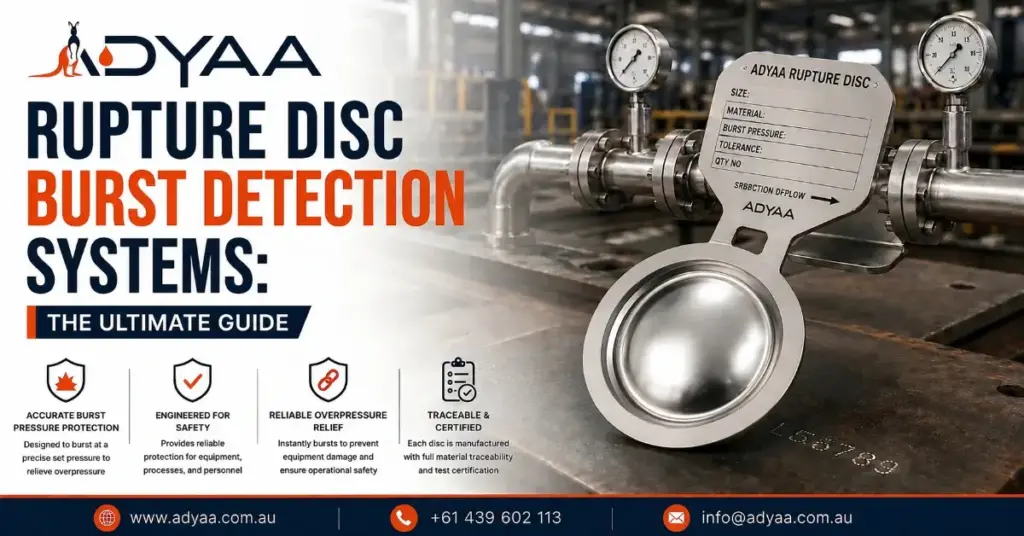
Rupture Disc Burst Detection Systems: The Ultimate Guide A rupture disc is designed to burst and relieve pressure instantly, but what happens after it blows? If a disc vents into a closed manifold, a flare header, or a remote stack, the rupture can go entirely unnoticed by plant operators for hours or even days. This blind spot leads to massive fugitive emissions, lost product, and severe EPA compliance violations. To close this safety gap, modern facilities rely on a rupture disc burst detection system. By integrating smart sensors directly into the pressure relief line, these systems instantly alert your control room the millisecond an overpressure event occurs, allowing you to trigger automated emergency shutdowns and isolate the hazard. Quick Comparison: Common Burst Detection Methods Sensor Type Operating Mechanism Best Application Membrane Wire Indicator Physical circuit break General chemical pipelines, atmospheric venting Magnetic Proximity Non-invasive magnetic shift Highly toxic media, zero-leakage systems Cavity Pressure Switch Pressure buildup detection Installed between a rupture disc and a safety valve What Is a Rupture Disc Burst Detection System? At its core, a rupture disc burst detection system is a specialized electronic circuit designed to monitor the physical integrity of your overpressure relief devices. Instead of relying on manual visual inspections—which are dangerous and time-consuming—these systems use low-voltage sensors to provide 24/7 continuous monitoring. When a disc activates, the sensor state changes (usually from a closed electrical loop to an open one), sending an immediate electrical signal directly to your DCS (Distributed Control System) or SCADA network. Types of Burst Sensors 1. Membrane Wire Burst Indicators This is the most common and cost-effective detection method. A thin Kapton or Teflon membrane containing a conductive copper or tantalum wire loop is installed on the downstream side of the rupture disc. When the disc bursts, the physical force of the escaping gas or fluid tears through the membrane. This severs the conductive wire, breaking the electrical circuit and instantly triggering the alarm relay. 2. Magnetic Proximity Sensors For ultra-critical or highly toxic processes, breaking a physical wire is sometimes undesirable. Magnetic proximity sensors offer a non-invasive alternative. Typically used with reverse-buckling discs, a small magnetic target is attached to the disc dome. A sensor sits outside the process media on the holder. When the disc buckles and opens, the target moves away from the sensor, registering the change in the magnetic field and triggering the alert without ever touching the process fluid. 3. Baffle / Leakage Detectors Also known as “tell-tale” indicators, these are heavily utilized in dual-device setups where a rupture disc isolates a mechanical safety relief valve. If the disc bursts (or develops a pinhole leak), pressure begins to build in the cavity between the disc and the valve. A pressure switch tapped into this cavity detects the rising pressure and alerts the control room before the mechanical safety valve is forced open. Integration and Plant Safety Deploying the physical sensor is only half the battle; integrating the signal into your plant’s safety logic is where the real value lies. Immediate Shutdown Protocols Once a burst is detected, the automated logic can instantly close upstream isolation valves, shut down heavy pumps, or divert process flow. This immediate response stops the loss of expensive raw materials and prevents toxic chemicals from continuously feeding the overpressure leak. Hazardous Area Compliance (ATEX / IECEx) Because pipelines often contain highly flammable hydrocarbons, running raw electricity near a venting point is a severe explosion hazard. A professional rupture disc burst detection system must be wired through intrinsically safe barriers. These isolators limit the electrical energy running to the sensor, ensuring that even if the wire snaps, it cannot generate a spark hot enough to ignite explosive gases. FAQ – Rupture Disc Burst Detection System Q: What is a rupture disc burst detection system? A: It is an electronic sensor network that instantly notifies a plant control room the moment a rupture disc bursts, enabling rapid emergency response. Q: How does a wire burst indicator work? A: It uses a closed-loop conductive wire on a thin membrane; when the disc bursts, the fluid tears the wire, breaking the electrical circuit and triggering an alarm. Q: Can a burst sensor be installed on an existing rupture disc? A: Yes, many membrane-style burst indicators can be retrofitted and installed as standalone units between the downstream flanges of an existing setup. Q: Do burst detection systems require a power supply? A: Yes, they require a low-voltage power supply to maintain the closed-loop electrical circuit or to power proximity sensors. Q: Are these sensors safe for explosive environments? A: Yes, industrial burst sensors are designed to be wired through intrinsically safe barriers, making them fully compliant for use in hazardous ATEX/IECEx zones. Q: How do you know if a rupture disc has blown without a sensor? A: Without a sensor, operators must rely on delayed secondary indicators like downstream pressure drops or conduct dangerous manual visual inspections of the venting line. Automate Your Plant Safety with ADYAA Do not wait for a fugitive emission audit to tell you your safety devices have failed. Upgrading to a continuous rupture disc burst detection system guarantees that your team is never caught off guard. As Australia’s leading supplier of industrial safety solutions, ADYAA provides advanced burst sensors, intrinsically safe relays, and precision rupture discs. Consult with ADYAA Instrumentation Experts Today Rupture Disc Operating Ratio Explained (Avoid Premature Failure) Rupture Disc Operating Ratio Explained (Avoid Premature Failure) If your pressure relief devices are blowing during normal plant operations, you… Read More → Rupture Disc Selection Guide: 5 Critical Steps Rupture Disc Selection Guide: 5 Critical Steps Industrial plants cannot afford guesswork when it comes to overpressure protection. Picking a… Read More → Guide to MNSB 53 for Fabrication Guide to MNSB 53 for Fabrication: Stop Moving Heavy Steel Let’s talk about the biggest bottleneck in a heavy fabrication… Read More →
Rupture Disc Material Selection Guide for Harsh Processes
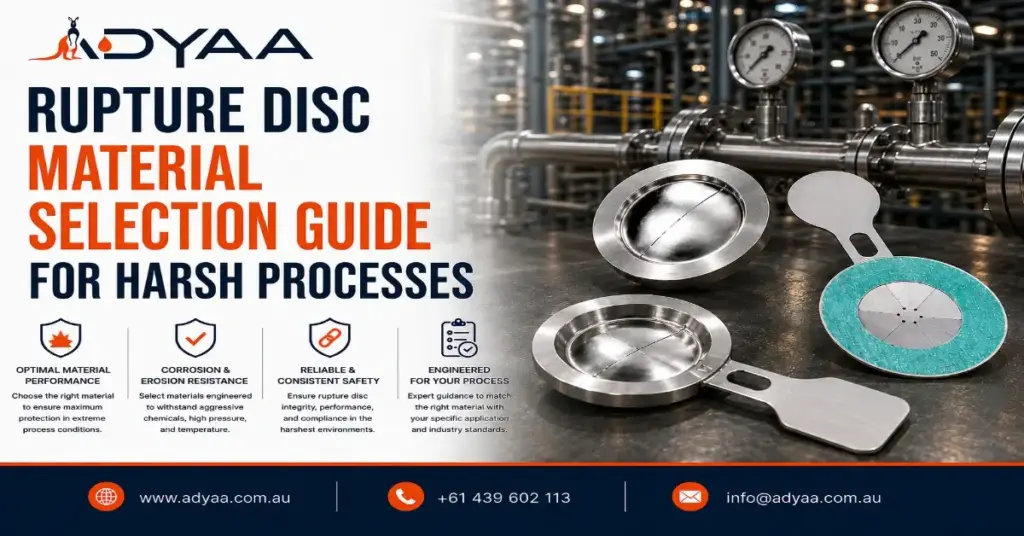
Rupture Disc Material Selection Guide for Harsh Processes If you pump highly corrosive acids or superheated steam through a standard stainless steel rupture disc, you are setting your plant up for failure. Corrosion eats away the metal membrane, artificially lowering the burst pressure and causing unexpected, dangerous blowouts. When dealing with aggressive chemical pipelines or extreme thermal cycling, standard metals simply will not survive. You must consult a dedicated rupture disc material selection guide to match your process media with the exact metallurgy required to prevent premature degradation. Quick Reference: Thermal & Corrosion Limits by Material Material Max Operating Temperature Corrosion Resistance Level Best Application 316 Stainless Steel 480°C Moderate Standard water, steam, non-corrosive gas Nickel 200 400°C Good Alkaline processes, dry halogens Monel 400 430°C High Hydrofluoric acid, saltwater, marine Inconel 600 590°C+ Excellent Extreme high heat, severe thermal cycling Hastelloy C276 480°C Extreme Severe corrosives, chlorides, wet chlorine Graphite 200°C (Standard) Ultimate Highly aggressive acids and solvents Why Material Selection is Critical to Safety A rupture disc is a highly sensitive, calibrated membrane. Its ability to burst at the correct pressure depends entirely on its structural thickness and tensile strength. The Threat of Corrosion: Even a microscopic layer of corrosion thins the metal. A disc rated for 150 PSI could easily weaken and burst at 90 PSI if eaten by acid. The Threat of Heat: Extreme temperatures alter the molecular structure of standard metals, causing them to stretch and fatigue well below their rated burst pressure. The Threat of Contamination: In pharmaceutical or food-grade lines, the disc material must not leach metallic particles or react with the process media. Top Materials for Industrial Rupture Discs 1. Standard Industrial Metals For general manufacturing, standard metals are cost-effective and highly reliable—provided the media is clean. 316 Stainless Steel: The industry default. Highly durable but susceptible to chloride stress-corrosion cracking. Nickel 200: Offers excellent resistance to caustic alkalis and is highly ductile, making it great for low-pressure disc designs. 2. High-Performance Exotic Alloys When process temperatures spike or aggressive chemicals are introduced, you must upgrade to exotic alloys to maintain burst stability. Inconel 600: The ultimate high-temperature alloy. It retains its tensile strength in superheated environments where stainless steel would warp. Monel 400: Highly resistant to sea water and hydrofluoric acid. Ideal for offshore platforms and marine engineering. Hastelloy C276: The ultimate metal for surviving severe chemical attacks, including wet chlorine gas and hypochlorites. 3. Non-Metallic Solutions When the chemical environment is so harsh that no metal can survive, non-metallic options become mandatory. Graphite: Resin-impregnated graphite is entirely immune to most industrial acids, alkalis, and organic solvents. It shatters cleanly upon bursting. PTFE / Fluoropolymer Liners: Instead of buying a solid exotic alloy, engineers often use a standard stainless steel disc protected by a thin layer of PTFE (Teflon) on the process-facing side to block chemical attacks. 3 Steps to Match Material to Your Process Follow this exact workflow to specify your disc material securely: Step 1: Check the Chemical Compatibility Review the Safety Data Sheet (SDS) of your process media. If chlorides, strong acids, or halogens are present, immediately rule out standard Stainless Steel. Step 2: Verify the Coincident Temperature Determine the exact temperature of the process when the overpressure event occurs. If temperatures exceed 480°C, upgrade directly to Inconel to prevent thermal weakening. Step 3: Evaluate the Downstream Environment Standard metals can fragment. Graphite always fragments. If you are discharging into a delicate manifold or a safety valve, you must choose a ductile metal (like Nickel or Stainless Steel) in a non-fragmenting reverse-acting design. FAQ – Rupture Disc Material Selection Guide Q: What is the best rupture disc material for highly corrosive acids? A: Graphite or Hastelloy C276 are the premier choices, as they offer extreme resistance to acidic degradation. Q: Can I use 316 Stainless Steel for high-temperature steam? A: Yes, but only up to roughly 480°C; beyond that, Inconel 600 is required to prevent thermal fatigue. Q: What is a PTFE-lined rupture disc? A: It is a standard metallic rupture disc that features a thin fluoropolymer (Teflon) layer to protect the metal from corrosive chemical attacks. Q: Why would I choose Nickel 200 over Stainless Steel? A: Nickel 200 provides vastly superior corrosion resistance against caustic alkalis and is more ductile for precise low-pressure bursting. Q: Can a graphite rupture disc be used upstream of a safety valve? A: No. Graphite shatters into solid chunks upon bursting, which will instantly jam the internal mechanisms of a downstream safety valve. Q: How does temperature affect my material choice? A: High temperatures lower the tensile strength of metals, meaning a material with high thermal stability (like Inconel) is required to prevent premature bursting. Engineer Your Overpressure Protection with ADYAA Do not guess which material will survive your pipeline. Sourcing the right alloy requires precision engineering and exact process mapping. As Australia’s premium supplier of industrial safety solutions, ADYAA provides fully certified rupture discs in exotic alloys, graphite, and PTFE-lined configurations to secure your most aggressive processes. Consult with ADYAA Materials Experts Today. Rupture Disc Operating Ratio Explained (Avoid Premature Failure) Rupture Disc Operating Ratio Explained (Avoid Premature Failure) If your pressure relief devices are blowing during normal plant operations, you… Read More → Rupture Disc Selection Guide: 5 Critical Steps Rupture Disc Selection Guide: 5 Critical Steps Industrial plants cannot afford guesswork when it comes to overpressure protection. Picking a… Read More → Guide to MNSB 53 for Fabrication Guide to MNSB 53 for Fabrication: Stop Moving Heavy Steel Let’s talk about the biggest bottleneck in a heavy fabrication… Read More →