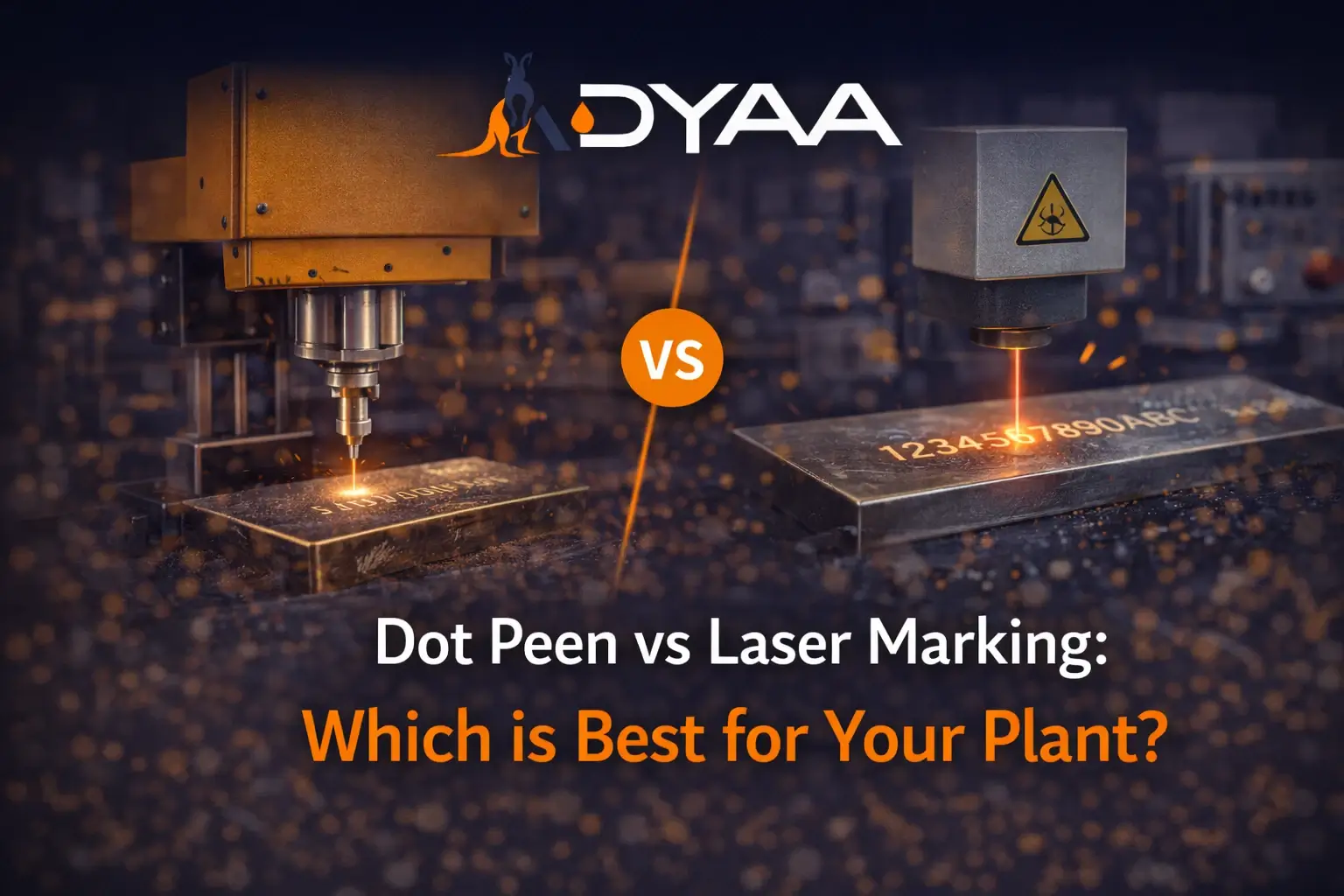
In the debate of dot peen vs laser marking, the best choice depends entirely on your production environment. If you need deep, rugged marks on heavy metals that will survive sandblasting or thick painting, dot peen is the best option. If you need ultra-fast, high-contrast precision (like 2D barcodes) on delicate or high-volume parts without physical impact, laser marking is superior.
Both technologies provide permanent industrial traceability, but they serve completely different manufacturing needs.
Quick Comparison: Dot Peen vs Laser Marking
Feature | Dot Peen Marking | Laser Marking |
Speed | Moderate (Mechanical process) | Extremely Fast (Speed of light) |
Depth | Deep (Survives heavy painting & coating) | Shallow (Surface-level alteration) |
Contrast | Low (Same color as base metal) | High (Dark, oxidized mark) |
Material Stress | High (Physical impact) | None (Non-contact process) |
Here is a comprehensive engineering breakdown to help you select the exact right system for your production line.
Understanding Industrial Traceability Technologies
Whether you are manufacturing aerospace components or heavy mining equipment, permanent identification is mandatory for quality control. To make an informed decision, facility managers must understand the core mechanics, benefits, and limitations of each marking system.
The Mechanics of Dot Peen Marking
Dot peen marking (often called pin marking) is a mechanical, contact-based process. A pneumatically or electrically driven carbide stylus repeatedly strikes the material’s surface, creating overlapping indentations to form text, numbers, or simple logos.
Key Advantages
- Exceptional Depth: The physical indentation is deep enough to remain highly legible even after the part undergoes galvanizing or thick powder coating.
- Extreme Durability: It easily withstands heavy wear, tear, and long-term outdoor exposure.
- Budget-Friendly: These systems typically require a much lower initial capital investment than laser alternatives.
Potential Trade-offs
- Slower Cycle Times: Because it relies on physical, mechanical movement, it cannot match the speed of a light beam.
- Low-contrast marks: The mark remains the same color as the base metal, making it harder for automated optical scanners to read without specialized lighting.
Best Industrial Applications
- Marking heavy structural steel I-beams.
- Tracking rugged oil-and-gas pipe flanges.
- Identifying cast-iron engine blocks that will be heavily coated later in production.
The Mechanics of Laser Marking
Laser marking is a non-contact, thermal process. A machine focuses a high-intensity beam of light (typically a fiber laser for industrial metals) directly onto the material. This instantly heats, oxidizes, or vaporizes the surface.
Key Advantages
- Unmatched Speed: Lasers can engrave complex codes and high-resolution logos in mere fractions of a second, maximizing line throughput.
- High Contrast: The intense heat alters the surface color. This creates a dark, high-contrast mark that barcode scanners and vision systems read instantly.
- No Material Stress: Because no physical tool touches the part, the laser will not warp, dent, or deform fragile components.
Potential Trade-offs
- Surface-Level Depth: Laser marks are generally shallower than dot peen. They can be completely obscured if the part is later painted with thick industrial coatings.
- Higher Upfront Cost: Fiber laser technology requires a larger initial capital investment and specific optical safety enclosures.
Best Industrial Applications
- Engraving high-density Data Matrix codes on medical devices.
- Etching serial numbers onto thin aerospace aluminum.
- Marking QR codes on delicate electronic circuit boards.
Direct Comparison: Choosing the Right System
To finally settle the dot peen vs laser marking debate for your facility, simply match the technology to your daily operational demands.
When to Choose Dot Peen
- Your parts will be painted, powder-coated, or galvanized after the marking process.
- You are working with heavy, rugged components that face physically abusive environments.
- You need a highly durable, permanent mark on a strict capital budget.
When to Choose Laser Marking
- You need to mark machine-readable codes (like 2D barcodes or QR codes) for automated tracking systems.
- Your production line has very fast cycle times and cannot afford bottlenecks.
- You are marking delicate parts, thin metals, or plastics where physical impact is strictly prohibited.
Optimize Your Traceability Setup
Ensuring total traceability across your production line requires precision technology. ADYAA Engineering supplies premium industrial marking systems tailored to the toughest manufacturing environments.
Speak to our industrial marking experts