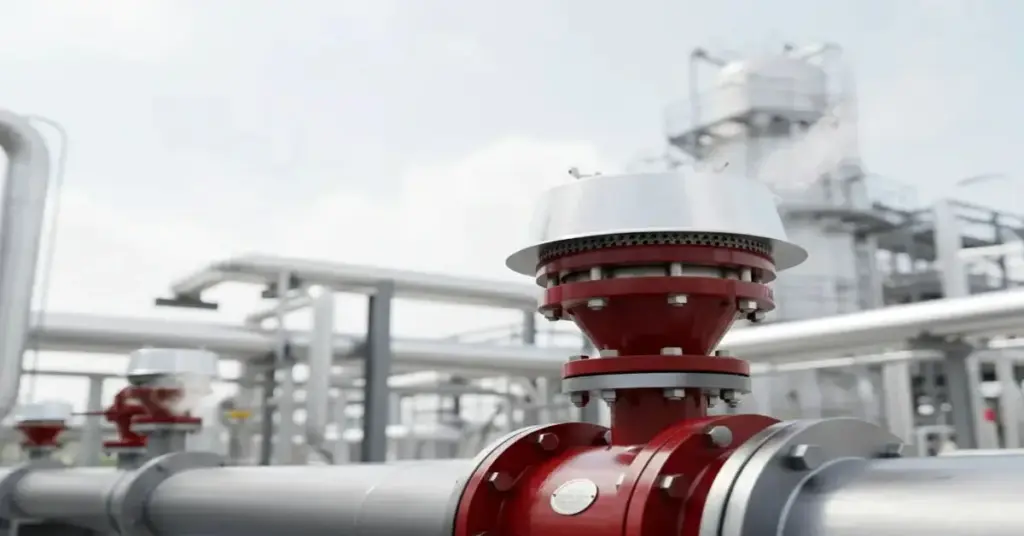
In industries that handle volatile liquids and gases, a spark is your worst enemy. If a fire starts outside a fuel tank, the real danger isn’t just the fire itself—it is the flame traveling back down the pipe into the tank, causing a catastrophic explosion.
To stop this “flashback,” engineers rely on a critical passive safety device: the Flame Arrester.
It acts as a firewall for your piping system, allowing gas to flow freely while stopping fire dead in its tracks. But selecting the wrong one (e.g., confusing a deflagration arrester with a detonation arrester) can be a fatal mistake.
ADYAA supplies and distributes flame arresters in Australia, protecting local refineries, biogas plants, and storage terminals from disaster. In this guide, we break down the mechanics, functions, and critical applications of these life-saving devices.
1. What is a Flame Arrester?
A flame arrester (also known as a flame trap) is a passive safety device installed on a storage tank nozzle or in a pipeline.
Its primary function is simple but vital: to allow gas to pass through but stop a flame from passing through.
It works on the principle of heat dissipation. By forcing the flame to pass through a series of narrow channels (the element), the device splits the flame into tiny “lets” and absorbs its heat energy until it becomes too cold to sustain combustion.
2. How Do They Work? (The Quenching Principle)
The heart of every flame arrester is the “element” or filter bank—usually made of wound crimped metal ribbon or wire mesh.
When a flame front hits the element, two things happen:
- Heat Transfer: The metal element acts as a massive heat sink. It absorbs the heat from the flame faster than the flame can generate it.
- Quenching: As the flame tries to squeeze through the tiny gaps (called the Maximum Experimental Safe Gap, or MESG), the temperature drops below the ignition point of the gas. The flame essentially “suffocates” and dies out.
3. Key Characteristics & Types
Not all fires burn the same way. The type of flame arrester you need depends entirely on how fast the flame is moving and where the device is located.
A. End-of-Line vs. In-Line
- End-of-Line: Installed at the very end of a pipe (e.g., a tank vent) to stop an atmospheric fire from entering the tank.
- In-Line: Installed in the middle of a pipe to stop a fire from traveling from one piece of equipment to another.
B. Deflagration vs. Detonation
This is the most critical distinction in safety engineering.
- Deflagration Arrester: Stops fires moving at subsonic speeds (slower than the speed of sound). Used for short pipe runs.
- Detonation Arrester: Stops fires moving at supersonic speeds (faster than sound). If a flame travels down a long pipe, it accelerates and creates a shockwave. Only a robust Detonation Arrester can stop this shockwave without shattering.
4. Applications & Use Cases
Where are these devices mandatory?
- Fuel Storage Tanks: To protect diesel, petrol, or solvent tanks from external sparks or lightning strikes igniting the vapors inside.
- Biogas & Anaerobic Digesters: Methane lines in wastewater treatment plants are highly flammable. A flame arrester prevents a flare stack fire from traveling back into the digester.
- Vapor Recovery Units (VRU): When collecting fumes from truck loading racks, the piping network connects multiple tanks. Arresters isolate each tank to prevent a chain-reaction explosion.
- Marine Vessels: Ships carrying oil or chemicals use them to prevent engine room fires from reaching cargo holds.
5. Advantages of Using a Flame Arrester
Why is this device essential for your safety strategy?
- Passive Protection: It has no moving parts, requires no power, and works instantly.
- Continuous Flow: It allows your system to “breathe” (venting pressure) while maintaining a safety barrier.
- Insurance Compliance: Most insurance policies for hazardous facilities require a certified flame arrester on all flammable storage vessels.
- Scalability: From small 1-inch vents to massive 24-inch pipeline units, they scale to fit any plant.
6. FAQ: People Also Ask
Here are the answers to the most common questions regarding these safety systems.
What is the purpose of a flame arrester?
The purpose is to stop the propagation of a flame through a flammable gas or vapor mixture. It protects equipment (like storage tanks) and personnel by extinguishing the flame front before it can cause an explosion.
Where are flame arrestors required?
They are required anywhere flammable gases are vented or transported. Common locations include:
- Storage tank vents.
- Fuel gas lines feeding burners.
- Vapor recovery piping.
- Flare stack inlets.
What is the purpose of a flame trap?
“Flame trap” is simply another name for a flame arrester. Its purpose is to “trap” the flame by absorbing its heat, preventing it from passing further down the line.
What is a flame arrester in a ship?
On ships, they are installed on fuel tank vents and cargo hold vents. They prevent external sparks (from static electricity or machinery) from igniting the explosive fumes inside the fuel or cargo tanks.
Conclusion: The Firewall for Your Pipes
A flame arrester is a simple device with a massive responsibility. It stands between a minor fire and a major industrial disaster.
Whether you are managing a biogas plant or a fuel terminal, selecting the right element size and location is non-negotiable.
ADYAA supplies and distributes flame arresters in Australia, offering expert sizing and selection for Deflagration and Detonation hazards. We ensure your plant meets local safety standards.
Is your facility protected from flashback?
Explore ADYAA Flame Arresters
View Tank Protection Systems
- Contact our Safety Engineers for a Site Review.