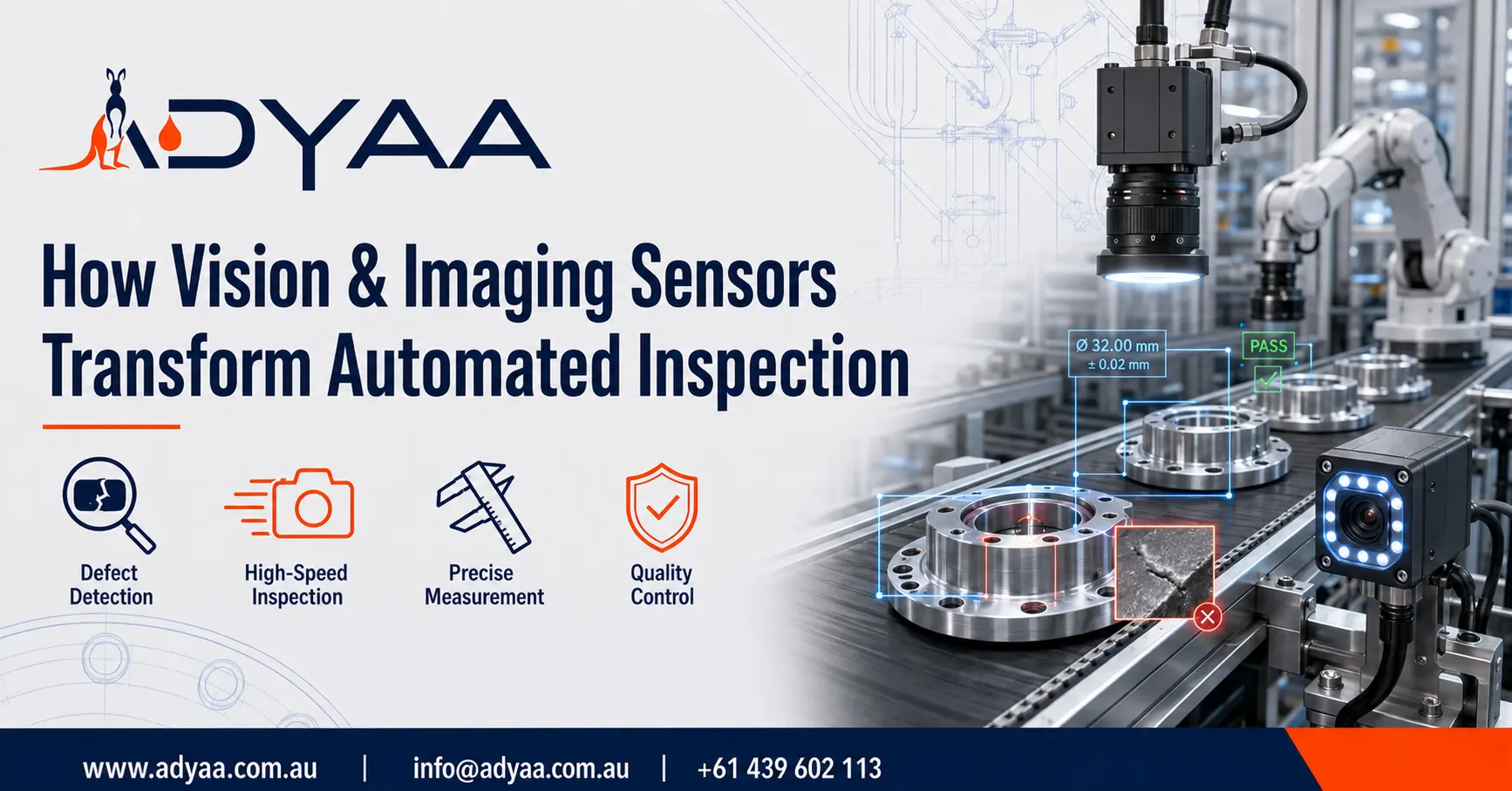
In the high-speed world of modern manufacturing, zero-defect production is no longer just a goal; it is an expectation. Relying on manual inspection or basic photoelectric sensors to catch flaws on a fast-moving conveyor belt is a recipe for bottlenecks, missed defects, and costly recalls.
The manufacturing landscape is undergoing a significant shift, driven by the adoption of Industry 4.0 technologies. At the forefront of this revolution is the integration of advanced Vision & Imaging Sensors. These are not just cameras; they are the eyes of the intelligent factory, converting visual information into actionable data in milliseconds.
ADYAA sees firsthand how implementing the right vision technology moves a facility from reactive quality sorting to proactive Automated Quality Control. In this blog, we explore how advanced Vision & Imaging Sensors are fundamentally transforming automated inspection systems.
Vision & Imaging Sensors for Manufacturing Engineers, Quality Control Managers, Automation Specialists and Plant Managers.
Beyond the Human Eye: The Power of Machine Vision
Traditional inspection methods rely on human operators, who fatigue over time, or simple sensors that can only detect the presence or absence of an object. Neither is sufficient for today’s complex products and high throughput rates.
Vision & Imaging Sensors provide a quantum leap in capability. By combining sophisticated optics, specialized lighting, and powerful on-board processing (often enhanced by Deep Learning/AI), these systems can analyze texture, shape, color, and dimensions with astonishing accuracy and consistency that human inspectors cannot match.
Key Areas of Transformation in Manufacturing
Incorporating these sensors into your production line doesn’t just improve existing processes; it enables entirely new capabilities in Real-time Inspection.
1. Advanced Defect Detection
Standard sensors might tell you a bottle is on the line. Vision & Imaging Sensors can tell you if the cap is cross-threaded, if the fill level is low by a millimeter, or if there is a microscopic crack in the glass.
Whether it is identifying surface scratches on automotive parts or detecting foreign contaminants in food packaging, these sensors ensure that flawed products are rejected immediately, long before they reach a customer.
2. Precise Non-Contact Metrology (Measurement)
In industries like aerospace and electronics, tolerances are measured in microns. Vision & Imaging Sensors allow for precise, non-contact measurement of critical dimensions during production.
Instead of stopping the line for manual gauging, the vision system measures parts “on the fly,” ensuring adherence to specifications and providing immediate feedback to process controllers if tooling begins to drift out of tolerance.
3. Identification, Verification, and Traceability
Traceability is critical in regulated industries like pharmaceuticals and automotive. Vision systems are essential for reading items that move at high speeds.
They utilize Optical Character Recognition (OCR) and Optical Character Verification (OCV) to read alphanumeric codes, date lots, and barcodes/Data Matrix codes. This ensures that the right label is on the right product and that every item is fully traceable throughout the supply chain.
The Business Impact of Smart Vision
Integrating Vision & Imaging Sensors into your automated inspection systems delivers measurable returns on investment:
- Increased Throughput: Inspections happen at full production speed, eliminating quality control bottlenecks.
- Reduced Waste and Rework: Catching defects early in the process prevents adding value to scrap parts.
- Brand Protection: Ensuring only perfect products leave the facility protects your reputation and avoids costly recalls.
- Data-Driven Insights: These sensors don’t just reject bad parts; they provide data on why parts are failing, allowing engineers to optimize upstream processes.
Conclusion: Seeing the Future of Quality with ADYAA
The transition from manual checking to intelligent, automated inspection is essential for staying competitive. However, selecting the right lighting, optics, and sensor resolution for your specific application can be complex.
At ADYAA, we help navigate the complexities of industrial automation. We can help you determine how best to deploy Vision & Imaging Sensors to solve your toughest quality challenges, ensuring your production line is faster, smarter, and visibly better.
Ready to transform your quality control process? 👉 Explore ADYAA’s Automation & Sensor Solutions 📞 Contact our engineering team to discuss your vision application.