
Gaskets vs O-Rings: Which Sealing Solution Is Right for You?
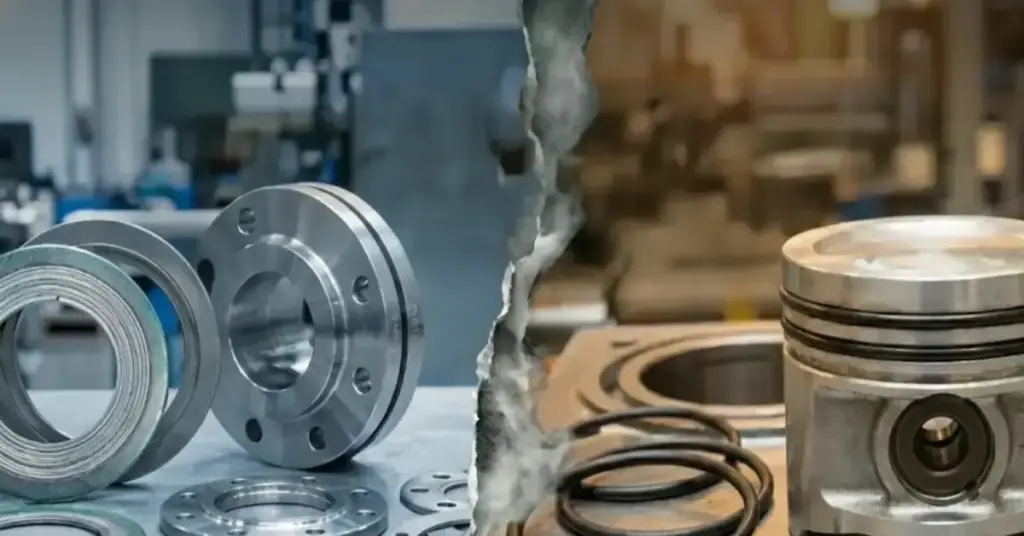
Gaskets vs O-Rings: Which Sealing Solution Is Right for You? In any fluid handling system, the weakest point is always the connection. Whether you are bolting two pipe flanges together or sealing a moving piston, you need a barrier that prevents leaks. This brings us to the most common question in industrial sealing: what is the difference between Gaskets vs O-Rings? While both devices serve the same ultimate purpose—keeping fluids in and contaminants out they function differently and are designed for distinct environments. ADYAA, supply both high-performance gaskets and precision O-rings. In this guide, we break down the battle of Gaskets vs O-Rings to help you select the right solution for your application. Gaskets vs O-Rings for: Mechanical Engineers, Maintenance Technicians, Procurement Officers. 1. What Is a Gasket? (The Static Specialist) A gasket is a flat seal designed to fill the space between two mating surfaces, typically held together by bolts. Function: It creates a seal by being compressed between two stationary parts (like pipe flanges). Common Types: Spiral Wound Gaskets, Ring Type Joints (RTJ), and cut sheet gaskets. Best For: Static applications where the two surfaces do not move relative to each other. 2. What Is an O-Ring? (The Versatile Performer) An O-ring is a loop of elastomer (rubber) or metal with a round cross-section. It sits inside a designated groove and is compressed to create a seal. Function: It can seal against high pressure in both static (stationary) and dynamic (moving) applications. Common Types: NBR, Viton, EPDM, and Metal O-Rings. Best For: Hydraulic cylinders, pump shafts, and precise static grooves. The Key Differences: Gaskets vs O-Rings When deciding between Gaskets vs O-Rings, the choice usually comes down to three factors: Motion, Pressure, and Flange Design. A. Static vs. Dynamic Motion This is the biggest differentiator. Gaskets are almost exclusively used for static seals. If the two surfaces move or vibrate significantly, a standard gasket may tear or lose compression. O-Rings excel in dynamic seals. If you have a piston moving inside a cylinder or a rotating shaft, an O-ring (or dynamic seal) is required because it can handle the friction and motion. B. Pressure Handling In the comparison of Gaskets vs O-Rings, gaskets often win in heavy industrial piping. Gaskets (specifically RTJs): Designed for extreme pressure (up to 20,000 PSI). The harder you bolt the flange, the tighter the seal. O-Rings: Can handle high pressure, but they require backup rings to prevent “extrusion” (where the rubber is blown out of the gap). C. Surface Requirements Gaskets are forgiving. They can seal rougher, uneven flange surfaces because the gasket material deforms to fill the imperfections. O-Rings require precision. The groove must be machined to exact tolerances. If the surface is rough, the O-ring will suffer from abrasion and leak. Selection Guide: Which Should You Choose? To settle the Gaskets vs O-Rings debate for your specific project, ask these questions: Is there movement? Yes (Shafts, Pistons) – Choose an O-Ring. No (Pipe Flanges, Valve Bonnets) – Choose a Gasket. What is the connection type? Flat Flanges – Gasket (Spiral Wound or RTJ). Grooved Housing – O-Ring. What is the Temperature? Extreme Heat (>500°C)? $rightarrow$ You need a Metal RTJ Gasket or a Metal O-Ring (Elastomers will melt). Conclusion Ultimately, the choice of Gaskets vs O-Rings isn’t about which is “better”—it is about which fits the geometry of your equipment. If you are sealing a heavy-duty pipe flange in an oil refinery, you need an ADYAA Ring Type Joint. If you are sealing a hydraulic actuator, you need an ADYAA O-Ring. We stock both, ensuring you never have to compromise on seal quality. Need help specifying the right seal? Explore Our Gaskets & O-Rings Collection Contact our technical team for advice. How Industrial Automation Sensors Improve Automation & Efficiency in Manufacturing How Industrial Automation Sensors Improve Automation & Efficiency in Manufacturing In modern manufacturing, efficiency, accuracy, and reliability are more important… Read More → How Vision & Imaging Sensors Transform Automated Inspection Systems How Vision & Imaging Sensors Transform Automated Inspection Systems Maintaining product quality while keeping up with high-speed production is crucial…. Read More → IoT and Automation in Industrial Operations: Boost Efficiency, Safety, and Reliability IoT and Automation in Industrial Operations: Boost Efficiency, Safety, and Reliability Discover how IoT and automation revolutionize industrial operations. Improve… Read More →