
Choosing Gasket Materials for Chemical Resistance
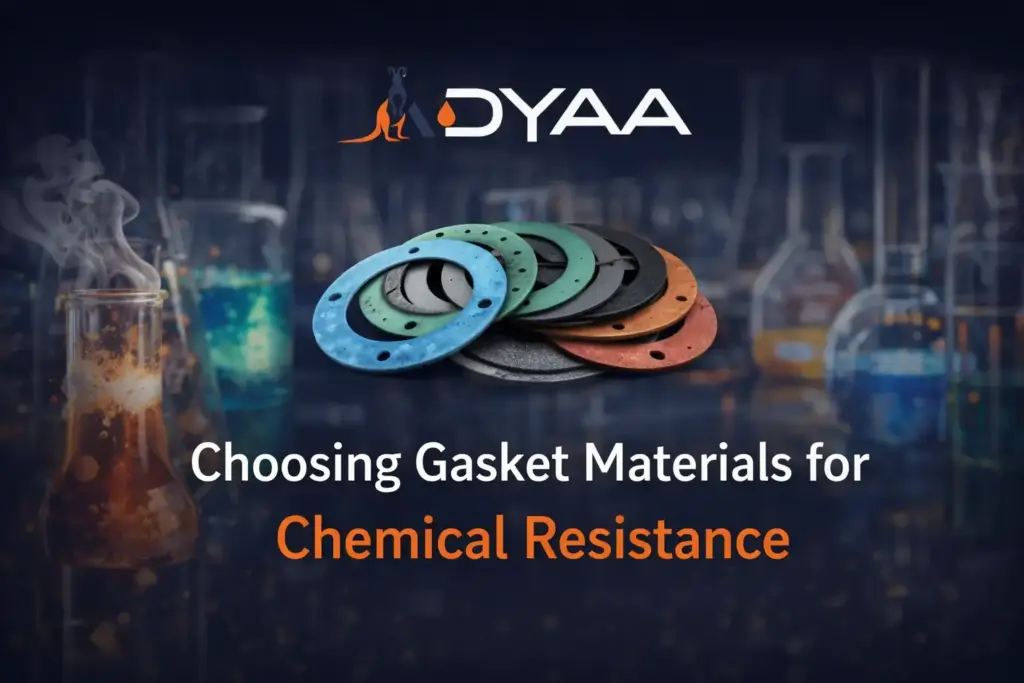
Choosing Gasket Materials for Chemical Resistance When processing volatile chemicals, your flange connections are only as secure as the gaskets sealing them. Installing the wrong elastomer in an aggressive fluid system guarantees a blowout, toxic leaks, and costly plant shutdowns. Choosing gasket materials for chemical resistance requires matching the material to specific media, temperature, and pressure. You cannot rely on guesswork. As we highlighted previously when discussing how Industrial Sealing Systems Prevent Leakage Failures, the material must physically withstand the operating environment without degrading. Always check a chemical compatibility chart to ensure the material resists degradation. Here is a breakdown of the top materials and how to select the right one for your Australian facility. Top Chemical-Resistant Gasket Materials Engineers rely on specific compounds to handle different fluid types. For accurately choosing gasket materials for chemical resistance, you must understand the strengths and limits of these core options: PTFE (Polytetrafluoroethylene): The universal choice for maximum chemical resistance, handling aggressive acids, bases, and solvents. FKM / Viton®: Ideal for high-temperature, aggressive chemical environments, oils, hydrocarbons, and fuels. EPDM: Best for water-based, steam, weak acids, and alkaline environments; excellent weather/UV resistance. Graphite: Excellent for high-temperature, high-pressure steam and hydrocarbons, though limited against strong oxidizers. Nitrile (NBR / Buna-N): Suitable for oil, fuels, and grease at lower temperatures. Neoprene: Good all-purpose elastomer for moderate chemical resistance, including mild acids and oils. Compressed Non-Asbestos Fiber (CNAF): Versatile, cost-effective for general industrial applications. Key Selection Factors You cannot select a gasket based on fluid type alone. Choosing gasket materials for chemical resistance means evaluating the entire operating condition of the flange. Review these four critical factors before installation: Chemical Compatibility: Does the fluid break down the material? Temperature Ranges: EPDM works up to ~150°C, Nitrile up to ~121°C, while PTFE/Graphite handle much higher temperatures. Pressure & Concentration: Higher pressures and stronger concentrations require more robust, specialized materials. Application Type: Consider if it is for chemical processing (PTFE), water treatment (EPDM), or oil/gas (Viton). Real-World Example: Acid Transfer Lines Imagine an industrial plant pumping highly concentrated sulfuric acid. If maintenance installs a standard Nitrile gasket, the acid will rapidly dissolve the rubber. This leads to an immediate loss of containment. By properly choosing gasket materials for chemical resistance and installing a PTFE gasket instead, the plant ensures the seal remains completely inert to the acid, maintaining total safety and operational uptime. People Also Ask (FAQs) Q: Which gasket material has the highest chemical resistance? A: PTFE (Teflon) offers the broadest and highest level of chemical resistance across aggressive acids, bases, and solvents. Q: Can I use EPDM for oil pipelines? A: No. EPDM breaks down when exposed to hydrocarbons and oils. FKM (Viton) or Nitrile are the correct choices for oil and fuel applications. Q: What is the best gasket for high-pressure steam? A: Graphite is the superior choice for high-temperature and high-pressure steam applications, as elastomers will degrade under extreme thermal stress. The Bottom Line Preventing hazardous leaks requires precision. Properly choosing gasket materials for chemical resistance protects your workforce, prevents environmental contamination, and saves your facility from expensive emergency repairs. Always evaluate the specific fluid concentration, operating temperature, and system pressure before specifying a seal. Upgrade Your Flange Safety with ADYAA Are you unsure which gasket material your specific chemical application requires? Don’t risk a blowout with incompatible seals. Contact the ADYAA Engineering Team today for expert selection and supply of high-performance gaskets across Australia. Burst Pressure Selection for Rupture Disc Safety – Copy Choosing Gasket Materials for Chemical Resistance When processing volatile chemicals, your flange connections are only as secure as the gaskets… Read More → Burst Pressure Selection for Rupture Disc Safety Burst Pressure Selection for Rupture Disc Safety When a pressurized system experiences an unexpected spike, your safety devices need to… Read More → When to Replace Rupture Discs in Pressure Equipment: A Maintenance Guide When to Replace Rupture Discs in Pressure Equipment: A Maintenance Guide In the world of pressure safety, the rupture disc… Read More →
When to Replace Rupture Discs in Pressure Equipment: A Maintenance Guide
When to Replace Rupture Discs in Pressure Equipment: A Maintenance Guide In the world of pressure safety, the rupture disc is a “silent guardian.” It sits quietly in the pipework, waiting for the one bad day when pressure spikes dangerously high. Because it doesn’t move or chatter like a valve, it is easy to forget. However, forgetting this critical device is a dangerous gamble. Unlike a valve that can be tested and put back, a rupture disc has a finite lifespan. It suffers from fatigue, corrosion, and physical damage just like any other component. Knowing When to Replace Rupture Discs is the key to preventing two major headaches: nuisance bursts (which stop production) and failure to open (which risks an explosion). 1. After Any Overpressure Event This is the golden rule: If a disc bursts, it must be replaced. But you must also check the discs that didn’t burst. If your system experienced a pressure spike that came close to the burst pressure (e.g., within 95% of the limit) but didn’t quite pop the disc, the metal membrane may still be stressed. The crystalline structure of the metal can stretch and weaken. If you leave it in service, it will likely fail prematurely later on during normal operation. 2. During Scheduled Maintenance (The “Best Before” Date) Rupture discs are not permanent fixtures. Manufacturers provide a recommended service life based on the material and the design. Standard Practice: Many plants proactively replace discs every 12 to 24 months during major shutdowns. Why? The cost of a new disc is tiny compared to the cost of an unscheduled plant shutdown caused by an old, fatigued disc bursting on a Tuesday afternoon. 3. If You See Corrosion or Pitting Visual inspection is your best friend. During a shutdown, if you inspect the disc and see: Pitting: Small holes or rough spots on the surface. Discoloration: Signs of chemical attack. Buildup: Product caking on the face of the disc. Then it is time to replace it immediately. Even microscopic corrosion thins the metal, which lowers the burst pressure.A disc designed for 100 PSI may fail at 80 PSI if corrosion has reduced its thickness by 20%. 4. After Installation Errors (The “Torque Trap”) This is a common, silent killer of discs. If a technician installs a disc, torques the flange bolts, and then realizes they need to loosen them to adjust alignment, the disc is ruined. Once a metal disc has been compressed (bited) into the holder, loosening and re-tightening creates stress fractures and potential leak paths. If a disc is ever removed or loosened for any reason, the rule on When to Replace Rupture Discs is simple: throw it away and install a fresh one. 5. When Process Conditions Change Did you increase the operating temperature of the vessel? Did you switch from a static load to a pulsating pump? Temperature: Burst pressure drops as temperature rises. A disc that was safe at 50°C might be dangerously weak at 150°C. Cycling: Rapid pressure cycling (pulsation) fatigues metal quickly. If you change the process to a high-cycling application, you may need to switch to a specialized “reverse buckling” disc designed to handle fatigue, rather than just replacing the old one with the same model. Bottom Line A rupture disc is a precision instrument, not a simple piece of metal. It is calibrated to save lives. Determining when to Replace Rupture Discs shouldn’t be a guessing game. It should be a scheduled part of your asset integrity program. Replacing a disc a month early costs a few dollars; replacing it one second too late costs everything. Is your plant due for a safety review? Stop relying on potentially fatigued equipment. Let our team help you establish a reliable replacement schedule. Contact ADYAA Pressure Safety Team Get advice on disc lifecycles and preventative maintenance. When to Replace Rupture Discs in Pressure Equipment: A Maintenance Guide When to Replace Rupture Discs in Pressure Equipment: A Maintenance Guide In the world of pressure safety, the rupture disc… Read More → Flange Sealing Solutions for High-Pressure Pipes: Zero Leakage Strategies Flange Sealing Solutions for High-Pressure Pipes: Zero Leakage Strategies In high-pressure industrial environments, the weakest link is rarely the pipe… Read More → How to Select Pressure Relief Valves for Industrial Plants How to Select Pressure Relief Valves for Industrial Plants If a pump fails, production stops. If a control valve fails,… Read More →