When to Replace Rupture Discs in Pressure Equipment: A Maintenance Guide
When to Replace Rupture Discs in Pressure Equipment: A Maintenance Guide In the world of pressure safety, the rupture disc...
Read More →

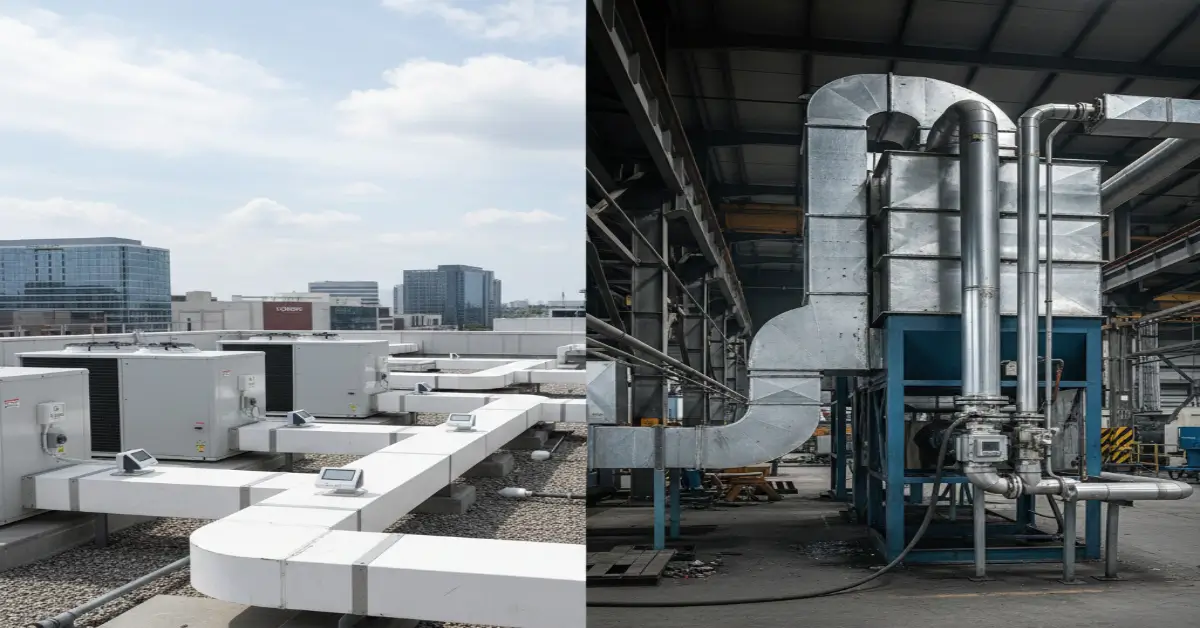
If you walk onto the roof of a shopping mall and then walk into a pharmaceutical manufacturing plant, you might see large metal boxes blowing air in both places. But make no mistake: that is where the similarities end.
The debate of Industrial HVAC vs Commercial HVAC isn’t just about size; it’s about purpose.
One system is designed to keep people comfortable while they shop. The other is designed to keep a critical production line from shutting down or a warehouse from spoiling millions of dollars in inventory.
Mistaking one for the other is a costly error. We have seen industrial facilities try to cut costs by installing commercial-grade units, only to face constant breakdowns, humidity spikes, and compliance failures.
ADYAA, we provide the high-precision sensors that drive these systems. In this guide, we break down the critical differences between Industrial HVAC vs Commercial HVAC so you can make the right investment for your facility
Commercial HVAC systems are found in office buildings, retail stores, schools, and hospitals.
The Goal: Keep human beings comfortable. The Standard: Maintain a temperature around 21°C–23°C and reasonable humidity.
These systems are generally standardized. Whether it’s a split system or a rooftop package unit (RTU), they operate intermittently. They might run hard during the day but dial back or shut off at night when the building is empty.
Industrial HVAC systems are found in manufacturing plants, data centers, food processing facilities, and chemical refineries.
The Goal: Maintain precise environmental conditions for equipment or products. The Standard: It varies wildly. A data center might need massive cooling capacity. A paper mill might need strict humidity control to prevent paper curl. A cleanroom needs heavy filtration (HEPA) to remove particles.
These systems are heavily customized. They often run 24/7, 365 days a year. If an industrial HVAC unit fails, production stops.
To the untrained eye, the equipment looks similar. But for an engineer, the differences are massive.
Because Industrial HVAC is about precision, the system is useless without accurate data. You can have a million-dollar chiller, but if the sensor feeding it data is drifting, the system fails.
ADYAA supplies, we specialize in the “eyes and ears” of these systems:
When evaluating Industrial HVAC vs Commercial HVAC, don’t just look at the price tag.
If you are running a warehouse, a manufacturing line, or a critical infrastructure site, a commercial unit is a band-aid solution that will eventually peel off. You need equipment built for the load, and you need sensors that tell you the truth about your environment.
Is your facility monitoring its environment correctly?