When to Replace Rupture Discs in Pressure Equipment: A Maintenance Guide
When to Replace Rupture Discs in Pressure Equipment: A Maintenance Guide In the world of pressure safety, the rupture disc...
Read More →

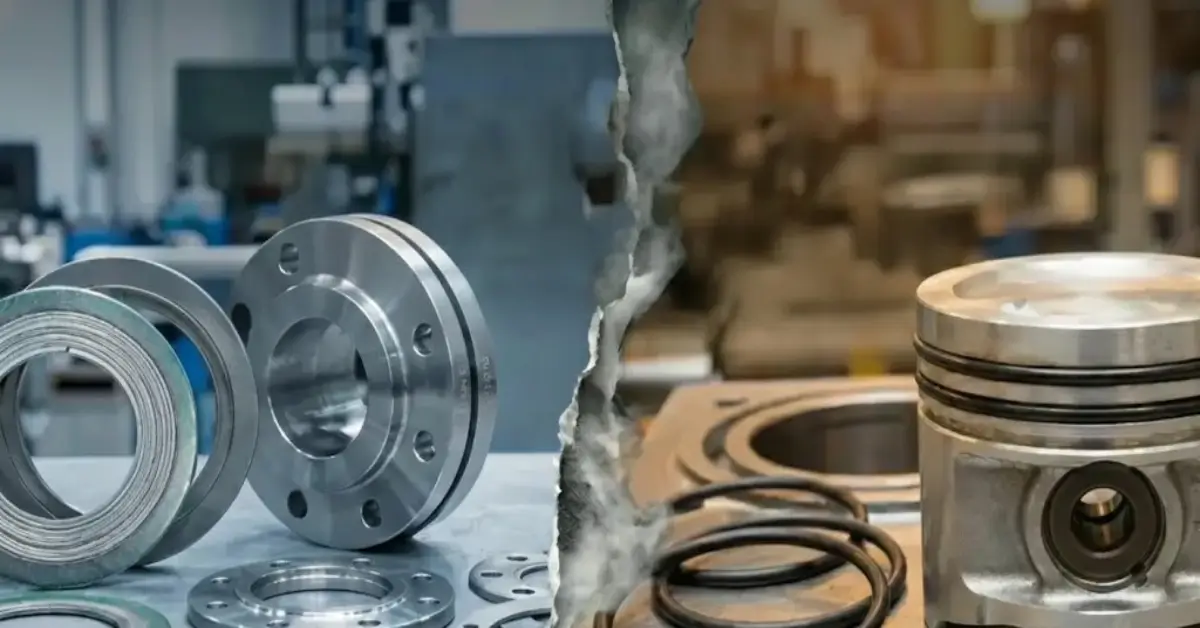
In any fluid handling system, the weakest point is always the connection. Whether you are bolting two pipe flanges together or sealing a moving piston, you need a barrier that prevents leaks. This brings us to the most common question in industrial sealing: what is the difference between Gaskets vs O-Rings?
While both devices serve the same ultimate purpose—keeping fluids in and contaminants out they function differently and are designed for distinct environments.
ADYAA, supply both high-performance gaskets and precision O-rings. In this guide, we break down the battle of Gaskets vs O-Rings to help you select the right solution for your application.
Gaskets vs O-Rings for: Mechanical Engineers, Maintenance Technicians, Procurement Officers.
A gasket is a flat seal designed to fill the space between two mating surfaces, typically held together by bolts.
An O-ring is a loop of elastomer (rubber) or metal with a round cross-section. It sits inside a designated groove and is compressed to create a seal.
When deciding between Gaskets vs O-Rings, the choice usually comes down to three factors: Motion, Pressure, and Flange Design.
This is the biggest differentiator.
In the comparison of Gaskets vs O-Rings, gaskets often win in heavy industrial piping.
To settle the Gaskets vs O-Rings debate for your specific project, ask these questions:
Ultimately, the choice of Gaskets vs O-Rings isn’t about which is “better”—it is about which fits the geometry of your equipment.
If you are sealing a heavy-duty pipe flange in an oil refinery, you need an ADYAA Ring Type Joint. If you are sealing a hydraulic actuator, you need an ADYAA O-Ring. We stock both, ensuring you never have to compromise on seal quality.
Need help specifying the right seal?
Explore Our Gaskets & O-Rings Collection
Contact our technical team for advice.