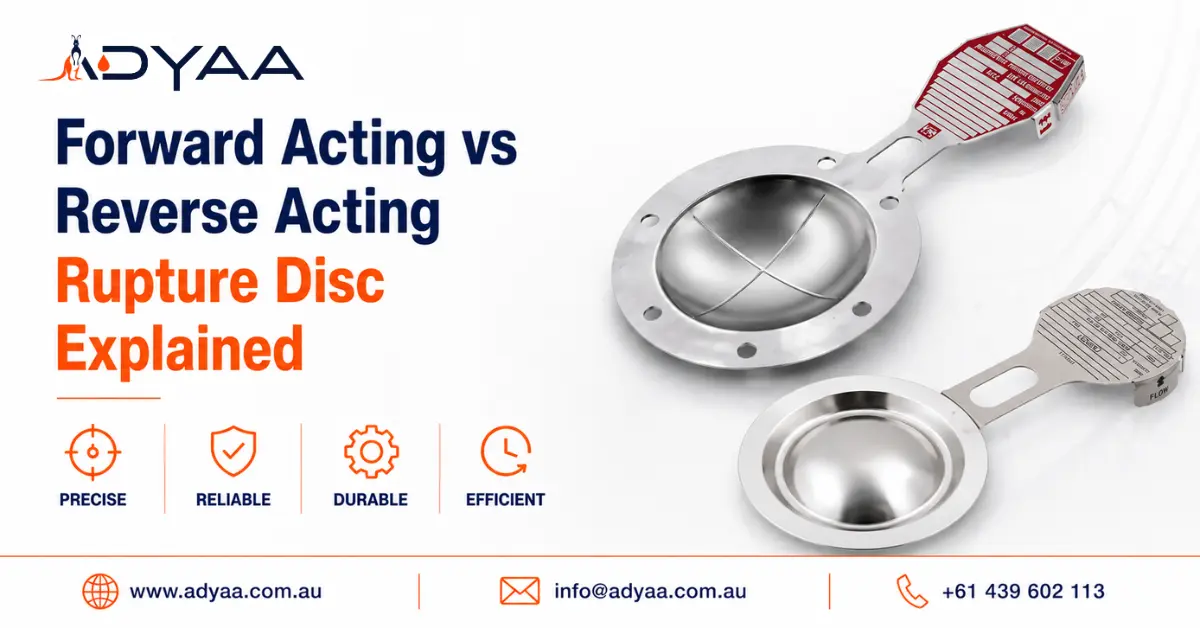
Selecting the wrong Rupture Disc can affect equipment safety, process reliability and maintenance costs. Although both Forward Acting and Reverse Acting Rupture Discs are designed to protect pressure systems from overpressure, they operate differently and are suited to different industrial applications.
The right choice depends on operating pressure, process conditions, cycling frequency and the type of media flowing through the system. Understanding these differences makes it easier to choose a solution that delivers reliable protection and longer service life.
What Is a Rupture Disc?
A Rupture Disc is a non-reclosing pressure relief device designed to burst at a predetermined pressure, protecting vessels, pipelines and process equipment from excessive pressure.
Unlike relief valves, rupture discs respond almost instantly and provide full-bore pressure relief when activated.
They are commonly installed in:
- Pressure vessels
- Chemical reactors
- Storage tanks
- Heat exchangers
- Pipelines
- Process equipment
What Is a Forward Acting Rupture Disc?
A Forward Acting Rupture Disc is installed so that process pressure causes the disc to stretch outward. As pressure increases to the rated burst pressure, the disc fails in tension and ruptures, relieving excess pressure.
How It Works
- Process pressure pushes against the disc.
- The disc stretches under tensile stress.
- When the burst pressure is reached, the disc tears open.
Best Suited For
- Moderate pressure applications
- Stable operating conditions
- General industrial processes
- Standard pressure protection
Advantages
- Simple construction
- Cost-effective solution
- Reliable burst performance
- Widely used across industries
What Is a Reverse Acting Rupture Disc?
A Reverse Acting Rupture Disc is installed so that process pressure causes the disc to buckle inward. When the burst pressure is reached, the disc reverses its shape (buckles) and then opens along a scored pattern.
How It Works
- Process pressure compresses the disc.
- The disc buckles at a predetermined pressure.
- The disc then opens along precision score lines.
Best Suited For
- High operating pressures
- Pressure cycling applications
- Pulsating process conditions
- Critical industrial systems
Advantages
- Longer service life
- Excellent fatigue resistance
- Higher operating ratios
- Improved durability
Forward Acting vs Reverse Acting Rupture Disc
Feature | Forward Acting | Reverse Acting |
Installation Concept | Pressure stretches the disc | Pressure compresses the disc |
Failure Mode | Tension rupture | Buckling then rupture |
Pressure Cycling | Moderate | Excellent |
Operating Ratio | Lower | Higher |
Service Life | Standard | Longer |
Best Applications | General process protection | High-cycle critical applications |
Neither design is universally better. The correct selection depends on your process requirements.
Which Industries Use Each Type?
Chemical Processing
Both designs are widely used depending on operating pressure and process conditions.
Oil & Gas
Reverse acting rupture discs are often selected for demanding pressure cycling applications.
Pharmaceutical Manufacturing
Forward acting rupture discs are commonly used where clean process protection is required.
Food & Beverage
Pressure protection supports hygienic processing equipment.
Power Generation
Protect boilers, pressure vessels and heat exchangers.
General Manufacturing
Provide reliable overpressure protection across industrial production systems.
Common Mistakes When Selecting a Rupture Disc
Avoid these common issues:
- Selecting based only on burst pressure
- Ignoring operating pressure ratio
- Overlooking pressure cycling
- Choosing incompatible materials
- Ignoring temperature effects
- Installing the disc incorrectly
These mistakes can shorten service life and reduce pressure protection reliability.
How Do You Choose the Right Rupture Disc?
Before selecting a Pressure Relief Device, consider:
- Operating pressure
- Burst pressure
- Process temperature
- Pressure cycling frequency
- Process media
- Corrosion resistance
- Installation orientation
- Industry standards and compliance requirements
Considering these factors helps improve equipment protection and long-term reliability.
Frequently Asked Questions
Which rupture disc lasts longer?
In applications with frequent pressure cycling, Reverse Acting Rupture Discs generally offer longer service life.
Which rupture disc is better?
Neither is universally better. The correct choice depends on the application’s pressure, temperature and operating conditions.
Can rupture discs replace pressure relief valves?
Some applications use rupture discs independently, while others combine them with relief valves for additional protection.
What industries commonly use rupture discs?
Chemical processing, oil & gas, pharmaceuticals, food processing, power generation and manufacturing.
Why is correct rupture disc selection important?
Proper selection improves equipment safety, reduces downtime and provides reliable overpressure protection.
Final Thoughts
Choosing between a Forward Acting vs Reverse Acting Rupture Disc depends on your operating conditions rather than the product alone. Understanding pressure cycling, burst pressure and process requirements helps improve safety, equipment protection and long-term reliability.
If you’re selecting Rupture Discs, Pressure Relief Devices or complete Industrial Safety Solutions, ADYAA supplies reliable products designed to support demanding industrial applications across Australia.