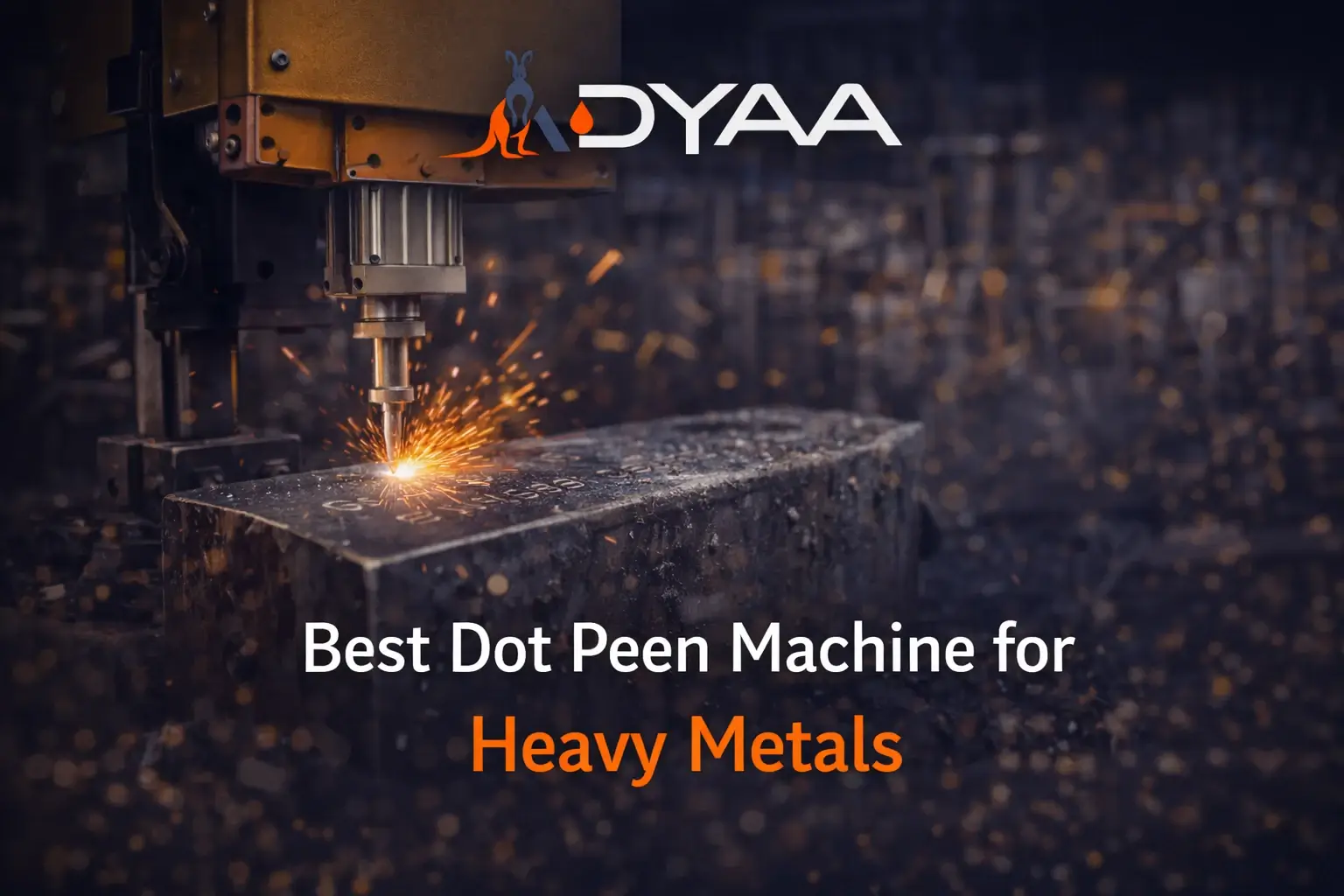
The best dot peen machine for heavy metals depends entirely on your required marking depth and facility setup. For extreme depth on hard steel that must survive sandblasting and galvanization, a pneumatic dot peen marking machine is the absolute best choice. If you require high-precision marking, portability, and do not have access to a compressed air line, an electromagnetic dot peen marking machine is the superior option.
As a premier supplier in Australia, ADYAA distributes both specialized dot peen marking machines and laser marking machines to ensure heavy industries achieve permanent, compliant part traceability.
Here is a comprehensive engineering breakdown to help you select the exact right system for your heavy metal applications.
Quick Comparison: Pneumatic vs. Electromagnetic Dot Peen
Feature | Pneumatic Dot Peen Machine | Electromagnetic Dot Peen Machine |
Power Source | Compressed Air + Electricity | Electricity Only (Plug & Play or Battery) |
Marking Depth | Extreme (Up to 1.0mm+ on steel) | Moderate to Deep (Up to 0.5mm) |
Best Substrate | Cast iron, structural steel, alloys | Aluminum, mild steel, hard plastics |
Post-Processing | Survives heavy paint & galvanizing | Survives light to medium coatings |
Portability | Limited (tethered to air lines) | High (Battery-powered handhelds available) |
What Is a dot peen marking machine?
A dot peen marking machine is a heavy-duty industrial traceability tool that uses a pneumatically or electrically driven carbide (or diamond-tipped) stylus to strike a material’s surface. Operating at high frequencies, the stylus creates overlapping micro-indentations (dots) to form permanent serial numbers, alphanumeric text, logos, and 2D Data Matrix codes. Because it physically displaces the metal rather than burning it, dot peen is widely considered the most rugged marking technology available for heavy industry.
Benefits of a Quality dot peen marking machine
Integrating a premium dot peen system into your production line offers distinct advantages over other marking methods:
- Unmatched Mark Survivability: The deep physical indentations remain perfectly readable even after harsh post-processing treatments like hot-dip galvanizing, sandblasting, and thick powder coating.
- Cold Marking Process: Unlike lasers, dot peen is a mechanical, non-thermal process. It does not introduce heat into the substrate, meaning it will not alter the metallurgical properties or warp the metal.
- Cost-Effective Operations: These machines do not require expensive inks, solvents, or high power consumption. The only consumable is the rugged metal stylus, which has an incredibly long operational lifespan.
Why Heavy Metals Require Dot Peen Technology
Heavy industrial manufacturing—such as mining equipment fabrication, oil & gas pipeline construction, and structural steel manufacturing—presents unique traceability challenges.
While a laser marking machine is incredibly fast and perfect for high-contrast barcodes, the mark it leaves is typically a surface-level oxidation. When heavy metals undergo harsh post-processing environments, surface marks are instantly destroyed.
The best dot peen machine solves this by physically driving the stylus into the metal. Because the metal is physically displaced, the mark remains perfectly legible even after decades of outdoor corrosion in the harsh Australian outback.
Types of Dot Peen Machines Distributed in Australia
To ensure your production line operates without bottlenecks, you must select the correct form factor for your specific workflow. ADYAA supplies three primary configurations of the best dot peen machine technologies across Australia.
1. Column-Mounted (Benchtop) Dot Peen Machines
These are stationary units bolted to a workbench on the factory floor.
- How They Work: The operator brings the metal component to the machine. A motorized Z-axis column lowers the marking head precisely onto the part.
- Best Application: High-volume batch marking of smaller, maneuverable heavy metal components like engine valves, gears, metal tags, and machined pipe fittings.
2. Portable Handheld Dot Peen Machines
For heavy industry, bringing the part to the machine is often impossible.
- How They Work: These lightweight, pistol-grip units are carried directly to the asset. Operators simply press the marking window against the metal and pull the trigger.
- Best Application: Marking massive structural I-beams, oversized oil flanges, heavy casting molds, and automotive chassis (VIN marking).
3. Integrated (Custom) Dot Peen Systems
These are headless marking units designed to be bolted directly into an automated production line or robotic cell.
- How They Work: Controlled entirely by the plant’s central PLC, these units automatically stamp parts as they move down a conveyor belt.
- Best Application: 24/7 automated automotive manufacturing and high-throughput metal fabrication.
How to Choose the Best dot peen marking machine
Choosing the right machine requires aligning your facility’s infrastructure with your specific traceability goals. As a leading supplier, ADYAA recommends evaluating your plant’s air supply, the size of your parts, and the hardness of your metal.
Core Specifications to Look For
1. Stylus Hardness (Rockwell Hardness – HRC)
The stylus is the only consumable in a dot peen system. If you are marking hardened tool steel or titanium (up to 62 HRC), you must ensure the machine is equipped with a high-grade tungsten carbide or custom diamond-tipped stylus to prevent rapid wear.
2. X/Y Axis Window Size
The marking window dictates the maximum size of the text or logo you can print in a single operation. A standard window is 100mm x 50mm, but heavy pipe fabricators often require larger 150mm x 100mm windows to fit multi-line specifications and API logos.
3. Software Connectivity
A modern dot peen marking machine is useless if it cannot communicate with your database. The best systems feature built-in Wi-Fi, Ethernet, and RS232 ports, allowing them to pull serial numbers directly from your ERP system, eliminating the risk of operators typing the wrong ID.
Common Mistakes When Buying a Dot Peen Marking Machine
Investing in heavy-duty marking equipment without expert guidance can lead to costly workflow bottlenecks. Here are common errors and how ADYAA resolves them:
1. Buying an Electromagnetic Machine for Deep Galvanizing
- The Mistake: Purchasing an electric machine to mark steel pipes that will later be heavily hot-dip galvanized. The shallow mark fills with zinc and becomes invisible.
- The Solution: ADYAA supplies high-pressure Pneumatic Dot Peen systems specifically designed to gouge deep enough into heavy steel to survive the thickest industrial coatings.
2. Limiting Mobility for Large Assets
- The Mistake: Buying a heavy, tethered benchtop marker for a facility that primarily manufactures massive, immobile structural beams.
- The Solution: ADYAA distributes fully wireless, battery-operated Handheld Dot Peen Machines that operators can carry directly to the asset, whether in the staging yard or out on a remote mining site.
3. Ignoring Substrate Hardness Limits
- The Mistake: Trying to mark extreme aerospace alloys with a standard industrial stylus, causing the pin to shatter or wear out after just a few hours.
- The Solution: We provide advanced material testing to match the exact tungsten carbide density required to strike hardened metals safely and consistently.
FAQ – Dot Peen Marking Machine
Q: Does a dot peen machine require an air compressor?
A: Pneumatic models require a clean, compressed air line to achieve maximum marking depth. Electromagnetic models run purely on electricity and do not need compressed air.
Q: Can a dot peen machine mark curved surfaces like pipes?
A: Yes, many dot peen systems can accommodate uneven or cylindrical surfaces. For continuous pipe marking, specialized rotary axis attachments are available.
Q: How deep can these machines actually mark?
A: Depending on the air pressure, stylus type, and metal hardness, a high-quality pneumatic dot peen machine can mark well over 1.0mm deep into heavy steel.
Bottom Line:
Sourcing industrial equipment requires a partner who understands the rigorous demands of local heavy industry. As a leading supplier, ADYAA distributes premium dot peen marking machines and laser marking machines engineered for extreme durability.
Whether your facility is located in the rugged mining sectors of Western Australia or the manufacturing hubs of Sydney, we provide the localized support, on-site setup, and technical calibration required to secure your traceability processes.
Consult with ADYAA Marking Experts Today.