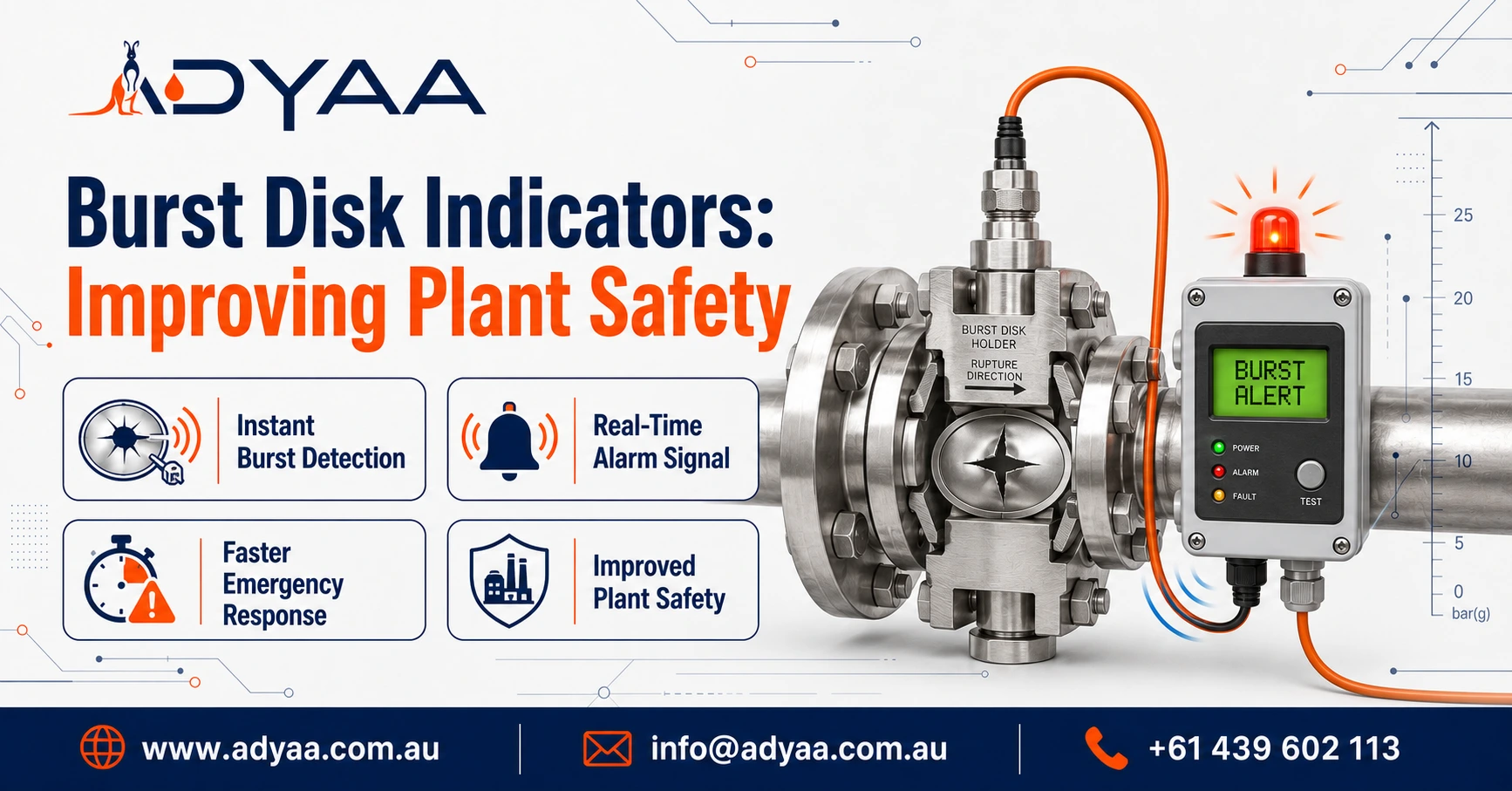
A rupture disc provides reliable protection against overpressure, but once it bursts, operators need to know immediately. A Burst Disk Indicator continuously monitors the condition of a rupture disc and instantly signals when the disc has activated. This allows maintenance teams to respond quickly, minimise downtime and restore normal operations as soon as possible.
From chemical processing plants to power generation facilities, burst disk indicators improve process visibility while supporting safer and more efficient industrial operations.
What Is a Burst Disk Indicator?
A Burst Disk Indicator is an electronic monitoring device used with a rupture disc to detect when the disc has burst.
During normal operation, the monitoring circuit remains intact. When the rupture disc activates because of an overpressure event, the electrical circuit changes state, sending an alarm or signal to the plant’s control system.
This immediate notification helps operators identify pressure events without manually inspecting the rupture disc.
Why Burst Disk Indicators Matter
Adding a burst disk indicator improves both plant safety and operational efficiency.
Immediate Burst Detection
Receive instant notification when a rupture disc activates.
Reduce Downtime
Allow maintenance teams to respond quickly after a pressure event.
Improve Plant Safety
Reduce the time equipment operates after rupture disc activation.
Support Remote Monitoring
Transmit alarm signals directly to PLC and SCADA systems.
Improve Maintenance Planning
Identify activated rupture discs without manual inspections.
Increase Operational Reliability
Provide continuous monitoring of pressure protection devices.
How a Burst Disk Indicator Works
Burst disk indicators continuously monitor the rupture disc during operation.
- The rupture disc remains intact during normal operating conditions.
- The burst disk indicator monitors the electrical circuit.
- An overpressure event causes the rupture disc to burst.
- The monitoring circuit changes state.
- An alarm is sent to the control room, PLC or SCADA system.
- Maintenance personnel replace the rupture disc and restore the system.
This simple monitoring method improves response times following overpressure events.
Types of Burst Disk Indicators
Different monitoring solutions are available depending on plant requirements.
Electrical Burst Disk Indicators
Monitor the rupture disc using electrical continuity.
Intrinsically Safe Indicators
Designed for hazardous area applications where explosion protection is required.
PLC Integrated Indicators
Provide direct communication with industrial automation systems.
Remote Monitoring Indicators
Allow operators to monitor rupture disc status from central control rooms.
Visual Indicator Systems
Provide local visual confirmation after rupture disc activation.
Smart Monitoring Systems
Support advanced diagnostics and integration with modern industrial networks.
Burst Disk Indicator Comparison
Type | Best For | Typical Application |
Electrical | General Industry | Manufacturing |
Intrinsically Safe | Hazardous Areas | Oil & Gas |
PLC Integrated | Automation | Process Plants |
Remote Monitoring | Central Control | Large Facilities |
Visual Indicator | Local Monitoring | Storage Tanks |
Smart System | Industry 4.0 | Advanced Manufacturing |
Where Burst Disk Indicators Are Used
Burst disk indicators are widely used wherever rupture discs protect critical equipment.
Oil & Gas
Monitor rupture discs installed on pressure vessels and process equipment.
Chemical Processing
Provide immediate notification following pressure relief events.
Petrochemical
Support continuous monitoring of pressure protection systems.
Pharmaceutical
Monitor sterile process equipment while maintaining system integrity.
Food & Beverage
Support pressure protection in hygienic production systems.
Power Generation
Monitor boilers, steam systems and pressure vessels.
Water & Wastewater
Protect chemical dosing and pressurised treatment systems.
Manufacturing
Improve equipment monitoring and maintenance response times.
Burst Disk Indicator Selection Checklist
Before selecting a burst disk indicator, consider:
✔ Rupture disc type
✔ Electrical compatibility
✔ Control system integration
✔ Hazardous area requirements
✔ Operating temperature
✔ Environmental conditions
✔ Alarm requirements
✔ Cable routing
✔ Maintenance accessibility
✔ Industry standards
Choosing the correct monitoring system improves safety and operational reliability.
Common Mistakes When Selecting Burst Disk Indicators
Common issues include:
- Selecting an incompatible indicator
- Ignoring hazardous area approvals
- Incorrect wiring
- Poor installation practices
- Failing to test alarm systems
- Delaying replacement after activation
- Not integrating with plant monitoring systems
A properly designed monitoring system helps avoid these problems.
Why Burst Detection Matters
A rupture disc performs its job only once before it must be replaced. Without a burst disk indicator, operators may not immediately know that the disc has activated.
Continuous monitoring helps reduce production delays, improve maintenance response times and ensure pressure protection systems are restored as quickly as possible.
Why Choose ADYAA?
ADYAA supplies pressure protection and monitoring solutions for industries across Australia.
Complete Pressure Protection Portfolio
Rupture Discs, Safety Valves, Tank Protection Systems and monitoring accessories.
Technical Expertise
Support in selecting compatible rupture disc monitoring solutions.
Reliable Industrial Products
Designed for demanding industrial operating environments.
Automation Ready
Compatible with PLC, SCADA and industrial control systems.
Australia-wide Support
Reliable technical assistance across Australia.
Long-Term Reliability
Helping industries improve pressure protection, monitoring and operational safety.
Frequently Asked Questions
What is a Burst Disk Indicator?
A Burst Disk Indicator monitors a rupture disc and sends an alarm when the disc bursts during an overpressure event.
Does a Burst Disk Indicator prevent overpressure?
No. The rupture disc provides pressure protection, while the burst disk indicator detects when the rupture disc has activated.
Can Burst Disk Indicators connect to PLC systems?
Yes. Many models integrate directly with PLC, SCADA and other industrial automation systems.
Where are Burst Disk Indicators commonly used?
Oil & Gas, Chemical Processing, Pharmaceutical, Food & Beverage, Manufacturing, Power Generation and Water Treatment industries.
Do Burst Disk Indicators require maintenance?
Routine inspection and functional testing help ensure reliable operation.
How do I choose the right Burst Disk Indicator?
Selection depends on the rupture disc type, control system, operating environment, hazardous area requirements and monitoring needs.
A Burst Disk Indicator improves the effectiveness of rupture disc systems by providing immediate notification when pressure relief occurs. Fast detection allows maintenance teams to restore equipment quickly, helping minimise downtime and maintain safe industrial operations.
ADYAA supplies burst disk indicators, rupture discs and complete pressure protection solutions for industries across Australia, helping businesses improve safety, monitoring and operational reliability.
Need help selecting the right Burst Disk Indicator?
Our specialists can help you choose a compatible monitoring solution for your rupture disc and pressure protection system.