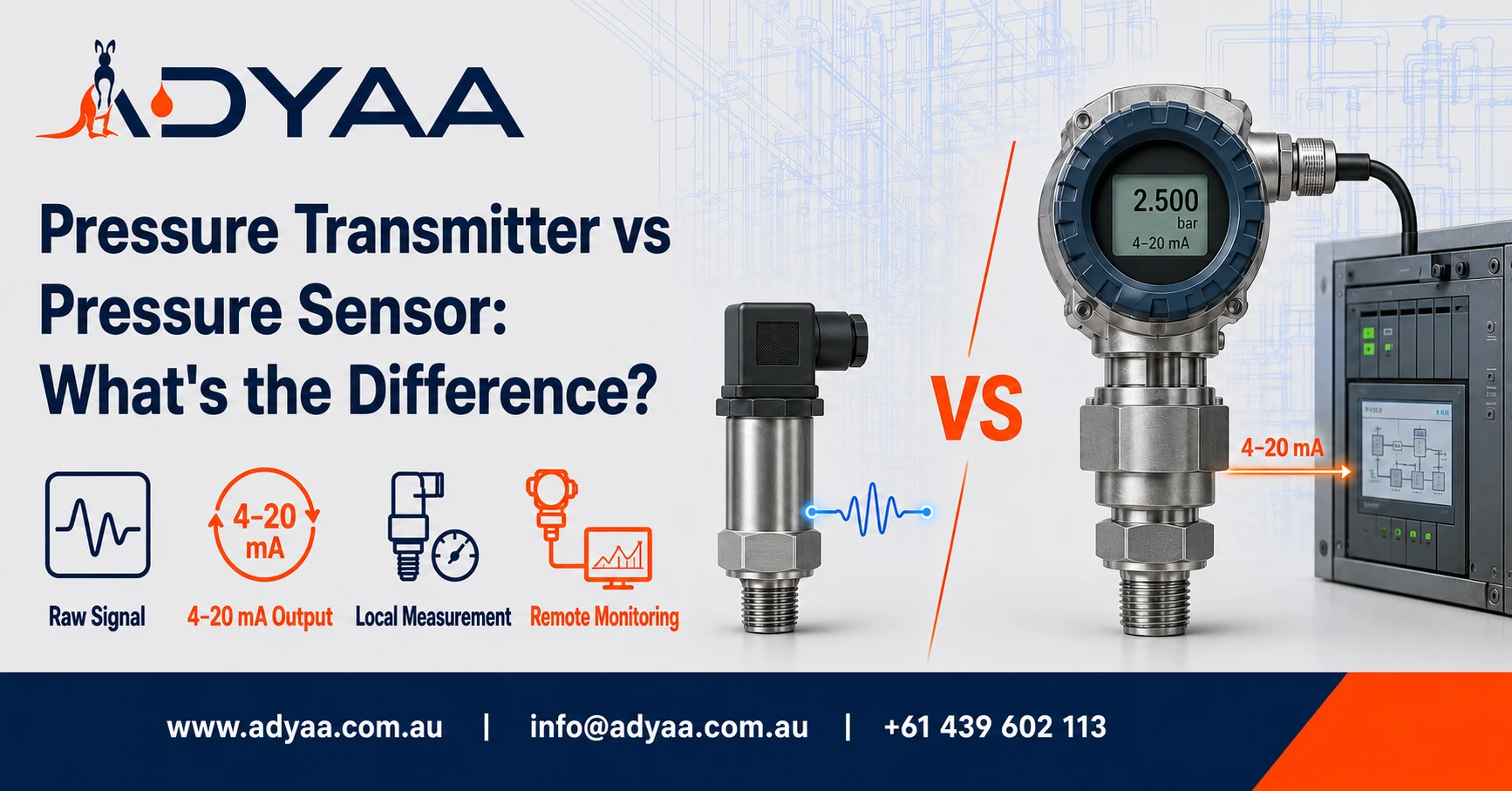
Pressure measurement is critical in industrial automation, manufacturing and process control. While the terms pressure transmitter and pressure sensor are often used interchangeably, they are not the same. Understanding the differences helps engineers, maintenance teams and procurement professionals choose the right device for accurate and reliable pressure monitoring.
This guide explains how each device works, their key differences and where they are commonly used.
What Is a Pressure Sensor?
A pressure sensor is a device that detects pressure and converts it into an electrical signal.
It measures the force exerted by gases or liquids and produces an output that represents the measured pressure. The raw signal generated by a pressure sensor is often processed by external electronics before it can be used by monitoring or control systems.
Pressure sensors are the sensing element found inside many pressure measurement devices.
Common Pressure Sensor Technologies
- Piezoresistive Sensors
- Capacitive Sensors
- Strain Gauge Sensors
- Ceramic Sensors
- Thin Film Sensors
- MEMS Pressure Sensors
What Is a Pressure Transmitter?
A pressure transmitter is a complete industrial instrument that includes a pressure sensor along with built-in signal conditioning and electronics.
It measures pressure, processes the signal and transmits a standard industrial output such as:
- 4–20 mA
- 0–10 V
- HART Communication
- Modbus
- IO-Link
Pressure transmitters are designed for direct integration with PLC, SCADA and Distributed Control Systems (DCS).
Key Differences Between a Pressure Transmitter and a Pressure Sensor
Although both devices measure pressure, they serve different purposes.
Measurement Function
A pressure sensor detects pressure and generates a raw electrical signal.
A pressure transmitter measures pressure and converts it into a standardised output suitable for industrial control systems.
Signal Output
Pressure sensors typically produce low-level electrical signals that require additional processing.
Pressure transmitters provide ready-to-use industrial communication signals.
Electronics
Pressure sensors contain only the sensing element.
Pressure transmitters include built-in electronics for signal conditioning, amplification and communication.
Installation
Pressure sensors are commonly integrated into OEM equipment or custom systems.
Pressure transmitters are designed for direct installation in industrial plants.
Industrial Applications
Pressure sensors are commonly used in electronic devices and embedded systems.
Pressure transmitters are widely used in manufacturing, water treatment, chemical processing, mining and oil & gas industries.
Pressure Transmitter vs Pressure Sensor Comparison
Feature | Pressure Sensor | Pressure Transmitter |
Primary Function | Detect Pressure | Measure & Transmit Pressure |
Output | Raw Electrical Signal | 4–20 mA, HART, Modbus, IO-Link |
Signal Conditioning | External | Built-In |
Industrial Integration | Limited | Direct PLC/SCADA Integration |
Installation | OEM Equipment | Industrial Process Plants |
Typical Cost | Lower | Higher |
Best For | Embedded Systems | Continuous Industrial Monitoring |
Advantages of Pressure Sensors
Pressure sensors are suitable for applications where additional electronics already exist.
Compact Design
Ideal for space-constrained equipment.
Lower Cost
Suitable for high-volume OEM applications.
Fast Response
Quickly detect pressure changes.
Flexible Integration
Can be incorporated into custom electronic systems.
Low Power Consumption
Suitable for battery-powered devices.
Wide Range of Technologies
Available in various sensing technologies for different applications.
Advantages of Pressure Transmitters
Pressure transmitters are designed for industrial environments.
Ready for Automation
Connect directly to PLC, SCADA and DCS systems.
High Measurement Accuracy
Provide stable and reliable pressure readings.
Robust Construction
Designed for harsh industrial environments.
Long Cable Runs
Standard output signals minimise electrical noise over long distances.
Easy Installation
Simple integration into existing industrial processes.
Advanced Diagnostics
Many models include self-monitoring and diagnostic capabilities.
Where Are They Used?
Manufacturing
Monitor hydraulic, pneumatic and process systems.
Oil & Gas
Measure pressure in pipelines, separators and processing equipment.
Chemical Processing
Control pressure in reactors, tanks and pipelines.
Water & Wastewater
Monitor pumps, filtration systems and distribution networks.
Food & Beverage
Maintain consistent process pressure during production.
Pharmaceutical
Support precise manufacturing processes.
Mining
Monitor slurry pipelines and hydraulic systems.
Power Generation
Measure steam, boiler and cooling system pressures.
Selection Checklist
Before choosing a pressure measurement device, consider:
✔ Measurement accuracy
✔ Pressure range
✔ Process media
✔ Operating temperature
✔ Pressure connection
✔ Output signal
✔ Communication protocol
✔ Environmental conditions
✔ Industry standards
✔ Future maintenance requirements
Selecting the correct device improves reliability, efficiency and long-term performance.
Common Mistakes When Choosing Pressure Measurement Devices
Avoid these common mistakes:
- Confusing sensors with transmitters
- Choosing the wrong pressure range
- Ignoring output signal compatibility
- Incorrect material selection
- Overlooking environmental conditions
- Poor installation practices
- Delaying calibration and maintenance
A proper application assessment helps prevent measurement errors and unnecessary downtime.
Why Choosing the Right Device Matters
Selecting the correct pressure measurement solution helps improve process reliability, measurement accuracy and operational efficiency.
While pressure sensors are ideal for embedded and OEM applications, pressure transmitters provide complete industrial measurement solutions that integrate seamlessly with automation systems.
Understanding the application requirements ensures the most appropriate technology is selected.
Why Choose ADYAA?
ADYAA supplies industrial pressure measurement solutions for businesses across Australia.
Comprehensive Pressure Instrumentation
Pressure Transmitters, Pressure Gauges, Pressure Switches and Pressure Accessories.
Technical Expertise
Support in selecting the right pressure measurement technology.
Reliable Industrial Products
Solutions designed for demanding industrial environments.
Automation Compatible
Products ready for PLC, SCADA and DCS integration.
Australia-wide Support
Technical assistance for customers across Australia.
Long-Term Performance
Helping industries improve process reliability through accurate pressure measurement.
Frequently Asked Questions
What is the difference between a pressure transmitter and a pressure sensor?
A pressure sensor detects pressure and produces a raw electrical signal, while a pressure transmitter processes that signal and provides a standard industrial output for control systems.
Which is better for industrial automation?
Pressure transmitters are generally preferred because they integrate directly with PLC, SCADA and DCS platforms.
Can a pressure transmitter work without a pressure sensor?
No. Every pressure transmitter contains a pressure sensor as its primary sensing element.
Where are pressure sensors commonly used?
Pressure sensors are often used in OEM equipment, automotive systems, medical devices and embedded electronics.
Do pressure transmitters require calibration?
Routine calibration and inspection help maintain measurement accuracy and long-term reliability.
How do I choose between a pressure sensor and a pressure transmitter?
Choose a pressure sensor for custom electronic designs and embedded applications. Select a pressure transmitter when you need a complete industrial measurement solution with standard output signals.
Choosing between a Pressure Transmitter vs Pressure Sensor depends on your application, system architecture and measurement requirements. Pressure sensors provide the sensing element for custom designs, while pressure transmitters deliver complete, industrial-ready solutions for reliable monitoring and process control.
ADYAA offers a wide range of pressure transmitters and industrial instrumentation solutions across Australia, helping businesses select the right technology for accurate, dependable and efficient pressure measurement.
Need help choosing the right pressure measurement solution?
Our specialists can help you select the most suitable pressure transmitter or pressure sensor for your application.