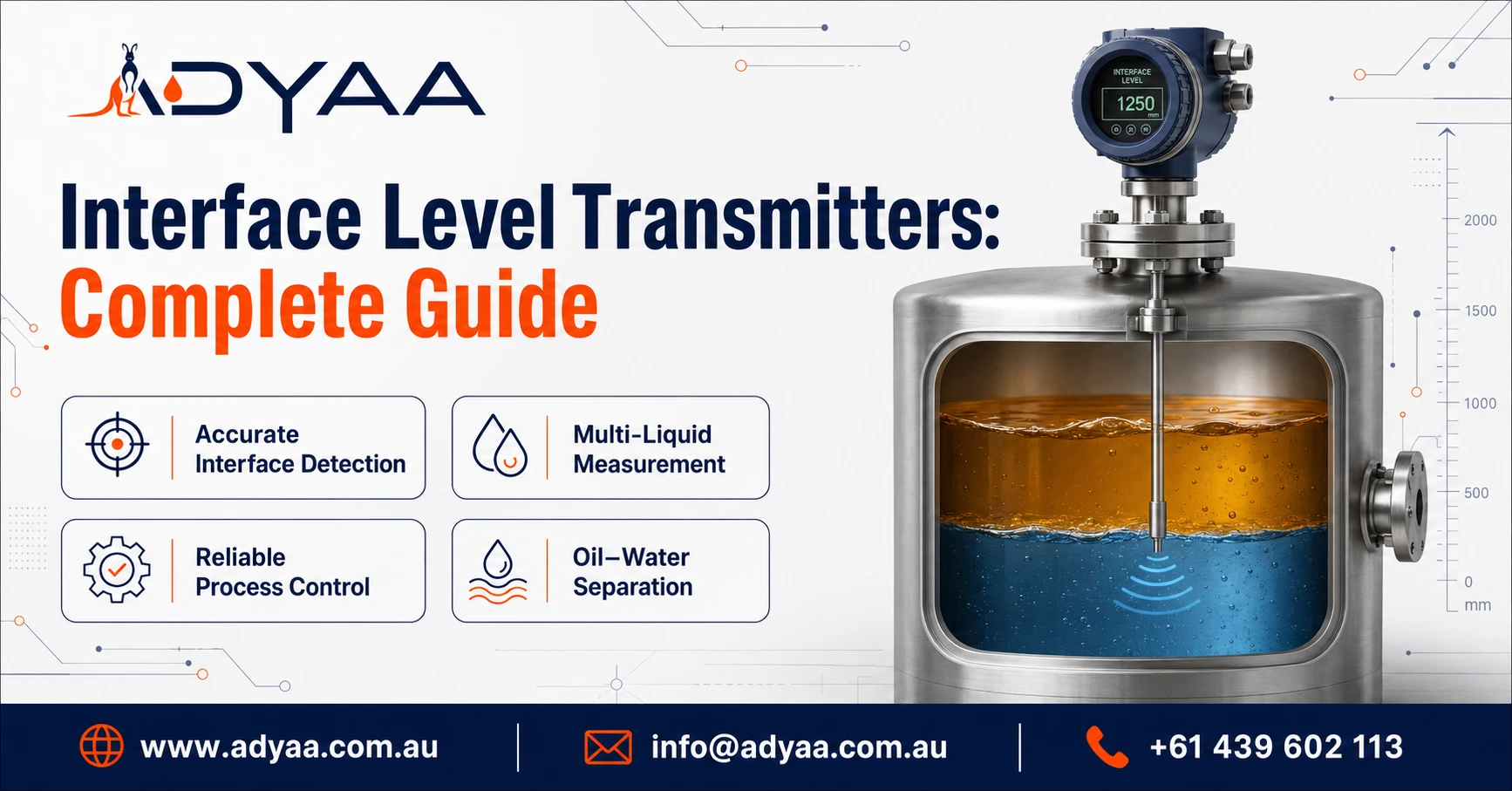
Many industrial processes involve storing or processing two immiscible liquids, such as oil and water. Measuring only the total liquid level is often not enough—the interface between the two liquids also needs to be monitored accurately. An Interface Level Transmitter provides continuous measurement of this boundary, helping industries improve process efficiency, product quality and operational reliability.
From oil refineries to wastewater treatment plants, interface level transmitters play a vital role in maintaining stable and efficient industrial processes.
What Is an Interface Level Transmitter?
An Interface Level Transmitter is an instrument designed to measure the boundary between two liquids with different densities.
Unlike standard level transmitters that measure the overall liquid level, interface level transmitters continuously monitor where one liquid ends and another begins.
Typical examples include:
- Oil and water
- Solvent and water
- Chemical mixtures
- Fuel and water
- Sludge and water
The measured data is transmitted to monitoring or control systems, enabling operators to optimise industrial processes.
Why Interface Level Measurement Matters
Accurate interface measurement improves both process efficiency and product quality.
Improve Product Quality
Maintain proper separation between liquids during processing.
Increase Process Efficiency
Optimise separation processes and reduce material losses.
Reduce Manual Monitoring
Continuous automatic measurement eliminates frequent manual inspections.
Support Automation
Provide reliable level data to PLC and SCADA systems.
Minimise Waste
Prevent product contamination caused by inaccurate interface detection.
Improve Operational Reliability
Enable consistent performance across industrial processes.
How an Interface Level Transmitter Works
Although different technologies are available, the operating principle is generally similar.
- The transmitter continuously monitors the process vessel.
- It detects differences in the physical properties of two liquids.
- The interface position is calculated.
- Measurement data is transmitted to the control system.
- Operators use the information to optimise the separation process.
Continuous monitoring improves accuracy while reducing manual intervention.
Common Technologies Used
Several technologies are used depending on the application.
Guided Wave Radar
Uses microwave pulses to detect both total level and liquid interface with high accuracy.
Radar Level Transmitters
Suitable for challenging process conditions requiring reliable non-contact measurement.
Capacitance Level Measurement
Measures changes in electrical capacitance between different liquids.
Ultrasonic Level Measurement
Suitable for selected interface applications involving relatively stable process conditions.
Differential Pressure Measurement
Uses pressure differences to estimate interface levels in certain tank configurations.
Float-Based Systems
Mechanical solutions for basic interface monitoring in specific applications.
Interface Measurement Technology Comparison
Technology | Best For | Typical Applications |
Guided Wave Radar | High Accuracy | Oil & Gas |
Radar | Non-contact Measurement | Chemical Processing |
Capacitance | Conductive Liquids | Industrial Tanks |
Differential Pressure | Large Vessels | Process Industries |
Ultrasonic | Clean Liquids | Water Treatment |
Float System | Simple Applications | Storage Tanks |
Where Interface Level Transmitters Are Used
Interface measurement is important across many industries.
Oil & Gas
Monitor oil-water separation tanks and storage vessels.
Chemical Processing
Control separation processes involving multiple liquid phases.
Water & Wastewater
Measure sludge blankets and oil-water separators.
Food & Beverage
Support controlled separation processes during production.
Mining
Monitor slurry separation and process tanks.
Power Generation
Measure condensate and water separation systems.
Marine
Monitor ballast and fuel storage tanks.
Pharmaceutical
Maintain accurate liquid separation during specialised manufacturing processes.
Interface Level Transmitter Selection Checklist
Before selecting an interface level transmitter, consider:
✔ Type of liquids
✔ Density difference
✔ Tank geometry
✔ Operating temperature
✔ Operating pressure
✔ Measurement range
✔ Required accuracy
✔ Process connections
✔ Communication protocol
✔ Installation location
Selecting the appropriate technology helps maximise measurement reliability and long-term performance.
Common Mistakes When Selecting Interface Level Transmitters
Common selection mistakes include:
- Choosing the wrong measurement technology
- Ignoring density differences between liquids
- Incorrect probe selection
- Poor installation location
- Overlooking process pressure and temperature
- Ignoring communication requirements
- Delaying calibration and maintenance
Proper application assessment helps ensure accurate and reliable measurements.
Why Accurate Interface Measurement Matters
Accurate interface measurement helps industries improve product recovery, reduce waste and optimise separation processes.
Reliable interface monitoring also supports automation, reduces manual intervention and improves operational efficiency across industrial facilities.
Why Choose ADYAA?
ADYAA supplies advanced level measurement solutions for industrial applications across Australia.
Comprehensive Level Measurement Solutions
Radar, Guided Wave Radar, Ultrasonic, Capacitance and Interface Level Transmitters.
Technical Expertise
Support in selecting the right technology for your application.
Reliable Industrial Products
Solutions designed for demanding industrial environments.
Automation Ready
Compatible with PLC, SCADA and modern process control systems.
Australia-wide Support
Reliable technical assistance across Australia.
Long-Term Performance
Helping industries improve process visibility, efficiency and measurement accuracy.
Frequently Asked Questions
What is an Interface Level Transmitter?
An Interface Level Transmitter measures the boundary between two liquids with different densities inside a vessel or tank.
Where are Interface Level Transmitters used?
They are commonly used in oil & gas, chemical processing, wastewater treatment, mining, food processing and pharmaceutical industries.
Which technology is best for interface measurement?
The most suitable technology depends on the application, but guided wave radar is widely used for accurate interface measurement.
Can an Interface Level Transmitter measure total level as well?
Many guided wave radar transmitters can measure both the total liquid level and the interface level simultaneously.
How do I choose the right Interface Level Transmitter?
Selection depends on liquid properties, tank design, operating conditions, required accuracy and installation requirements.
Do Interface Level Transmitters require maintenance?
Routine inspection and periodic calibration help maintain reliable long-term measurement performance.
Accurate Interface Level Transmitter solutions help industries improve separation efficiency, reduce product losses and maintain consistent process performance. Selecting the right measurement technology ensures reliable operation even in demanding industrial environments.
ADYAA supplies industrial interface level transmitters and advanced level measurement solutions for customers across Australia, helping businesses achieve accurate, reliable and efficient level monitoring.
Need help selecting the right Interface Level Transmitter?
Our specialists can help you choose the most suitable interface level measurement solution for your application.