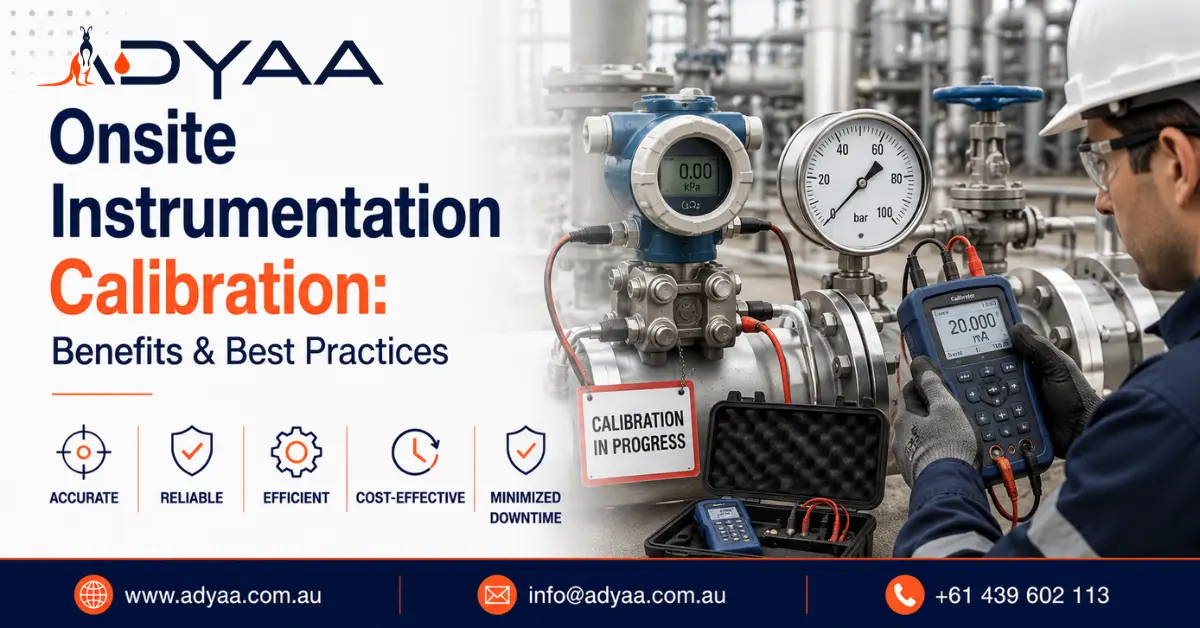
A pressure transmitter reading slightly higher than the actual pressure or a temperature sensor drifting by just a few degrees may seem insignificant. Over time, these small measurement errors can affect product quality, increase energy consumption and even lead to unexpected equipment shutdowns.
This is why Onsite Instrumentation Calibration plays an important role in industrial operations. Instead of removing instruments and sending them to a laboratory, calibration is carried out at the facility, allowing equipment to be verified, adjusted and returned to service with minimal interruption.
For industries where continuous operation matters, onsite calibration helps maintain reliable measurements while reducing production downtime.
What Is Onsite Instrumentation Calibration?
Onsite Instrumentation Calibration is the process of testing, verifying and adjusting industrial instruments at the installation site using certified calibration equipment.
It confirms that an instrument continues to measure within its specified accuracy and performs as expected under actual operating conditions.
Commonly calibrated instruments include:
- Pressure Transmitters
- Pressure Gauges
- Temperature Transmitters
- RTDs and Thermocouples
- Flowmeters
- Level Transmitters
- Analytical Instruments
Regular Instrumentation Calibration helps maintain process consistency and confidence in measurement data.
When Is Onsite Calibration the Better Choice?
While laboratory calibration is suitable for many instruments, onsite calibration is often preferred when removing equipment would interrupt production or require significant maintenance.
It is particularly valuable when:
- Production cannot be stopped for long periods.
- Instruments are installed in difficult-to-access locations.
- Large process plants require multiple instruments to be calibrated.
- Verification is needed immediately after installation or maintenance.
- Shutdown time needs to be minimised.
For example, calibrating several Pressure Transmitters during a planned maintenance shutdown is often more practical than removing each instrument and sending it to a calibration laboratory.
Why Regular Calibration Matters
Accurate measurements support better operational decisions.
Routine Onsite Instrumentation Calibration helps:
- Improve measurement accuracy
- Reduce unexpected process variations
- Support product quality
- Increase equipment reliability
- Minimise unplanned downtime
- Maintain process consistency
In industries with strict quality requirements, regular calibration also helps maintain confidence in production data and inspection records.
Common Mistakes That Affect Calibration Results
Calibration is only effective when it follows the correct procedure.
Some common mistakes include:
- Extending calibration intervals without reviewing instrument performance
- Using uncertified calibration equipment
- Ignoring environmental conditions during testing
- Skipping calibration records
- Reinstalling instruments incorrectly after maintenance
These issues can reduce measurement reliability even if the instrument appears to be functioning normally.
Onsite Calibration vs Laboratory Calibration
Onsite Instrumentation Calibration | Laboratory Calibration |
Performed at the facility | Performed in a calibration laboratory |
Reduces production downtime | Requires instrument removal |
Faster return to operation | Longer turnaround time |
Suitable for installed process instruments | Suitable for standalone instruments requiring detailed testing |
The right approach depends on the application, operational requirements and maintenance strategy.
Industries That Benefit from Onsite Instrumentation Calibration
Water & Wastewater
Maintain accurate monitoring of flow, pressure and level throughout treatment processes.
Chemical Processing
Support reliable process control and consistent product quality.
Food & Beverage
Maintain measurement accuracy across hygienic production systems.
Pharmaceutical Manufacturing
Help ensure precise measurements during regulated production processes.
Oil & Gas
Improve the reliability of pressure, flow and temperature measurements in critical operations.
Power Generation
Support accurate monitoring across boilers, turbines and utility systems.
Manufacturing
Improve process efficiency through dependable measurement performance.
General Process Industries
Reduce downtime while maintaining confidence in measurement accuracy.
Frequently Asked Questions
How often should industrial instruments be calibrated?
Calibration frequency depends on the instrument type, operating conditions, manufacturer recommendations and quality requirements.
Which instruments can be calibrated onsite?
Pressure Transmitters, Pressure Gauges, Temperature Transmitters, Flowmeters, Level Transmitters and many Analytical Instruments can often be calibrated onsite.
Does onsite calibration reduce downtime?
Yes. Since instruments remain at the facility, production interruptions are generally much shorter than laboratory calibration.
Why is calibration important even if an instrument appears to be working?
Instruments can gradually drift over time. Calibration verifies that measurements remain within acceptable accuracy limits.
Can calibration improve product quality?
Yes. Accurate measurement supports better process control, consistent production and reduced process variation.
Final Thoughts
Onsite Instrumentation Calibration helps maintain reliable measurements, minimise downtime and improve process efficiency across industrial operations. Regular calibration ensures your instruments continue to perform accurately, supporting better operational decisions and consistent product quality.
If you’re planning to calibrate Pressure Transmitters, Pressure Gauges, Temperature Transmitters, Flowmeters, Level Instruments or other Industrial Instrumentation, ADYAA provides reliable calibration solutions and industrial instrumentation to help keep your processes running with confidence across Australia.