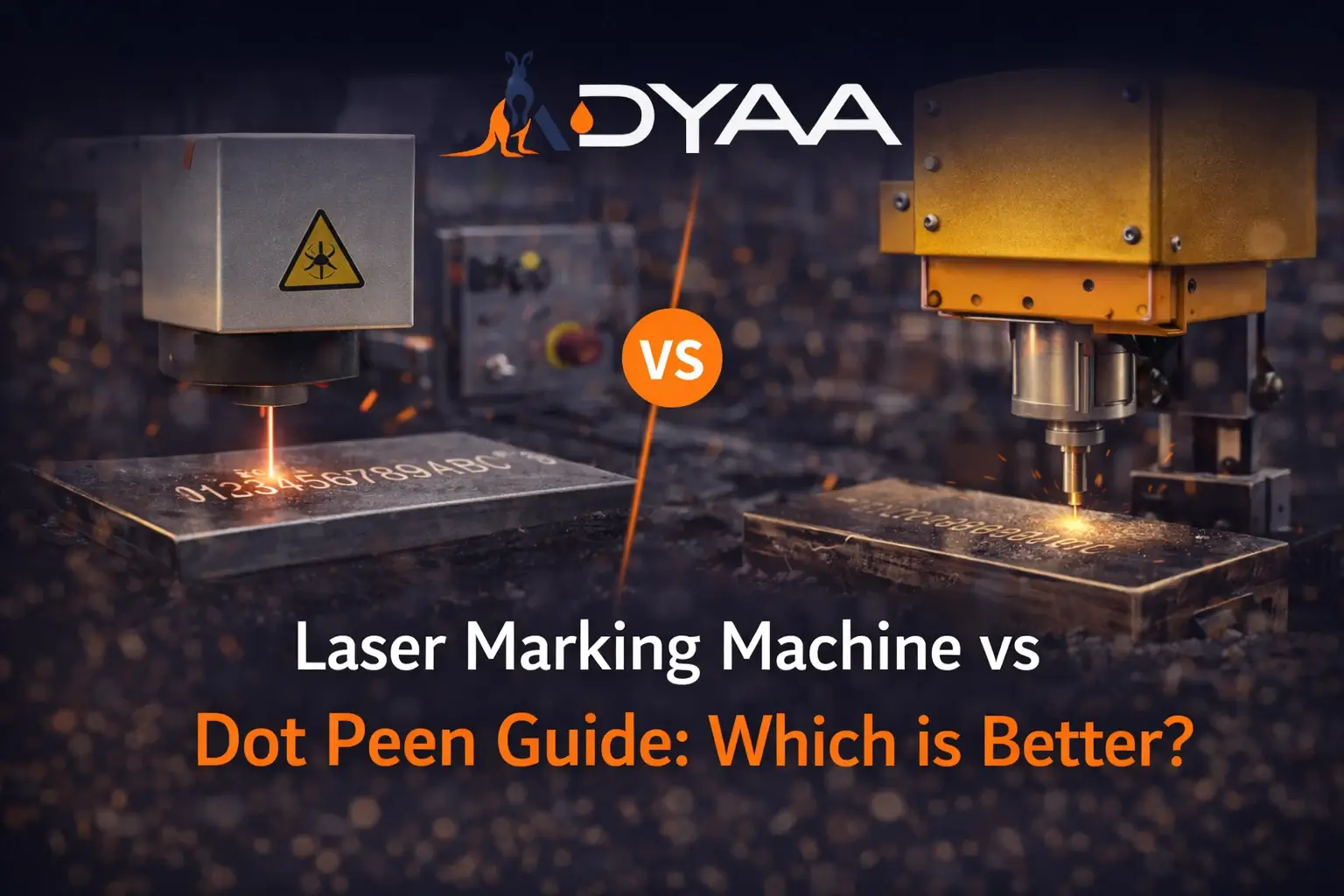
When engineering a traceability process for your facility, the debate between a laser marking machine and a dot peen system comes down to one absolute rule: match the physics of the machine to the realities of your production line. If you need ultra-fast, high-contrast, non-contact precision for barcodes, a laser marking machine is superior. If you are marking heavy cast iron that will be sandblasted and hot-dip galvanized, a dot peen marking machine is the only technology that will survive.
As a leading supplier in Australia, ADYAA distributes both specialized laser marking machines and dot peen marking machines. We do not rely on guesswork; we engineer permanent traceability solutions that guarantee your plant remains compliant with global industrial standards.
Quick Comparison: Laser Marking vs Dot Peen Technologies
Feature | Laser Marking Machine | Dot Peen Marking Machine |
Primary Process | Non-contact thermal oxidation | Mechanical physical impact |
Marking Speed | Extreme (Fractions of a second) | Moderate |
Mark Depth | Surface-level to shallow | Deep (Survives heavy coatings) |
Contrast | High (Perfect for 2D Barcodes) | Low (Matches base material color) |
Consumables | Zero | Carbide Stylus |
What Is a laser marking machine?
A laser marking machine is a high-speed, non-contact industrial system that uses a focused beam of light to alter the surface of a material.
Powered by a high-intensity source (such as a Fiber, UV, or CO2 laser), the machine instantly heats, oxidizes, or vaporizes the substrate to create permanent alphanumeric text, high-density 2D Data Matrix codes, and high-resolution logos.
Because no physical tool ever touches the part, the process causes zero mechanical stress, making it the premier choice for everything from delicate electronics to hardened aerospace alloys.
Benefits of a Quality laser marking machine
Integrating a premium optical marking system into your factory floor completely transforms your traceability speed and accuracy:
- Unmatched Production Speed: Lasers operate at the speed of light. They can etch complex, machine-readable codes in milliseconds, eliminating bottlenecks on high-volume automated lines.
- Maximum Contrast & Readability: The thermal process creates a dark, highly contrasted oxidation layer. This guarantees a 100% first-pass read rate when scanned by automated vision systems and barcode readers.
- Zero Consumables: Unlike inkjet printers that require expensive fluids or dot peen systems that wear out mechanical styluses, a laser marking machine runs purely on electricity, drastically reducing your long-term operational expenditure (OpEx).
The Dot Peen Alternative: When You Need Extreme Depth
While a laser marking machine dominates in speed and contrast, you must understand its limitations. A laser mark is generally a surface-level alteration.
If you are manufacturing structural steel beams, heavy mining equipment, or automotive chassis in Australia, your parts will likely undergo aggressive post-processing—such as sandblasting, heavy powder coating, or galvanization. These processes will completely erase a laser mark. In these harsh environments, a dot peen marking machine is required to gouge deep physical indentations into the metal that remain legible through the thickest industrial coatings.
How to Choose the Best laser marking machine vs Dot Peen
Stop wasting capital on the wrong technology. As a specialist supplier, ADYAA ensures you select the correct system based on strict operational data. Evaluate these critical factors:
- Automated Scanning Requirements: If your supply chain relies on automated optical scanners to read QR codes or Data Matrix codes, you must choose a laser marking machine for its high contrast.
- Post-Marking Surface Treatments: If the part will be painted or galvanized after it is marked, you must choose a dot peen marking machine for its physical depth.
- Material Fragility: If you are marking thin-walled aluminum, medical plastics, or delicate PCB boards, the mechanical impact of a dot peen stylus will shatter or warp the part. A non-contact laser is mandatory.
Common Mistakes When Buying a laser marking machine
Purchasing optical equipment without a technical strategy is a costly rookie mistake. Here are the most common errors and exactly how ADYAA solves them:
1. Buying the Wrong Laser Source for the Material
- The Mistake: Purchasing a standard Fiber laser to mark organic materials like wood or transparent plastics. The light will pass right through or burn the material uncontrollably.
- The Solution: ADYAA provides strict onsite material testing to match the exact wavelength to your substrate—supplying CO2 lasers for organics, UV lasers for cold-marking sensitive plastics, and Fiber lasers for industrial metals.
2. Ignoring Environmental Hazards
- The Mistake: Installing an unprotected open-source laser marking machine in a dusty fabrication shop, leading to ruined optical lenses and severe safety hazards for workers.
- The Solution: ADYAA distributes fully enclosed, Class 1 safety-rated laser workstations equipped with industrial fume extractors to protect your staff and your equipment.
3. Overlooking Deep Coating Requirements
- The Mistake: Buying an expensive laser to mark steel pipes, only to watch the mark disappear completely when the pipe is painted black.
- The Solution: For heavy coatings, we steer our clients away from lasers entirely and supply our high-pressure pneumatic dot peen systems to ensure the ID survives the paint.
FAQ – laser marking machine
Q: Can a laser marking machine cut through metal?
A: No. While they operate on similar principles, a marking laser uses lower wattage (typically 20W to 100W) designed to alter the surface, whereas a cutting laser uses massive wattage (1,000W+) to slice entirely through the material.
Q: Are there safety concerns with laser marking?
A: Yes, direct exposure to a raw laser beam can cause severe eye damage. That is why reputable suppliers ensure all industrial systems are housed in Class 1 safety enclosures with specialized optical viewing glass.
Q: Do I need a computer to run the machine?
A: Most modern systems come with integrated industrial PCs or user-friendly touchscreen controllers loaded with software to easily generate serial numbers, barcodes, and logos.
Conclusion
Do not leave your plant’s traceability to chance. As a dedicated distributor and supplier of industrial equipment, ADYAA provides the most advanced laser marking machines and dot peen marking machines in the country.
From the heavy manufacturing sectors of Sydney to the remote mining operations of Perth, our team provides the exact hardware, software integration, and technical support you need to future-proof your production line. Consult with ADYAA Traceability Experts Today