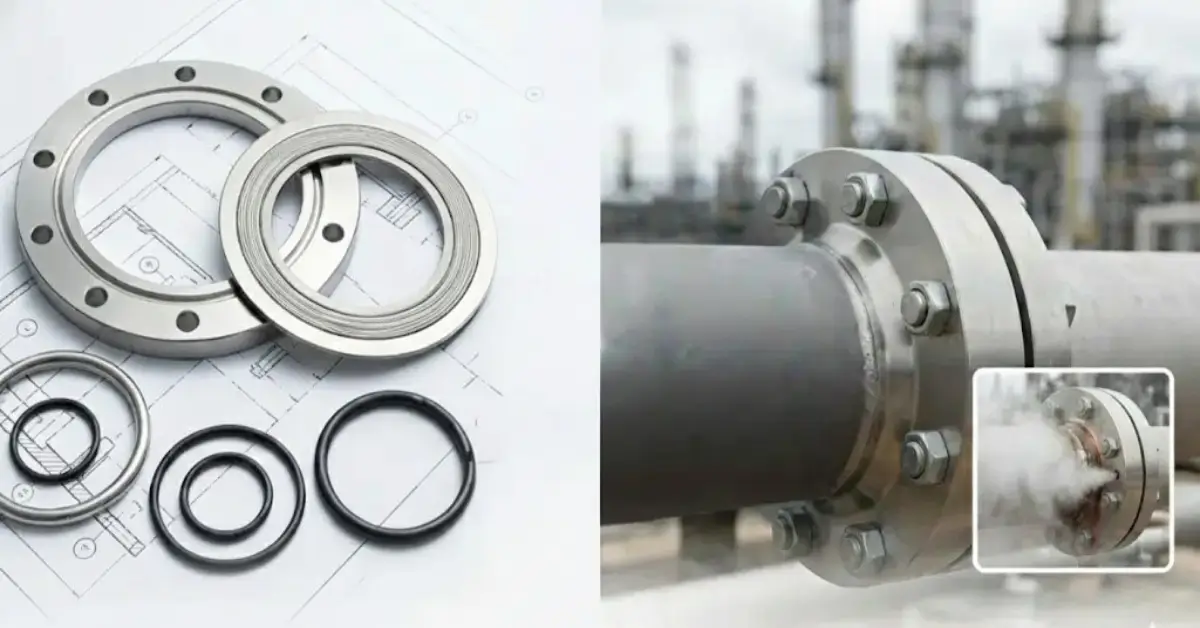
In a massive refinery or a high-pressure mining plant, the most critical component often isn’t the largest pump or the tallest reactor—it’s the smallest seal.
Industrial sealing is the unsung hero of process integrity. Whether it is a Ring Type Joint (RTJ) gasket in an oil pipeline or a simple O-ring in a hydraulic cylinder, seals are the barrier between a safe, efficient operation and a catastrophic failure.
We specialize in high-performance sealing solutions for Australia’s toughest environments. In this guide, we break down what industrial sealing actually is, why it is critical for your bottom line, and the different types you need to know about.
Industrial Sealing Solutions for Maintenance Managers, Process Engineers and Procurement Officers in Oil & Gas/Mining.
What Is Industrial Sealing?
At its core, industrial sealing is the technology used to block the passage of fluids (liquids or gases) through the gap between two joined surfaces.
It serves two primary functions:
- Containment: Keeping the internal media (oil, steam, acid) inside the system.
- Exclusion: Keeping external contaminants (dust, dirt, moisture) outside the system.
While this sounds simple, the challenge lies in the conditions. Industrial seals must maintain this barrier while enduring extreme temperatures (from cryogenic -196°C to scorching +1000°C), massive pressures (up to 20,000 PSI), and aggressive chemical corrosion.
Why Is Industrial Sealing Important?
You might view seals as cheap consumables, but their failure can cost millions. Here is why investing in quality sealing (like ADYAA’s RX Rings or Spiral Wound Gaskets) is non-negotiable.
1. Safety and Hazard Prevention
The most immediate importance of sealing is human safety. In industries like Oil & Gas, a leaking flange isn’t just a mess; it’s a fire hazard or a toxic cloud. Proper sealing ensures that volatile organic compounds (VOCs) and dangerous chemicals stay contained, protecting your workforce from exposure and explosions.
2. Operational Efficiency
A system that leaks pressure is a system that bleeds money.
- Pneumatic systems: Leaking air forces compressors to work harder, driving up electricity bills.
- Hydraulic systems: Fluid loss results in sluggish machinery and reduced force. High-quality seals ensure your equipment runs at peak parameter settings without wasting energy.
3. Environmental Compliance
Australia has strict environmental regulations regarding emissions and ground contamination. A reliable sealing system helps you meet EPA standards by preventing “fugitive emissions”—the slow, invisible leaks of gas from valves and flanges that can lead to heavy fines.
4. Equipment Longevity
Seals act as the first line of defense for your expensive assets. For example, a Spring-Energized Seal or a Polymer Bellow protects internal bearings and shafts from grit and corrosion. If the seal fails, the contaminant enters, and the machine destroys itself from the inside out.
Types of Industrial Sealing Solutions
Not all seals are created equal. Depending on your application, you will generally rely on one of these categories:
A. Static Seals (Gaskets)
These are used between two stationary surfaces, such as pipe flanges.
- RTJ Gaskets (Ring Type Joints): Metal gaskets (Oval, Octagonal, RX, BX) designed for high-pressure/high-temperature applications. They form a metal-to-metal seal ideal for the Oil & Gas industry.
- Spiral Wound Gaskets: A mix of metal winding and soft filler (graphite/PTFE), offering excellent recovery for fluctuating temperatures.
B. Dynamic Seals
These seals are between parts that move relative to each other (like a piston rod or a rotating shaft).
- Spring-Energized Seals: Used when standard elastomers fail. A spring ensures constant contact even when the polymer seal wears down.
- Packing: Soft braided material compressed around a shaft to prevent leakage in pumps and valves.
C. O-Rings
The most common seal type. These donut-shaped loops sit in a groove and compress to block fluid.
- Elastomeric: NBR, Viton, or EPDM for standard uses.
- Metal O-Rings: Used by ADYAA for extreme environments (aerospace, cryogenics) where rubber would melt or shatter.
Summary: Don’t Let a Leak Stop Your Plant
A seal might cost $50, but it protects a $500,000 pump and ensures the safety of everyone on site. Whether you need standard Lens Rings for steam lines or custom CNC-machined sealing components, quality matters.
ADYAA supplies a full range of gaskets, O-rings, and custom seals engineered for the Australian industry.
Need help selecting the right material for your chemical plant? View Our Full Range of Sealing Solutions. Contact our engineers for a consultation.