RTD vs. Thermocouple: Which Sensor is Right for Your Application?
In industrial automation, temperature is not just a number, it’s the heartbeat of your process. Whether you are pasteurizing milk, refining oil, or monitoring exhaust gas, your control system is only as good as the sensor feeding it data.
But when you need to spec a new project, you face the classic engineering debate: RTD vs. Thermocouple.
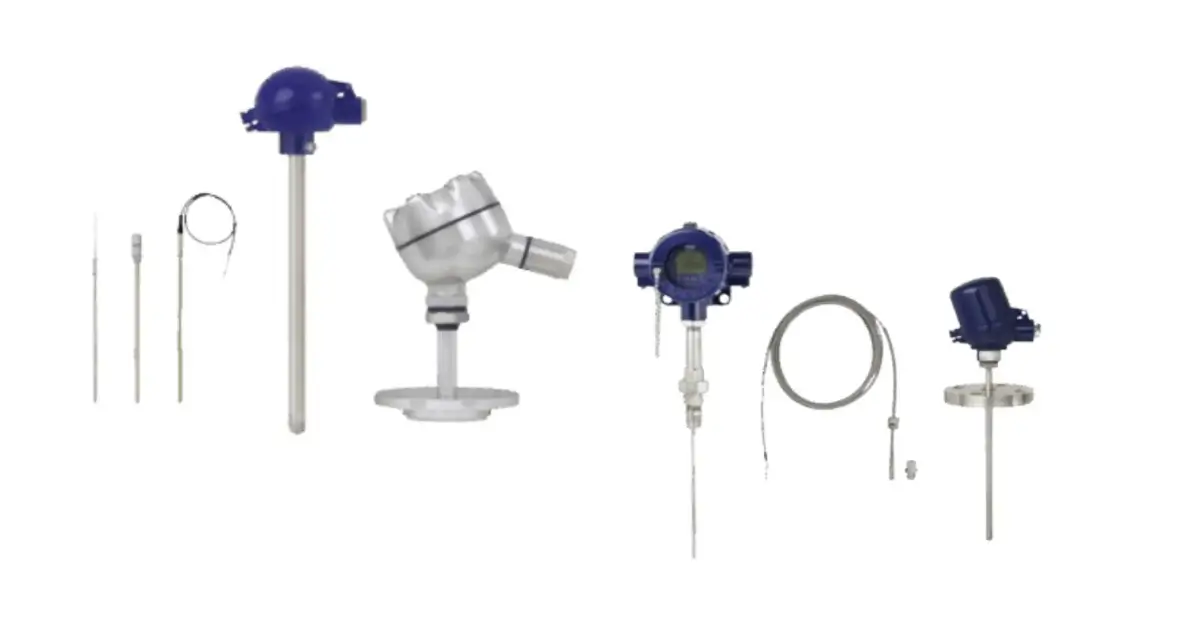
To the naked eye, they look identical. But inside the metal sheath, they operate on completely different physics. Choosing the wrong one can lead to “drifting” readings, frequent failures from vibration, or unnecessary costs.
ADYAA supplies RTD and thermocouples to all industries across Australia. In this guide, we break down the technical differences to help you choose the right tool for the job.
RTD and Thermocouples for Engineers, Maintenance Managers, and Procurement.
What is the Difference Between RTD and Thermocouple?
Before we compare them, we need to define what they actually are.
What is an RTD Sensor? (Resistance Temperature Detector)
Think of the RTD as the “Precision Instrument.”
It works on a physical principle: as metal gets hotter, it becomes harder for electricity to pass through it (resistance increases). By measuring this resistance, we calculate the exact temperature.
- Most Common Type: Pt100 (Platinum element, 100 ohms at 0°C).
- Key Characteristic: High accuracy and long-term stability.
What is a Thermocouple? (T/C)
Think of the Thermocouple as the “Rugged Workhorse.”
It works on the Seebeck Effect. Two different metal wires are joined together at a tip. When that tip heats up, it generates a tiny voltage signal.
- Most Common Type: Type K (Nickel-Chromium).
- Key Characteristic: Extreme durability and high-heat handling.
Comparison: RTD vs. Thermocouple Accuracy & Range
When choosing between these two, the decision usually comes down to four critical factors.
1. Temperature Range: How Hot Does It Get?
This is your primary filter.
- RTD Range (-200°C to +850°C): This covers 90% of industrial applications, including Food & Beverage, Pharma, and HVAC.
- Thermocouple Range (-200°C to +2300°C): If you are working with fire—blast furnaces, kilns, or jet engines—you must use a Thermocouple. A standard Type K handles 1250°C easily.
2. Accuracy: Do You Need Precision?
- RTD Accuracy: If your process needs to be within ±0.1°C (like dairy or chemical dosing), the RTD is the winner. They are linear, stable, and don’t “drift” much over time.
- Thermocouple Accuracy: They are generally less precise, typically drifting by ±1.0°C to ±2.0°C. Over time, the internal wires can degrade, causing the reading to shift.
3. Response Time: How Fast Does It React?
- Thermocouples: Because the measuring point is just a tiny welded bead, they react almost instantly to temperature spikes.
- RTDs: The platinum element is often encased in ceramic or glass, which adds mass. This means they take a few seconds longer to register a temperature change.
4. Durability: Handling Vibration
- Thermocouples: Being essentially solid wire, they are incredibly tough. They are the best choice for high-vibration environments like engines, compressors, and crushers.
- RTDs: The internal element is delicate. Heavy vibration can break the fine platinum wires inside, leading to sensor failure.
Comparison Chart: Pt100 vs. Type K
Quick reference guide for Engineers.
Feature | RTD (Pt100) | Thermocouple (Type K) |
Best Application | Precision Control (Food, Pharma) | High Heat & Vibration (Furnace, Mining) |
Temp Limit | Up to 850°C | Up to 1250°C+ |
Accuracy | High (±0.15°C) | Medium (±1.1°C – ±2.2°C) |
Response Time | Slower | Fast |
Drift / Stability | Very Stable | Prone to drift over time |
Cost | Moderate | Low |
When Should You Use an RTD?
Choose an ADYAA RTD if:
- Accuracy is critical: Your process requires tight control (e.g., pasteurization, labs).
- Temperature is moderate: The process is below 600°C.
- Stability matters: You want a “set and forget” sensor that won’t drift over the years.
When Should You Use a Thermocouple?
Choose an ADYAA Thermocouple if:
- Heat is extreme: You are measuring over 850°C.
- Vibration is high: The sensor is mounted on a heavy engine or vibrating machine.
- Budget is tight: You need a simple, low-cost solution for general monitoring.
- Speed is key: You need to catch rapid temperature spikes instantly.
Conclusion: Making the Right Choice
There is no “bad” sensor, only the wrong application. Putting a delicate RTD in a blast furnace will destroy it. Putting a generic Thermocouple in a vaccine fridge will compromise your data.
ADYAA helps you engineer the loop. From custom-length thermocouples to sanitary RTDs, we have the stock and the expertise to get your process running right.
Need help selecting the right sensor?